October 28, 2011

Zentai is a term for skin-tight garments that cover the entire body. The word is a contraction of zenshin taitsu (Japanese: ‘full-body tights’). Zentai is most commonly made using nylon/spandex blends, but other materials such as cotton and wool are used as well. There are several variations based on the Zentai suit including mummy bag (similar to a sleepsack) and hybrid suits consisting of either a single leg and arms, or separate legs and no arms. Some companies have tried to create generic brands of the suits, by dropping the traditional name; in particular, examples include RootSuit or Superfan Suit in the United States and Bodysocks or Morphsuits in the United Kingdom. Morphsuits has actively tried to disassociate themselves from the existing zentai community, occasionally being listed as the product’s co-inventor.
This mainstream push has made them relatively common apparel at major sporting events, and created internationally recognized personalities out of The Green Men, two fans of the Vancouver Canucks NHL team. Some sports leagues, such as Major League Baseball, ban the use of the costume hoods. Various professional street dance/hip hop dance groups use the outfits, such as The Body Poets in the United States, and Remix Monkeys in the United Kingdom.
Posted in Humor |
Leave a Comment »
October 28, 2011

After consuming large amounts of sugar or caffeine, Beavis sometimes undergoes a radical personality change, or psychotic break. He will raise his forearms in a 90-degree angle next to his chest, pull his shirt over his head, and then begin to yell or scream erratically, producing a stream of gibberish and strange noises, his eyes wide. This is an alter-ego named ‘Cornholio,’ a normally dormant persona. Cornholio tends to wander aimlessly while reciting ‘I am the Great Cornholio! I need TP for my bunghole!’ in an odd faux-Spanish accent. Sometimes Beavis will momentarily talk normally before resuming the persona of Cornholio. Once his Cornholio episode is over, Beavis usually has no memory of what happened.
In the guise of Cornholio, Beavis becomes a successful beat poet (Buttniks), and in ‘Vaya Con Cornholio’ he is deported to Mexico after wrongfully being subjected to immigration detention by an agent of the INS. During his detention the agent and his superior attempt to make sense of the gibberish that is Cornholio, going so far as to look up the definition of ‘bunghole.’ In that same episode, he claims to be from Lake Titicaca, but when asked where it was, he responded with ‘Nicaragua,’ despite the fact that Lake Titicaca is in Peru/Bolivia.
Posted in Art, Humor |
1 Comment »
October 25, 2011


The Steve Allen Theater at the Center for Inquiry (CFI) Los Angeles is a multidisciplinary resident fringe theater and theater of the absurd in Hollywood developed and helmed by Founding Artistic Director, Amit Itelman. The Center for Inquiry is a nonprofit group founded by Carl Sagan and Isaac Asimov to promote science and secular humanism. When paranormal investigator James Underdown became the Executive Director of CFI West in 2003, he named the theater after Center for Inquiry supporter and television personality Steve Allen and offered Itelman an opportunity to define an artistic vision for the space.
Itelman has booked interdisciplinary acts (music, comedy and theater) that strike a brainy and idiosyncratic chord. ‘A kind of theater that bounces off the walls.’ Itelman’s artistic credo reflects CFI’s mission of ‘not accepting things as they are’ an unlikely lab for some of the freshest, strangest work in town…The bar for eccentricity may be pretty high in Hollywood, but the Steve Allen Theater clears it easily.’
Posted in Art, Humor, Philosophy |
Leave a Comment »
October 25, 2011

The Theatre of the Absurd is a designation for particular plays of absurdist fiction, written by a number of primarily European playwrights in the late 1940s, 1950s, and 1960s, as well as to the style of theater which has evolved from their work. Their work expressed the belief that, in a godless universe, human existence has no meaning or purpose and therefore all communication breaks down.
Logical construction and argument gives way to irrational and illogical speech and to its ultimate conclusion, silence. Plays within this group are absurd in that they focus not on logical acts, realistic occurrences, or traditional character development; they, instead, focus on human beings trapped in an incomprehensible world subject to any occurrence, no matter how illogical. The theme of incomprehensibility is coupled with the inadequacy of language to form meaningful human connections.
read more »
Posted in Art, Humor, Philosophy |
Leave a Comment »
October 25, 2011
Duck Amuck is a surreal animated cartoon directed by Chuck Jones and produced by Warner Bros. Cartoons. The short was released in early 1953 by The Vitaphone Corporation, the short subject division of Warner Bros. Pictures, as part of the Merrie Melodies series. It stars Daffy Duck, who is tormented by a seemingly sadistic, initially unseen animator, who constantly changes Daffy’s locations, clothing, voice, physical appearance and even shape. Pandemonium reigns throughout the cartoon as Daffy attempts to steer the action back to some kind of normality, only for the animator to either ignore him or, more frequently, to over-literally interpret his increasingly frantic demands. Mel Blanc performed the voices. It was directed by Chuck Jones with a story by Michael Maltese. The film contains many examples of self-referential humor, breaking the fourth wall.
According to director Chuck Jones, this film demonstrated for the first time that animation can create characters with a recognizable personality, independent of their appearance, milieu, or voice. Although in the end, the animator is revealed to be Daffy’s rival Bugs Bunny (who famously declares ‘Ain’t I a stinker?’), according to Jones the ending is just for comedic value: Jones (the director) is speaking to the audience directly, asking ‘Who is Daffy Duck anyway? Would you recognize him if I did this to him? What if he didn’t live in the woods? Didn’t live anywhere? What if he had no voice? No face? What if he wasn’t even a duck anymore?’ In all cases, it is obvious that Daffy is still Daffy; not all cartoon characters can claim such distinctive personality.
Posted in Art, Humor |
1 Comment »
October 24, 2011
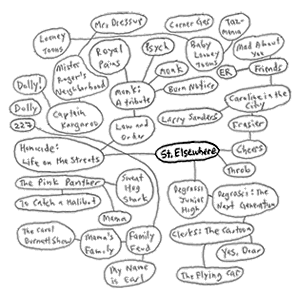
Tommy Westphall is a minor character from the drama television series ‘St. Elsewhere,’ which ran on NBC from 1982 to 1988. Westphall, who is autistic, took on major significance in the show’s final episode, where the common interpretation of that finale is that the entire St. Elsewhere storyline exists only within Westphall’s imagination. As characters from St. Elsewhere have appeared on other television shows and those shows’ characters appeared on more shows, a ‘Tommy Westphall Universe’ hypothesis was developed where a significant amount of fictional episodic television exists within Tommy Westphall’s imagined fictional universe.
The Tommy Westphall universe hypothesis, an idea discussed among some television fans, makes the claim that not only does ‘St. Elsewhere’ take place within Tommy’s mind, but so do numerous other television series which are directly and indirectly connected to ‘St. Elsewhere’ through fictional crossovers and spin-offs, resulting in a large fictional universe taking place entirely within Tommy’s mind. In 2002 writer Dwayne McDuffie wrote ‘Six Degrees of St. Elsewhere’ for the Slush Factory website, the earliest version of the hypothesis to be found online. In a 2003 article published on BBC News Online, ‘St. Elsewhere’ writer Tom Fontana was quoted as saying, ‘Someone did the math once… and something like 90 percent of all television took place in Tommy Westphall’s mind. God love him.’
read more »
Posted in Art, Humor, Language |
1 Comment »
October 24, 2011


A plot hole is a gap or inconsistency in a storyline that goes against the flow of logic established by the story’s plot, or constitutes a blatant omission of relevant information regarding the plot. These include such things as unlikely behavior or actions of characters, illogical or impossible events, events happening for no apparent reason, or statements/events that contradict earlier events in the storyline. While many stories have unanswered questions, unlikely events or chance occurrences, a plot hole is one that is essential to the story’s outcome. Plot holes are usually seen as weaknesses or flaws in a story, and writers usually try to avoid them to make their stories seem as realistic as possible. However, certain genres (and some media) which require or allow suspension of disbelief are more tolerant of plot holes.
Writers can deal with plot holes in different ways, from completely rewriting the story, to having characters acknowledge illogical or unintelligent actions, to having characters make vague statements that could be used to deflect accusations of plot holes (e.g. ‘I’ve tried everything I can think of…’ to keep critics from asking why a particular action was not taken). The nature of the plot hole and the developmental stage at which it is noticed usually determine the best course of action to take. For example, a motion picture that has already wrapped production would much more likely receive an added line of dialogue rather than an entire script rewrite.
Posted in Art, Humor, Language |
Leave a Comment »
October 23, 2011


An innuendo [in-yoo-en-doh] is a baseless invention of thoughts or ideas. It can also be a remark or question, typically disparaging (also called insinuation), that works obliquely by allusion. In the latter sense, the intention is often to insult or accuse someone in such a way that one’s words, taken literally, are innocent. It is an indirect remark about somebody or something, usually suggesting something bad, mean or rude. The word is often used to express disapproval.
The term sexual innuendo has acquired a specific meaning, namely that of a ‘risque’ double entendre by playing on a possibly sexual interpretation of an otherwise innocent uttering. For example: ‘We need to go deeper’ can be seen as both a request for further inquiry on any given issue or a request to go deeper into an orifice. Alternatively the more simple changing the pronunciation of a word in order for it to sound vulgar e.g. innuendo to ‘in-your-endo.’
Posted in Humor, Language, Sex |
Leave a Comment »
October 23, 2011

A pub quiz is a quiz held in a public house (or pub for short). Origins of the pub quiz are unclear but there is little evidence of them existing before 1970 in the United Kingdom. Pub quizzes (also known as live trivia, or table quizzes) are often weekly events and will have an advertised start time, most often in the evening. While specific formats vary, most pub quizzes depend on answers being written in response to questions which may themselves be written or announced by a quizmaster.
Generally someone (either one of the bar staff or the person running the quiz) will come around with pens and quiz papers, which may contain questions or may just be blank sheets for writing the answers on. A mixture of both is common, in which case often only the blank sheet is to be handed in. Traditionally a member of the team hands the answers in for adjudication to the quiz master or to the next team along for marking when the answers are called.
read more »
Posted in Education, Games, Humor |
Leave a Comment »
October 23, 2011

A factoid [fak-toid] is a questionable or spurious (unverified, false, or fabricated) statement presented as a fact, but without supporting evidence. The word can also be used to describe a particularly insignificant or novel fact, in the absence of much relevant context. The word is defined as ‘an item of unreliable information that is repeated so often that it becomes accepted as fact.’
The term was coined by Norman Mailer in his 1973 biography of Marilyn Monroe. He described a factoid as ‘facts which have no existence before appearing in a magazine or newspaper,’ and created the word by combining ‘fact’ and the ending -‘oid’ to mean ‘similar but not the same.’ ‘The Washington Times’ described Mailer’s new word as referring to ‘something that looks like a fact, could be a fact, but in fact is not a fact.’
read more »
Posted in Education, Humor, Language |
1 Comment »
October 23, 2011

The Liberal Arts is a curriculum of seven subjects, the first three of which are called the trivia (grammar, rhetoric and logic). Its literal meaning in Latin could have been, ‘appropriate to the street corner, commonplace, vulgar.’
In medieval Latin, it came to refer to the lower division of the Liberal Arts (the other four were the quadrivium, namely arithmetic, geometry, music, and astronomy, which were more challenging). Hence, trivial in this sense would have meant ‘of interest only to an undergraduate.’ The meaning ‘trite, commonplace, unimportant, slight’ occurs from the late 16th century, notably in the works of Shakespeare.
read more »
Posted in Education, Games, Humor |
1 Comment »
October 20, 2011


Tactical frivolity is a form of public protest involving humor, often including peaceful non-compliance with authorities, carnival and whimsical antics. Humor has played a role in political protests at least as far back as the Classical period in ancient Greece. Yet it is only since the 1990s that the term tactical frivolity has gained common currency for describing the use of humor in opposing perceived political injustice.
There is no universally agreed definition as to which sorts of humorous protest count as tactical frivolity. Generally the term is used for a whimsical, non confrontational approach rather than aggressive mocking or cutting jokes.
read more »
Posted in Humor, Money, Politics |
1 Comment »



