April 26, 2011

Vinegar valentines are greeting cards, or, rather, insult cards, that come in the form of an aspersion, decorated with a caricature and, below that, an insulting poem. Ostensibly given on Valentine’s Day, the caricature and poem is about the ‘type’ that the recipient belongs to–spinster, floozy, dude, scholar, etc.
They were later also produced in the form of postcards. They were usually sent anonymously. Postmasters sometimes confiscated these cards as unfit to be mailed.The cards were first produced in the late Victorian era and enjoyed their greatest popularity in that period and in the first quarter of the 20th century.
Posted in Humor |
Leave a Comment »
April 26, 2011

Minnesota nice is the stereotypical behavior of long-time Minnesota residents, to be courteous, reserved, and mild mannered. The cultural characteristics of Minnesota nice include a polite friendliness, an aversion to confrontation, a tendency toward understatement, a disinclination to make a fuss or stand out, emotional restraint, and self-deprecation.
It can also refer to traffic behavior, such as slowing down to allow another driver to enter a lane in front of the other person. The negative side of ‘Minnesota nice,’ occurs in the form of passive aggressiveness and resistance to change.
read more »
Posted in Humor, Language, Politics |
Leave a Comment »
April 26, 2011

A panty raid is a prank in which male students steal the panties (undergarments) of female students by intruding into their living quarters. The term dates to February, 1949.
It was the first college craze after World War II, following the 1930s crazes of goldfish swallowing or seeing how many could fit in a phone booth. By the 1970s, mixed dorms, less inhibited attitudes to intercourse on campus led to fading of panty raids.
read more »
Posted in Games, Humor, Sex |
Leave a Comment »
April 26, 2011

The Cardboard Tube Fighting League (CTFL) is a global organization that hosts cardboard tube based events in Seattle, Washington; San Francisco, California; and Sydney, Australia. The CTFL hosts tournaments and battles where cardboard tube fighters go head-to-head in an attempt to break their opponents tube without breaking their own.
The events also focus on cardboard costumes and theatrics. These events are often held at public parks throughout the summer, are open to everyone ages 5 and up, and emphasize fun over competition. Cardboard tubes are provided and all events are free for participants.
Posted in Games, Humor |
Leave a Comment »
April 26, 2011

Deadpan is a form of comic delivery in which humor is presented without a change in emotion or body language, usually speaking in a casual, monotone, solemn, blunt, disgusted or matter-of-fact voice and expressing an unflappably calm, archly insincere or artificially grave demeanor.
This delivery is also called dry wit when the intent, but not the presentation, is humorous, oblique, sarcastic, or apparently unintentional. The term ‘deadpan’ first emerged as an adjective or adverb in the 1920s, as a compound word (‘pan’ was a slang term for ‘face’).
read more »
Posted in Art, Humor, Language |
Leave a Comment »
April 23, 2011

Bacon mania refers to passionate bacon enthusiasm in the US, Canada, and the UK. The movement (sometimes called ‘Bacon Nation’) has been traced to the 1980s and 1990s when high-protein foods became a more prominent diet focus due in part to the Atkins diet. Bacon possesses six ingredient types of umami, which elicits an addictive neurochemical response. Newer bacon creations have joined more traditional foods like the BLT and Cobb salad, including bacon bubble gum, bacon band-aids, sizzling bacon flavored rolling papers, and bacon air freshener.
The growing popularity of bacon has also encouraged product introductions such as bacon salt, maple bacon donuts, and baconnaise. Other bacon food oddities include the bacon explosion (a bacon-wrapped loaf of pork sausage), chicken fried bacon, bacon ice cream, and chocolate covered bacon, all popularized over the internet. A bacon alarm clock that wakes people up with the smell of cooking bacon has also been announced. The increased interest in bacon has led to Bacon-of-the-month clubs, bacon recipe contests, blogs, and even ‘bacon camps.’
Posted in Food, Humor, Language |
Leave a Comment »
April 20, 2011

Hash Bash is an annual event held in Ann Arbor, Michigan, on the first Saturday of April at high noon on the University of Michigan Diag (a large open space in the middle of the university’s Central Campus). A collection of speeches, live music, street vending and occasional civil disobedience are centered on the goal of reforming federal, state, and local marijuana laws. The first Hash Bash was held on Saturday, April 1 1972 in response to the March 9th 1972 decision by Michigan Supreme Court declaring unconstitutional the law used to convict cultural activist John Sinclair for possession of two marijuana joints.
Ann Arbor has very lenient laws regarding the possession of marijuana, it is a civil infraction rather than a criminal offense. Even so, the campus of the University of Michigan sits upon state property, and so anyone caught with marijuana on any campus location is subject to the more strict state marijuana laws. In addition, since state law takes precedence over municipal law, many people are prosecuted under state law regardless of where in Ann Arbor they are located.
Posted in Drugs, Humor, Politics |
1 Comment »
April 20, 2011


420 (pronounced four-twenty) refers to cannabis subculture. April 20th has evolved into a counterculture holiday, where people gather to celebrate and consume cannabis. Some events have a political nature to them, advocating for the decriminalization of non-medical cannabis. The term was allegedly coined by a group of teenagers in California in 1971. Calling themselves the Waldos, because their chosen hang-out spot was a wall outside the school,’ the group first used the term in connection to a plan to search for an abandoned cannabis crop that they had learned about. They designated the Louis Pasteur statue on the grounds of San Rafael High School as their meeting place, and 4:20 p.m. as their meeting time.
The Waldos referred to this plan with the phrase ‘4:20 Louis.’ Multiple failed attempts to find the crop eventually shortened their phrase to simply ‘4:20,’ which ultimately evolved into a codeword the teens used to mean pot-smoking in general. ‘High Times’ Creative Director Steven Hager was the first person to track down the Waldos and publish their account of the origins of the term. In 1998, Hager wrote ‘Are You Stoner Smart or Stoner Stupid?’ in which he called for 4:20 p.m. to be the socially accepted hour of the day to consume cannabis. ‘I believe 420 is a ritualization of cannabis use that holds deep meaning for our subculture,’ wrote Hager. ‘It also points us in a direction for the responsible use of cannabis.’
Posted in Drugs, Humor, Politics |
Leave a Comment »
April 19, 2011
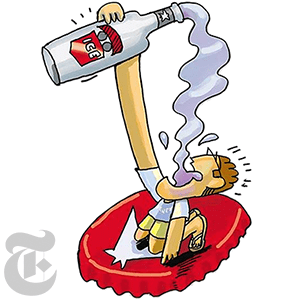
Icing is a drinking game in which players are required to bend down on one knee and chug a bottle of Smirnoff Ice. Participants are encouraged to come up with elaborate ways to present the Ice to their targets by hiding bottles in inconspicuous locations, or in situations where drinking it would be dangerous or embarrassing (e.g. before they drive somewhere, attend a meeting, etc.). Failure to drink, no matter the circumstance, results in the humiliation of the victim, and players are encouraged to mistreat those who refuse to play.
The target of an Icing can perform an ‘ice block’ by grabbing a Smirnoff Ice within arms reach (e.g. on his person). An ice block can be in the form of any size Smirnoff Ice, thus upping the stakes for the challenger. Once the player presents this ice block to the original player, the original player must drink both ices. You can ice block an ice block, even though this would lead to back and forth infinite ice blocks. Refusal to consume an Ice results in excommunication, meaning that that player can no longer ice anyone or get iced. Furthermore, you cannot pour it into any other drinking container to mimic another liquid. This is punishable by drinking that said ice.
Posted in Food, Games, Humor |
Leave a Comment »
April 14, 2011

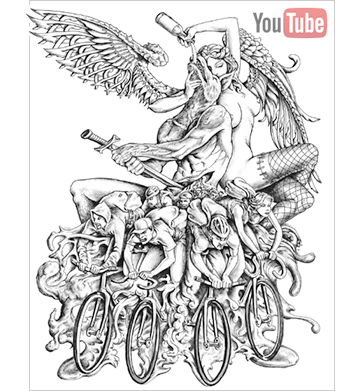
An Alleycat race is an informal bicycle race. Alleycats almost always take place in cities, and are often organized by bicycle messengers. The informality of the organization is matched by the emphasis on taking part, rather than simple competition. Many Alleycats present prizes for the last competitor to finish (sometimes known as Dead Friggin’ Last or DFL).
The first race to be called ‘Alleycat’ was held in Toronto in 1989. Regularly organized Alleycats can be found in cities across North America, Europe and Asia. Many smaller cities with no cycle messenger population are also home to alleycats run by the burgeoning urban cyclist subculture.
read more »
Posted in Games, Humor |
Leave a Comment »
April 14, 2011

The weasel war dance is a colloquial term for a behavior of excited ferrets and weasels. In wild animals, it is speculated that this dance is used to confuse or disorient prey. In domestic animals, the war dance usually follows play or the successful capture of a toy or a stolen object.
It consists of a frenzied series of sideways and backwards hops, often accompanied by an arched back, hissing noises, and a frizzy tail. Ferrets are notoriously clumsy in their surroundings during their dance and will often bump into or fall over objects and furniture. Although the weasel war dance may make a ferret appear frightened or angry, they are often just excited and are usually harmless to humans.
Posted in Humor, Science |
Leave a Comment »
April 13, 2011

Leslie Conway ‘Lester’ Bangs (1948 – 1982) was an American music journalist and musician. He wrote for ‘Creem’ and ‘Rolling Stone’ magazines and has been called one of the ‘most influential’ voices in rock criticism. In 1969, Bangs began writing freelance after reading an ad in ‘Rolling Stone’ soliciting readers’ reviews.
His first piece was a negative review of the MC5 album ‘Kick Out The Jams,’ which he sent to ‘Rolling Stone’ with a note detailing that should the magazine decide not to publish the review, then they would have to contact Lester and tell him why. They published it.
read more »
Posted in Art, Humor, Money |
Leave a Comment »




 The Daily Omnivore