October 28, 2010

Funky Forest: The First Contact, also known as Naisu no mori is a 2005 Japanese movie written and directed by Katsuhito Ishii, Hajimine Ishimine and Shunichiro Miki. The movie is a collection of several surreal, non-sequitur shorts. Dance numbers, pillow fights, animation, comedy, and science fiction all combine to create a unique and disorienting viewing experience featuring such highlights as an absurdist tribute to David Cronenberg, an ass-television, and a girl who fires lasers from her forehead in order to battle a floating space blob which emits spinning, spherical projectiles.
Posted in Art, Humor, World |
Leave a Comment »
October 28, 2010

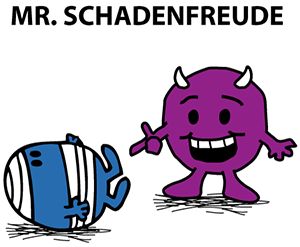
The Darwin Award are a tongue-in-cheek honor, originating in Usenet newsgroup discussions circa 1985. They recognize individuals who have contributed to human evolution by self-selecting themselves out of the gene pool via death or sterilization due to their own (unnecessarily foolish) actions. The project became more formalized with the creation of a website in 1993, and followed up by a series of books starting in 2000, authored by Wendy Northcutt. The criterion for the awards states, ‘In the spirit of Charles Darwin, the Darwin Awards commemorate individuals who protect our gene pool by making the ultimate sacrifice of their own lives. Darwin Award winners eliminate themselves in an extraordinarily idiotic manner, thereby improving our species’ chances of long-term survival.’
Accidental self-sterilization also qualifies; however, the site notes: ‘Of necessity, the award is usually bestowed posthumously.’ But the candidate is disqualified if ‘innocent bystanders,’ who might have contributed positively to the gene pool, are killed in the process. The Darwin Awards books state that an attempt is made to disallow known urban legends from the awards, but some older ‘winners” have been ‘grandfathered’ to keep their awards. The Darwin Awards site does try to verify all submitted stories, but many similar sites, and the vast number of circulating ‘Darwin awards’ emails, are largely fictional.
read more »
Posted in Death, Humor |
Leave a Comment »
October 28, 2010
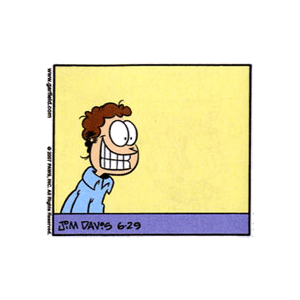
Garfield Minus Garfield is a webcomic created by Dan Walsh. Each strip consists of a reprint of a past episode from the comic strip Garfield, from which the character of Garfield himself has been removed through photo manipulation. Though Walsh admits that he was not the first to come up with this idea, he was the first to popularize it. The resulting strips thus consist mostly of Garfield’s owner, Jon Arbuckle, interacting with himself, rather than with his pet cat.
The strip’s website characterizes this result as ‘a journey deep into the mind of an isolated young everyman as he fights a losing battle against loneliness and depression in a quiet American suburb.’ Garfield artist Jim Davis has commented on the webcomic, stating that he is an occasional reader and finds it ‘fascinating’ and an ‘inspired thing to do.’
Posted in Art, Humor |
1 Comment »
October 28, 2010
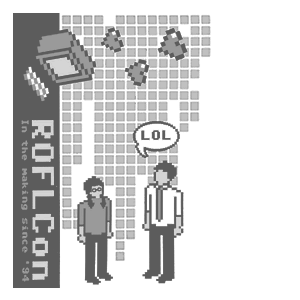
ROFLCon is a biennial convention of Internet memes that first took place April 25–26, 2008, at the Massachusetts Institute of Technology. Various Net celebrities attended, such as the authors of the webcomics xkcd, Questionable Content and Dinosaur comics, Jay Maynard ‘The Tron Guy,’ 4Chan founder moot, Leeroy Jenkins, The Brothers Chaps, and many others. ROFLCon was organized by a group of students from Harvard University led by Tim Hwang.
The ROFLCon team spent months tracking down people associated with memes, but many of the invited guests did not attend. Attendance was open to the public after pre-registration and a fee. The primary events of ROFLCon were moderated panel discussions with the Internet celebrities, as well as question and answer sessions with the audience. Several guest speakers gave talks on issues pertaining to internet culture. The convention ended with the ROFLConcert, featuring live performances by Group X, Leslie Hall, Lemon Demon, Trocadero and Denny Blaze. In 2010, the conference took place from April 30 to May 1 at MIT.
Posted in Humor, Technology |
Leave a Comment »
October 27, 2010


Yarn bombing is a type of graffiti or street art that employs colorful displays of knitted or crocheted cloth rather than paint or chalk. While yarn installations – called yarn bombs or yarnstorms – may last for years, they are considered non-permanent, and, unlike graffiti, can be easily removed if necessary.
The practice is believed to have originated in the U.S. with Texas knitters trying to find a creative way to use their leftover and unfinished knitting projects, but it has since spread worldwide. While other forms of graffiti may be expressive, decorative, territorial, socio-political commentary, advertising or vandalism, yarn bombing is almost exclusively about reclaiming and personalizing sterile or cold public places.
Posted in Art, Games, Humor |
Leave a Comment »
October 26, 2010
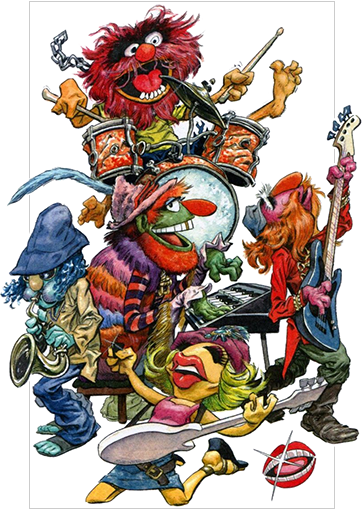
Dr. Teeth and The Electric Mayhem is the name of a Muppet rock band. Dr. Teeth was designed by Jim Henson, while the rest of the original band members were designed by Michael K. Frith. The band consists of Dr. Teeth on vocals and keyboards, Janice on guitar, Sgt. Floyd Pepper on bass guitar, Zoot on saxophone, and Animal on drums. In season five of ‘The Muppet Show,’ Lips joined the band on trumpet. The original pilot episode featured ‘Jim,’ a Muppet caricature of Jim Henson on banjo.
read more »
Posted in Art, Humor |
Leave a Comment »
October 18, 2010

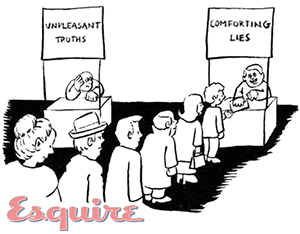
Radical Honesty is a technique and self-improvement program developed by Dr. Brad Blanton. The program asserts that lying is the primary source of modern human stress, and that practitioners will become happier by being more honest, even about painful or taboo subjects. Blanton claims this form of honesty can help all human relationships since it ‘creates an intimacy not possible if you are hiding something for the sake of someone’s feelings.’ The Radical Honesty technique includes having practitioners state their feelings bluntly, directly and in ways typically considered impolite.
People who practice Radical Honesty employ a collection of techniques to shift them out of acceptable norms of ‘white lying’ for the purpose of having a more truthful relationship with themselves and others. The material employed to communicate and teach Radical Honesty through books and workshops is drawn from an eclectic collection of sources including Sufism, clinical psychology, Gestalt therapy and the comic spiritual belief (developed by Blanton) called Futilitarianism. Futilitarianism claims it is futile to have any belief whatsoever.
Posted in Humor, Language, Philosophy |
Leave a Comment »
October 18, 2010

Robert Crumb (b. 1943) is an American artist, illustrator and musician recognized for the distinctive style of his drawings and his critical, satirical, subversive view of the American mainstream. Crumb was a founder of the underground comix movement and is regarded as its most prominent figure.
Though one of the most celebrated of comic book artists, Crumb’s entire career has unfolded outside the mainstream comic book publishing industry. One of his most recognized works is the ‘Keep on Truckin” comic, which became a widely distributed fixture of pop culture in the 1970s. Others are the characters Devil Girl, Fritz the Cat, and Mr. Natural.
read more »
Posted in Art, Humor |
Leave a Comment »
October 18, 2010

‘Cleatus the Robot,’ is the official mascot of Fox NFL Sunday, named by a viewer during a contest in the winter of 2007 in which fans were able to submit entries as to what they thought the robot’s name should be. Cleatus made his first appearance during the 2005-2006 NFL season, but was not used regularly until the following season. Cleatus mainly appears during the intro sequence of the show as well as brief commercials for movies and TV shows.
In commercials he commonly gets attacked by a CGI character from whatever the advertisement is about. He has thus far been attacked by Iron Man, a dragon, and a Terminator robot. Cleatus is also known to hop on two feet, play the electric guitar, shake out his limbs, and do dance moves such as the swim and the electric slide. In response to Cleatus, NASCAR on Fox created ‘Digger,’ an animated gopher mascot.
Posted in Games, Humor, Money |
Leave a Comment »
October 13, 2010

A meme [meem] is a unit of cultural ideas, symbols or practices, which can be transmitted from one mind to another through writing, speech, gestures, rituals or other imitable phenomena. Supporters of the concept regard memes as cultural analogues to genes, in that they self-replicate and respond to selective pressures. The British scientist Richard Dawkins coined the word in ‘The Selfish Gene’ (1976) as a concept for discussion of evolutionary principles in explaining the spread of ideas and cultural phenomena.
Examples of memes given in the book included melodies, catch-phrases, beliefs (notably religious beliefs), clothing fashion, and the technology of building arches. Meme-theorists contend that memes evolve by natural selection (in a manner analogous to that of biological evolution) through the processes of variation, mutation, competition, and inheritance influencing an individual meme’s reproductive success. Memes spread through the behaviors that they generate in their hosts. Memes that propagate less prolifically may become extinct, while others may survive, spread, and (for better or for worse) mutate.
Posted in Humor, Language, Philosophy |
Leave a Comment »
October 12, 2010
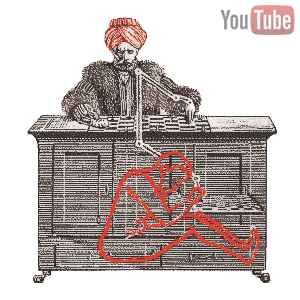
The Turk was a fake chess-playing machine constructed in the late 18th century. From 1770 until its destruction by fire in 1854, it was exhibited by various owners as an automaton. Constructed and unveiled in 1770 by Wolfgang von Kempelen (1734–1804) to impress the Empress Maria Theresa, the mechanism appeared to be able to play a strong game of chess against a human opponent. The Turk was in fact a mechanical illusion that allowed a human chess master hiding inside to operate the machine.
With a skilled operator, the Turk won most of the games played during its demonstrations around Europe and the Americas for nearly 84 years, playing and defeating many challengers including statesmen such as Napoleon Bonaparte and Benjamin Franklin. Although many had suspected the hidden human operator, the hoax was initially revealed only in the 1820s by the Londoner Robert Willis.
Posted in Games, Humor, Technology |
1 Comment »
September 25, 2010

The Flat Earth Society is an organization that seeks to further the belief that the Earth is flat rather than the scientifically accepted view that it is a sphere or a geoid. The modern organization was founded by Englishman Samuel Shenton in 1956. The belief that the Earth was flat was typical of ancient cosmologies until about the 4th century BC, when the Ancient Greek philosophers proposed the idea that the Earth was a sphere, or at least rounded in shape. Aristotle was one of the first thinkers to propose a spherical Earth in 330 BC. By the early Middle Ages, it was widespread knowledge throughout Europe that the Earth was a sphere.
Modern hypotheses supporting a flat Earth originated with English inventor Samuel Rowbotham (1816–1884). Based on his interpretation of certain biblical passages, Rowbotham published a 16-page pamphlet, which he later expanded into a 430-page book, ‘Earth Not a Globe,’ expounding his views. According to Rowbotham’s system, which he called ‘Zetetic Astronomy,’ the earth is a flat disc centered at the North Pole and bounded along its southern edge by a wall of ice (Antarctica), with the sun and moon 3000 miles (4800 km) and the ‘cosmos’ 3100 miles (5000 km) above earth. As of September 2009, two web-based discussion forums exist devoted to the Flat Earth Society is also represented on Twitter and Facebook.
Posted in Humor, Science, World |
Leave a Comment »





