September 12, 2010
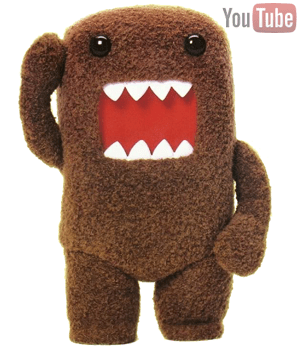

Domo Kun is the official mascot of NHK television station, appearing in several 30 second stop-motion interstitial sketches shown as station identification during shows. NHK is Japan’s national public broadcasting organization. The name ‘Domo’ was acquired during the second episode of his show in which a TV announcer said, ‘dōmo, konnichiwa,’ which is a greeting meaning something along the lines of, ‘Well, hello there!” but which can also be interpreted as ‘Hello, Domo!’ The suffix ‘kun’ is a Japanese honorific often used with young males.
Posted in Art, Humor, World |
Leave a Comment »
September 10, 2010

The Streisand effect is a phenomenon in which an attempt to censor or remove a piece of information has the unintended consequence of causing the information to be publicized widely and to a greater extent than would have occurred if no censorship had been attempted. It is named after American entertainer Barbra Streisand, following a 2003 incident in which her attempts to suppress photographs of her residence inadvertently generated further publicity.
Posted in Humor, Language |
Leave a Comment »
September 1, 2010
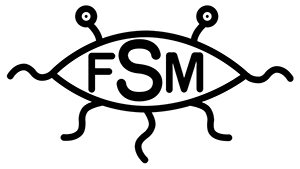

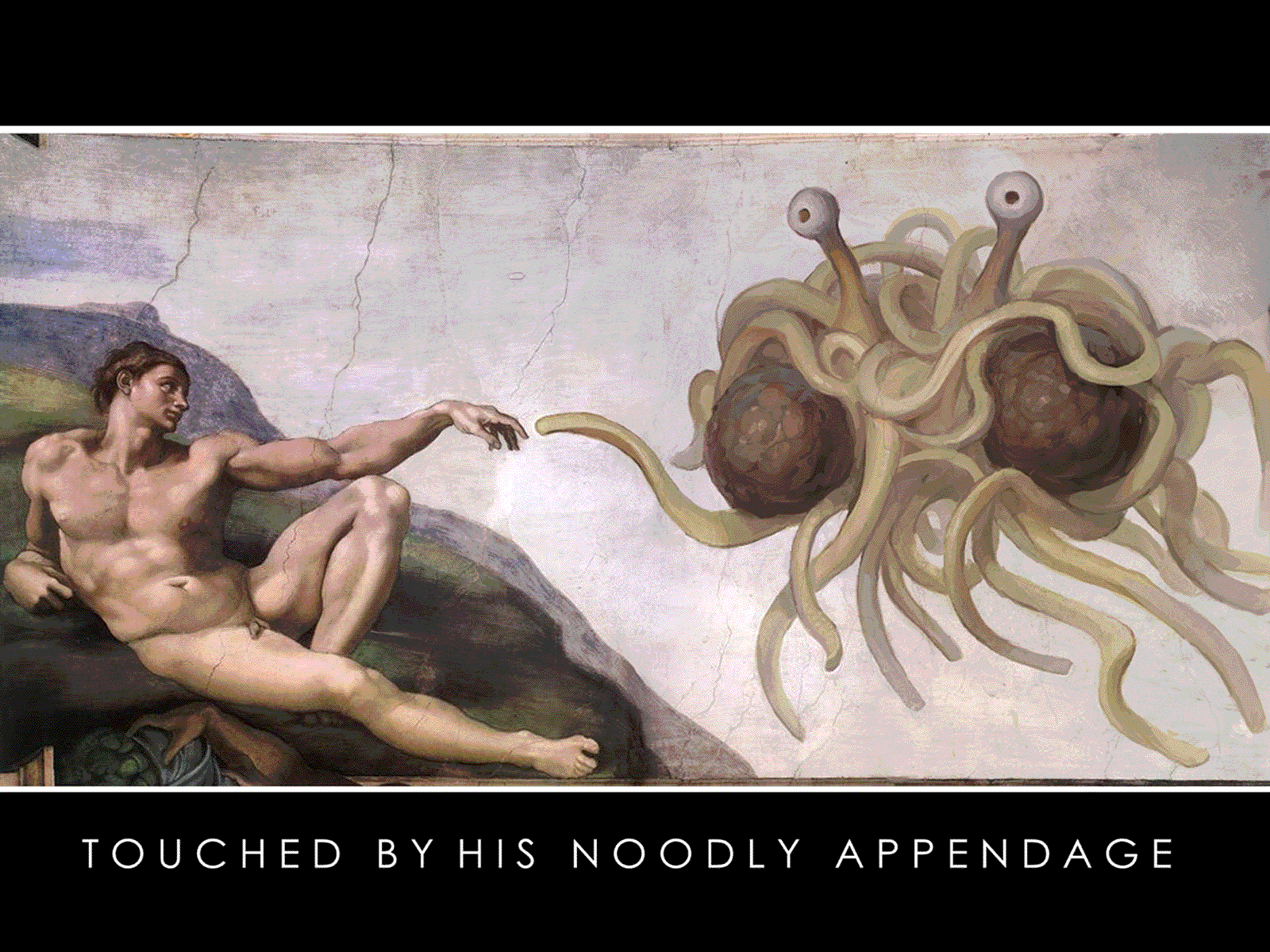
The Flying Spaghetti Monster (FSM) is the deity of the parody religion the Church of the Flying Spaghetti Monster or Pastafarianism, a satirical movement that promotes a light-hearted view of religion and opposes the teaching of intelligent design and creationism in public schools. Created in 2005 by Oregon State physics graduate Bobby Henderson, it was originally intended as a satirical protest against the decision by the Kansas State Board of Education to permit the teaching of intelligent design as an alternative to evolution in public schools. In an open letter, Henderson parodied the concept of intelligent design by professing belief in a supernatural creator which closely resembles spaghetti and meatballs. Henderson further called for his theory of creation to be allotted equal time in science classrooms alongside intelligent design and evolution.
In his letter he wrote, ‘I think we can all look forward to the time when these three theories are given equal time in our science classrooms across the country, and eventually the world; one third time for Intelligent Design, one third time for Flying Spaghetti Monsterism, and one third time for logical conjecture based on overwhelming observable evidence.’
read more »
Posted in Education, Humor, Philosophy |
1 Comment »
September 1, 2010
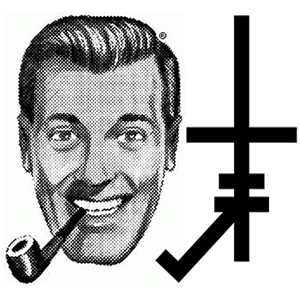
The Church of the SubGenius is a religious organization often seen as a ‘parody religion,’ that satirizes religion, conspiracy theories, Ufology, and popular culture. Originally based in Dallas, Texas, the Church of the SubGenius gained prominence in the 1980s and 1990s subculture and maintains an active presence on the Internet. In 1996 the legal entity SubGenius Foundation was incorporated in Cleveland, Ohio. The Foundation’s president and founder is Ivan Stang. It’s mascot is ‘world’s greatest salesman’ J. R. ‘Bob’ Dobbs. ‘Bob’ is depicted as a cartoon of a Ward Cleaver-like man smoking a pipe. It’s symbol is the ‘Dobb’s Mark,’ a stylized cross with three bars and a pipe, placed in a pattern that matches the eyes, nose, mouth, and pipe of ‘Bob’s’ image.
The central belief in the Church is the pursuit of ‘Slack,’ which generally stands for the sense of freedom, independence, and original thinking that comes when you stop worrying about personal goals. In essence, slack is about finding satisfaction with what you have and who you are, as opposed for searching for satisfaction in accomplishment.
Posted in Humor, Philosophy |
1 Comment »
August 25, 2010


Xenu [zee-noo] was, according to the founder of Scientology and science fiction writer L. Ron Hubbard, the dictator of the ‘Galactic Confederacy’ who, 75 million years ago, brought billions of his people to Earth in a DC-8-like spacecraft, stacked them around volcanoes and killed them using hydrogen bombs. Official Scientology dogma holds that the essences of these many people remained, and that they form around people in modern times, causing them spiritual harm.
Posted in Humor, Philosophy |
Leave a Comment »
August 24, 2010
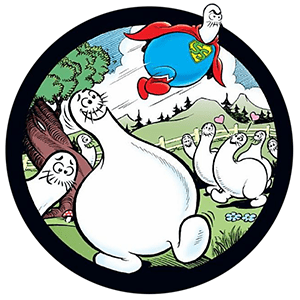
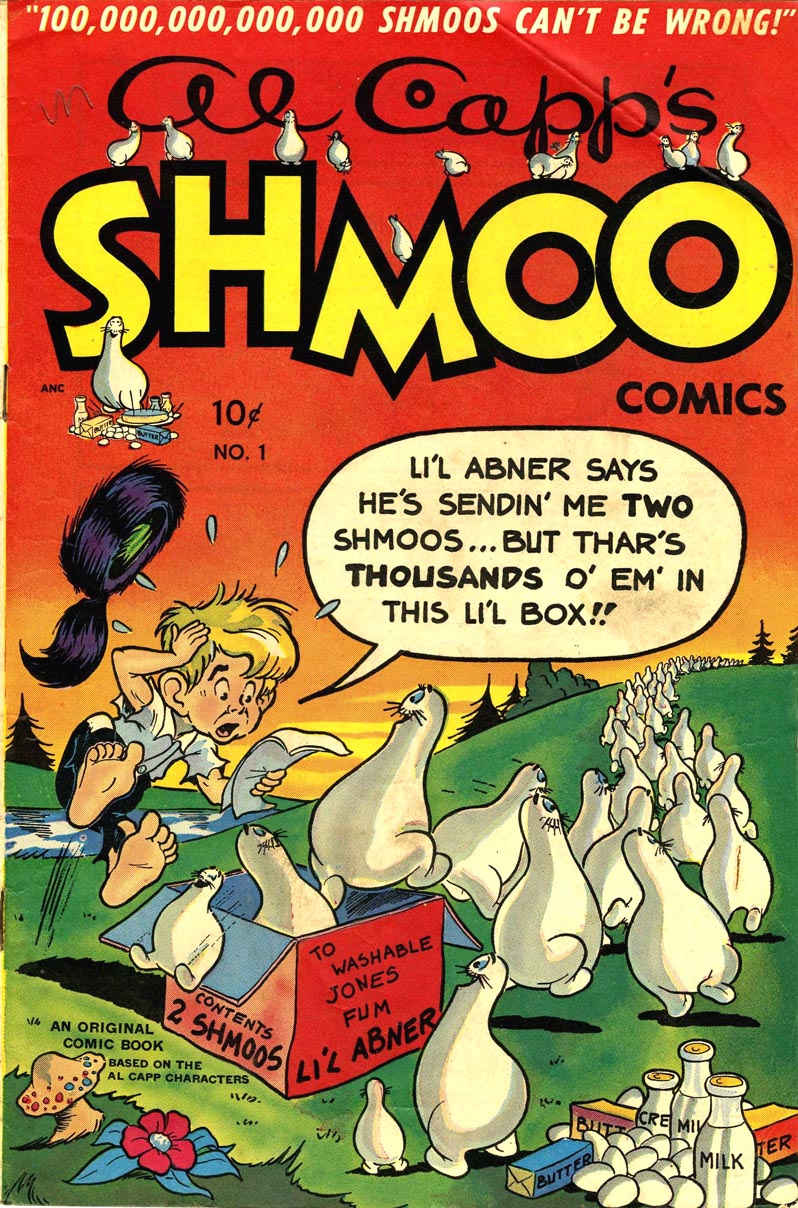
A shmoo is a fictional cartoon creature created by Al Capp. They first appeared in his comic strip ‘Li’l Abner’ on August 31, 1948, and quickly became a postwar national craze in the USA. Shmoon reproduce asexually, require no sustenance other than air, make good pets, are delicious to eat, and are eager to be eaten. Their pelts make perfect boot leather or house timber, depending on how thick you slice it. They have no bones, their eyes make the best suspender buttons, and their whiskers make perfect toothpicks. In short, they are the ideal herd animal.
In the comic strip the frolicking of shmoon is so entertaining that people no longer feel the need to watch television or go to the movies. It’s been used in discussions of socioeconomics, for instance, a widget is any material good which is produced through labor from a finite resource. In contrast, a shmoo is a material good that reproduces itself and is captured or bred as an economic activity.
Posted in Art, Humor, Money |
Leave a Comment »
August 16, 2010
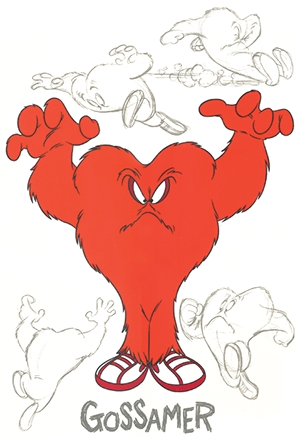
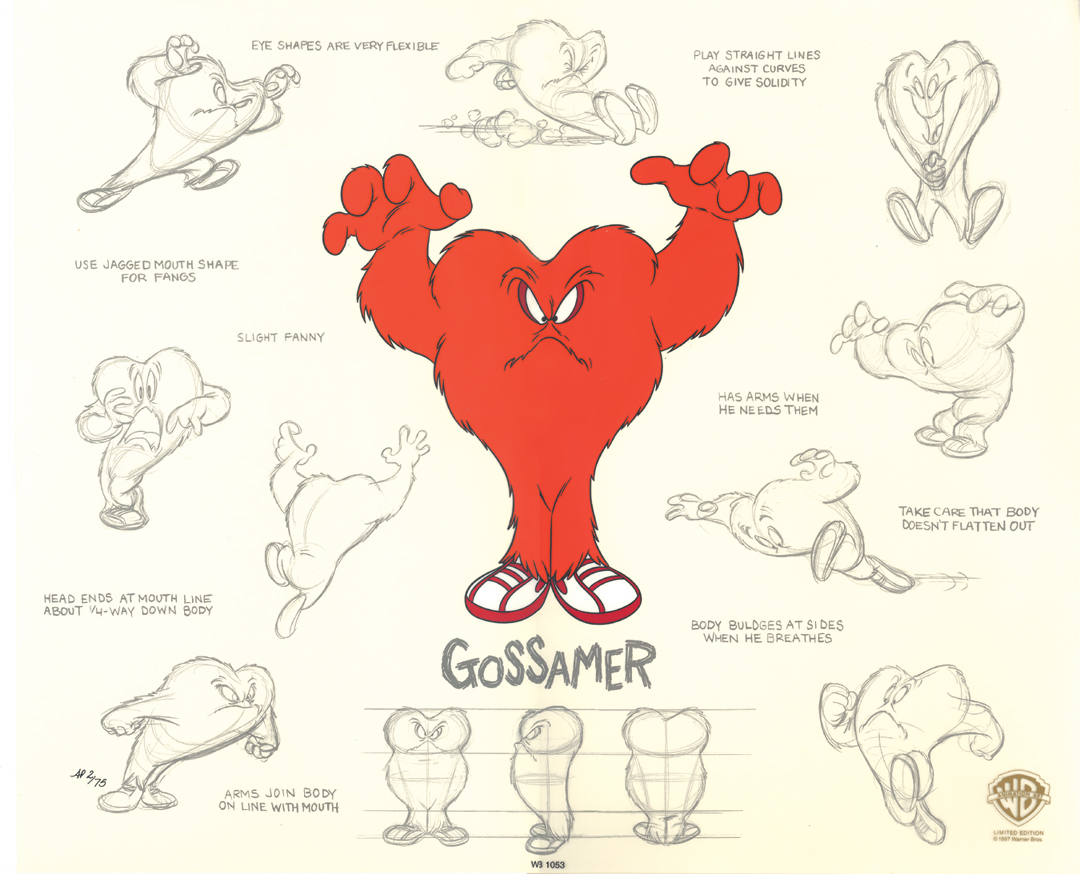
Gossamer is an animated cartoon character in the Warner Bros. Looney Tunes and Merrie Melodies series of cartoons. The character is a hairy, orange monster. His rectangular body is perched on two giant tennis shoes, and his heart-shaped face is composed of only two oval eyes and a wide mouth, with two hulking arms. The monster’s main trait, however, is bright uncombed red hair.
In fact, a gag in the 1980 short Duck Dodgers and the Return of the 24½th Century lampoons this by revealing that Gossamer is, in fact, composed entirely of hair. He was originally voiced by Mel Blanc and has been voiced by Joe Alaskey and Jim Cummings. The word ‘Gossamer’ refers to things light, delicate, or insubstantial. The name is meant to be ironic, since the character is large, menacing, and destructive.
Posted in Art, Humor |
Leave a Comment »
August 12, 2010
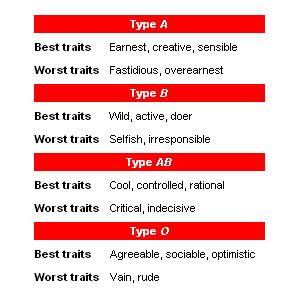
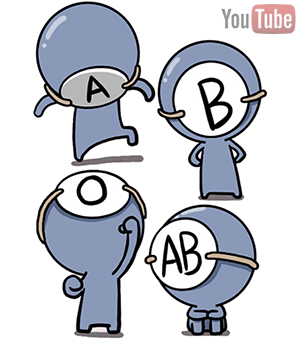
Ketsuekigata is a Japanese pseudoscience based on human blood types. There is a popular belief in Japan that a person’s ABO blood type is predictive of their personality, temperament, and compatibility with others. Ultimately deriving from ideas of historical scientific racism, the popular belief originates with publications by Masahiko Nomi in the 1970s. The scientific community dismisses such beliefs as superstition. Discussion of blood types is widely popular in women’s magazines as a way of gauging relationship compatibility with a potential or current partner. Morning television shows feature blood type horoscopes, and similar horoscopes are published daily in newspapers. In addition, a series of four books that describe people’s character by blood type ranked third, fourth, fifth and ninth on a list of best selling books in Japan in 2008.
Although there is no proven correlation between blood type and personality, it remains popular with the many matchmaking services that cater to blood type. In this way, it is similar to the use of astrological signs in the West, which is also popular in Japan. Asking one’s blood type is common in Japan, and people are often surprised when a non-Japanese does not know his or her own blood type.
Posted in Humor, Philosophy, World |
Leave a Comment »
August 10, 2010


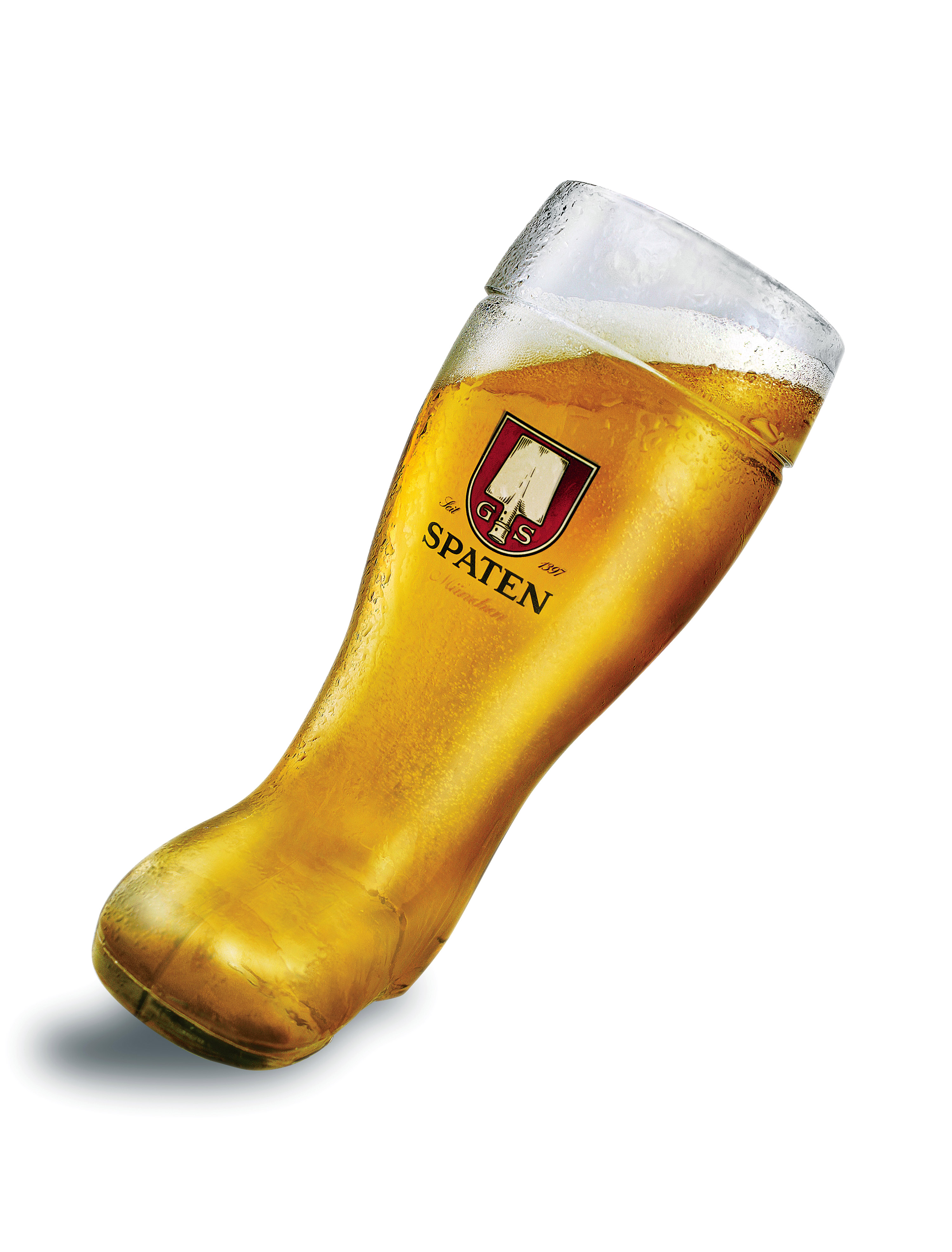
The custom of drinking beer from a boot-shaped glass is common in German themed bars, beer gardens, and the like. Machine pressed beer boots range in size from a shot glass up to 1 litre. The more popular mouth blown beer boots are typically 1 and 2 litres in size.
There are several different origin stories for the boot of beer. One tradition holds that a Prussian general swore to his troops that he would drink beer from his boot dependent on the successful outcome in a coming battle. When victorious, the general ordered a glass fashioned in the shape of a boot to fulfill his promise without, ‘having to taste his own feet.’ Another tradition holds that the boot began when German soldiers during World War I having nothing else to drink from instead passed around an actual leather boot of beer before heading into battle. They would flick the boot before drinking from it for good luck and again after drinking to wish the next soldier good luck.
Posted in Food, Humor, World |
Leave a Comment »
August 10, 2010

Wojtek (1942–1963), was a Syrian brown bear cub adopted by soldiers of the 22nd Artillery Supply Company of the Polish II Corps. During the Battle of Monte Cassino, Wojtek helped move ammunition. The name Wojtek is Slavic and has two meanings: ‘he who enjoys war’ or ‘smiling warrior.’
The bear was fed with fruits, marmalade, honey and syrup, and was often rewarded with beer, which became his favourite drink. He also enjoyed eating cigarettes. As one of the officially enlisted ‘soldiers’ of the company, he lived with the other men in their tents or in a transportable wooden crate. After the war, Wojtek was given to the Edinburgh Zoo. There he spent the rest of his days, often visited by journalists and former Polish soldiers, some of whom would toss him cigarettes. Wojtek died in December of 1963, at the age of 22.
Posted in Humor, War |
Leave a Comment »
August 4, 2010

Rule 34 is a generally accepted internet observation which states: ‘If it exists, there is porn of it. No exceptions.’ It implies that there is a sexual fetish for every conceivable subject matter. It originated from a 2003 webcomic drawn by Peter Morley-Souter to depict his shock at seeing Calvin and Hobbes parody porn. Morley-Souter posted his comic on the United Kingdom website ‘Zoom-Out in 2004,’ and it has been widely reproduced. ‘Boing Boing’ blogger Cory Doctorow writes of the meme: ‘Rule 34 can be thought of as a kind of indictment of the Web as a cesspit of freaks, geeks, and weirdos, but seen through the lens of cosmopolitanism,’ which ‘bespeaks a certain sophistication—a gourmet approach to life.’
The conundrum of finding an Internet pornographic exception to Rule 34’s ‘No exceptions’ led to Rule 35: ‘If no porn is found at the moment, it will be made.’
Posted in Humor, Sex |
Leave a Comment »
August 4, 2010

Godwin’s law is a humorous observation made by Mike Godwin in 1990 which has become an Internet adage. It states: ‘As an online discussion grows longer, the probability of a comparison involving Nazis or Hitler approaches 1.’ In other words, given enough time, all discussions —regardless of topic or scope —inevitably wind up being about Hitler and the Nazis. Also the poster who mentioned Nazis loses all debates/discussions they had in said topic, and their insults are nullified. Godwin’s law is often cited in online discussions as a deterrent against the use of arguments in the widespread reductio ad Hitlerum form.
The rule does not make any statement about whether any particular reference or comparison to Adolf Hitler or the Nazis might be appropriate, but only asserts that the likelihood of such a reference or comparison arising increases as the discussion progresses. It is precisely because such a comparison or reference may sometimes be appropriate, Godwin has argued that overuse of Nazi and Hitler comparisons should be avoided, because it robs the valid comparisons of their impact. Although in one of its early forms Godwin’s law referred specifically to Usenet newsgroup discussions, the law is now applied to any threaded online discussion: electronic mailing lists, message boards, chat rooms, and more recently blog comment threads, wiki talk pages, and social networking sites.
Posted in Humor, Language, War |
Leave a Comment »


 The Daily Omnivore