March 29, 2011

Schadenfreude [shahd-n-froi-duh] is a German loanword meaning ‘pleasure derived from the misfortunes of others.’ The corresponding German adjective is ‘schadenfroh.’ The word derives from ‘Schaden’ (‘adversity,’ ‘harm’) and ‘Freude’ (‘joy’). An English expression with a similar meaning is ‘Roman holiday,’ a metaphor taken from the poem ‘Childe Harold’s Pilgrimage’ by Lord Byron, where a gladiator in Ancient Rome expects to be ‘butcher’d to make a Roman holiday’ while the audience would take pleasure from watching his suffering. The term suggests debauchery and disorder in addition to sadistic enjoyment.
Another phrase with a meaning is ‘morose delectation’ (‘delectatio morosa’ in Latin), meaning ‘the habit of dwelling with enjoyment on evil thoughts.’ ‘Gloating’ is a related English word where ‘gloat’ is defined as ‘to observe or think about something with triumphant and often malicious satisfaction, gratification, or delight’ (‘gloat over an enemy’s misfortune’). The Buddhist concept of ‘mudita,’ ‘sympathetic joy’ or ‘happiness in another’s good fortune,’ is cited as an example of the opposite of schadenfreude. Alternatively, envy, which is unhappiness in another’s good fortune, could be considered the counterpart of schadenfreude. Completing the quartet is unhappiness at another’s misfortune, which may be termed empathy, pity, or compassion.
Posted in Language, Philosophy, World |
1 Comment »
March 29, 2011

Scapegoating is singling out someone for unmerited negative treatment or blame. A whipping boy or ‘fall guy’ is a form of scapegoat. The word is a mistranslation of the Hebrew word ‘Azazel.’ The Biblical scapegoat was a goat cast out into the desert as part of the ceremonies of the Day of Atonement.
Since this goat, carrying the sins of the people placed on it, is sent away to perish, the word ‘scapegoat’ has come to mean a person, often innocent, who is blamed and punished for the sins, crimes or sufferings of others, generally as a way of distracting attention from the real causes. In Christian theology, the story of the scapegoat in Leviticus is interpreted as a symbolic prefiguration of the self-sacrifice of Jesus, who takes the sins of humanity on his own head, having been crucified on a cross outside the city by order of the high priests.
read more »
Posted in Language, Philosophy, Politics |
Leave a Comment »
March 29, 2011

Sheeple (a portmanteau of ‘sheep’ and ‘people’) is a term of disparagement, in which people are likened to sheep. It is often used to denote persons who voluntarily acquiesce to a perceived authority or suggestion without sufficient research to understand fully the ramifications involved in that decision, and thus undermine their own human individuality or in other cases give up certain rights.
The implication of sheeple is that as a collective, people believe or do whatever they are told, especially if told so by a perceived authority figure believed to be trustworthy, without critically thinking about it or doing adequate research to be sure that it is an accurate representation of the real world around them. The term is generally used in a political, social, and mostly in a spiritual sense.
Posted in Humor, Language, Politics |
Leave a Comment »
March 26, 2011
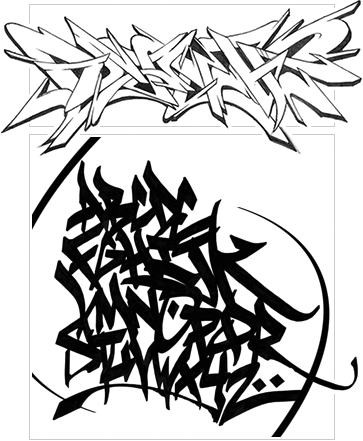
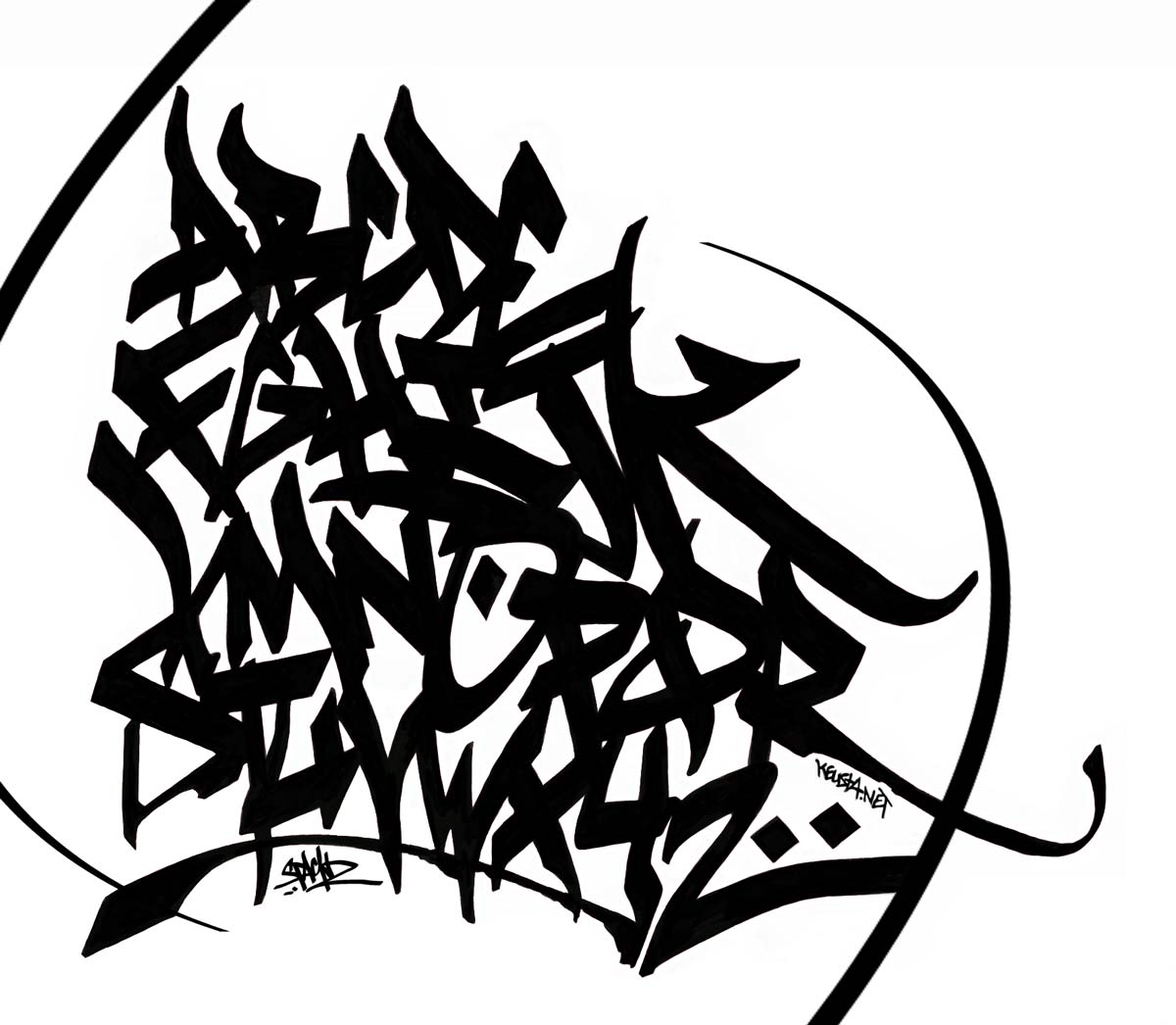
Wildstyle is a difficult and intricate form of graffiti. Due to its complexity, it is often very hard to read by people who are not familiar with it. It incorporates interwoven and overlapping letters and shapes, and may include arrows, spikes, and other decorative elements. It has also been common practice to incorporate 3D elements into the pieces, and even transform the whole letter structure into three dimensions, to add to the depth of visual perception of the work.
The numerous layers and shapes make this style extremely difficult to produce homogeneously, which is why developing an original style in this field is seen as one of the greatest artistic challenges to a graffiti writer. Wildstyle pieces are also known as ‘burners,’ meaning ‘hot’ as fire.
Posted in Art, Language |
Leave a Comment »
March 26, 2011


Graffiti refers to images or lettering scratched, scrawled, painted, or marked in any manner on property. Examples date back to Ancient Greece and the Roman Empire. The word ‘graffiti’ and the singular, ‘graffito,’ are from the Italian word ‘graffiato’ (‘scratched’).
The first known example of modern graffiti survives in the ancient Greek city of Ephesus (in modern-day Turkey). It is an advertisement for prostitution. Located near a mosaic and stone walkway, the graffiti shows a handprint that vaguely resembles a heart, along with a footprint and a number. This is believed to indicate that a brothel was nearby, with the handprint symbolizing payment and the number indicating the price.
read more »
Posted in Art, Language, Politics |
Leave a Comment »
March 25, 2011

Grisaille [gri-zahy] is a term for painting executed entirely in monochrome or near-monochrome, usually in shades of grey. It is particularly used in large decorative schemes in imitation of sculpture. Paintings executed in brown are sometimes referred to by the more specific term brunaille, and paintings executed in green are sometimes called verdaille.
A grisaille may be executed for its own sake, as underpainting for an oil painting (in preparation for glazing layers of color over it), or as a model for an engraver to work from. Full coloring of a subject makes many more demands of an artist, and working in grisaille was often chosen as being quicker and cheaper, although the effect was sometimes deliberately chosen for aesthetic reasons.
Posted in Art, Language |
Leave a Comment »
March 25, 2011

The Dilbert Principle refers to a 1990s satirical observation by ‘Dilbert cartoonist’ Scott Adams stating that companies tend to systematically promote their least-competent employees to management (generally middle management), in order to limit the amount of damage they are capable of doing. In the ‘Dilbert’ strip of February 5, 1995 Dogbert says that ‘leadership is nature’s way of removing morons from the productive flow.’ Adams expanded on the idea in a satirical 1996 book of the same name, which is required reading at some management and business programs.
The Dilbert principle is comparable to the Peter Principle (in a hierarchy every employee tends to rise to his level of incompetence). It assumes that people are promoted because they are competent, and that the tasks higher up in the hierarchy require skills or talents they do not possess. It concludes that due to this, a competent employee will eventually be promoted to, and remain at, a position at which he or she is incompetent. The Dilbert principle, by contrast, assumes that the upper echelons of an organization have little relevance to its actual production, and that the majority of real, productive work in a company is done by people lower in the power ladder.
Posted in Humor, Language, Money |
Leave a Comment »
March 25, 2011

Depressive realism is the proposition that people with depression actually have a more accurate perception of reality, specifically that they are less affected by positive illusions of illusory superiority, the illusion of control, and optimism bias.
The concept refers to people with borderline or moderate depression, suggesting that while non-depressed people see things in an overly positive light and severely depressed people see things in overly negative light, the mildly discontented grey area in between in fact reflects the most accurate perception of reality.
read more »
Posted in Health, Language, Science |
Leave a Comment »
March 25, 2011

Inbreeding depression is the reduced fitness in a given population as a result of breeding of related individuals. It is often the result of a population bottleneck. In general, the higher the genetic variation within a breeding population, the less likely it is to suffer from inbreeding depression. Inbreeding depression seems to be present in most groups of organisms, but is perhaps most important in hermaphroditic species. The majority of plants are hermaphroditic and thus are capable of the most severe degree of inbreeding depression.
Although severe inbreeding depression in humans is uncommon, there have been several cases. As with animals, this phenomenon tends to occur in isolated, rural populations that are cut off to some degree from other areas of civilization. A notable example is the Vadoma tribe of western Zimbabwe, many of whom carry the trait of having only two toes due to a small gene pool.
Posted in Health, Language, Science |
Leave a Comment »
March 25, 2011

Heterosis, or hybrid vigor or outbreeding enhancement, is the increased function of any biological quality in a hybrid offspring. It is the occurrence of a genetically superior offspring from mixing the genes of dissimilar parents. Heterosis is the opposite of inbreeding depression, which occurs in the offspring of closely related parents.
The term often causes controversy, particularly in regard to selective breeding of domestic animals, because sometimes it’s inaccurately claimed, that all crossbred plants or animals are genetically superior to their parents. It’s only true in certain circumstances. When a hybrid is seen to be superior to its parents, this is known as hybrid vigor. When the opposite happens, and a hybrid inherits traits from its parents that makes it unfit for survival, the result is referred to as outbreeding depression. Typical examples of this are crosses between wild and hatchery fish that have incompatible adaptations.
Posted in Health, Language, Science |
Leave a Comment »
March 25, 2011

Miscegenation [mi-sej-uh-ney-shuhn] (Latin: miscere ‘to mix,’ genus ‘kind’) is the mixing of different racial groups, a social construct, through marriage, cohabitation, sexual relations, and procreation. The term miscegenation has been used since the 19th century to refer to interracial marriage and interracial sex, and more generally to the process of racial interbreeding, which has taken place since ancient history.
The term entered historical records during European colonialism, but societies such as China and Japan also had restrictions on marrying with peoples they considered different. Historically the term has been used in the context of laws banning interracial marriage and sex, so-called anti-miscegenation laws.
read more »
Posted in Language, Politics, Sex |
Leave a Comment »
March 24, 2011
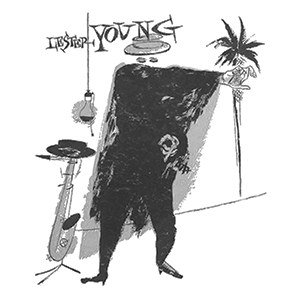
Lester Young (1909 – 1959), nicknamed ‘Prez,’ was an American jazz tenor saxophonist. He also played clarinet, trumpet, violin, and drums. Coming to prominence while a member of Count Basie’s orchestra, Young was one of the most influential players on his instrument, playing with a cool tone and using sophisticated harmonies. He invented or popularized much of the hipster ethos which came to be associated with the music. He is said to have popularized the term ‘cool’ as slang for something fashionable.
Another slang term he reputedly coined was the term ‘bread’ for money. He would ask ‘How does the bread smell?’ when asking how much a gig was going to pay. Young’s playing style influenced many other tenor saxophonists. Perhaps the most famous and successful of these were Stan Getz and Dexter Gordon, but he also influenced many in the cool movement such as Zoot Sims. Lester Young also had a direct influence on young Charlie Parker (‘Bird’), and thus the entire be-bop movement.
Posted in Art, Language, Money |
Leave a Comment »