March 24, 2011
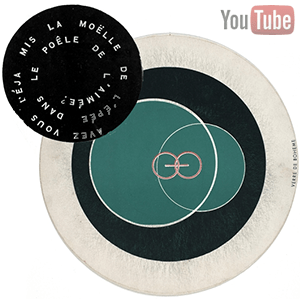
Kinetic art is art that contains moving parts or depends on motion for its effect. The moving parts are generally powered by wind, a motor or the observer. ‘Bicycle Wheel’ (1913) by Marcel Duchamp, is said to be the first kinetic sculpture. Besides being an example of kinetic art it is also an example of a readymade, a type of art of which Duchamp made a number of varieties throughout his life.
read more »
Posted in Art, Language, Money |
Leave a Comment »
March 23, 2011
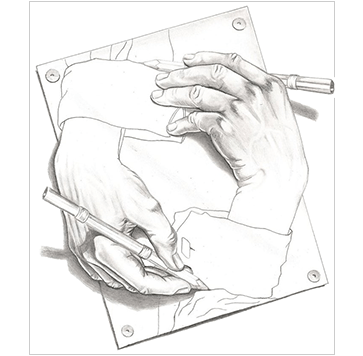

A strange loop arises when, by moving up or down through a hierarchical system, one finds oneself back where one started. Strange loops may involve self-reference and paradox.
The concept of a strange loop was proposed and extensively discussed by Douglas Hofstadter in ‘Gödel, Escher, Bach,’ and is further elaborated in Hofstadter’s book ‘I Am a Strange Loop,’ published in 2007. A tangled hierarchy is a hierarchical system in which a strange loop appears.
Posted in Language, Science |
Leave a Comment »
March 23, 2011

Antonin Carême [kah-rehm] (1784 – 1833), known as the ‘King of Chefs, and the Chef of Kings’ was an early practitioner and exponent of the elaborate style of cooking known as haute cuisine, the ‘high art’ of French cooking: a grandiose style of cookery favored by both international royalty and by the newly rich of Paris. Carême is often considered as one of the first, internationally renowned celebrity chefs.
He is remembered as the founder of the haute cuisine, and credited with creating the standard chef’s hat, the toque. He designed new sauces and dishes, and published a classification of all sauces into groups, based on four mother sauces. He is also frequently credited with replacing the practice of service à la française (serving all dishes at once) with service à la russe (serving each dish in the order printed on the menu).
read more »
Posted in Art, Food, Language |
Leave a Comment »
March 22, 2011

The Biker Cross is a derivative of the Iron Cross (a Prussian, and later German, military decoration). Bikers started to display the Iron Cross in the mid 1960’s with the advent of outlaw biker gangs. Originally bikers displayed the Iron Cross as a symbol of rebellion to society in general.
Today it is also worn to signify honor, valor, strength and ‘standing up for what you believe.’ Hot rodders (American car customizers) and others also use it as a provocative gesture to offend the public, or as a symbol of rebellion or non-conformity.
read more »
Posted in Art, Language, War |
Leave a Comment »
March 21, 2011
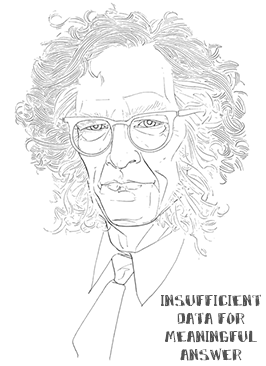
Multivac is the name of a fictional supercomputer in many stories by Isaac Asimov. Like most of the technologies Asimov describes in his fiction, Multivac’s exact specifications vary among appearances. In all cases, it is a government-run computer that answers questions, usually buried deep underground for security purposes. However, Asimov never settles on a particular size for the computer except for mentioning it is very large.
Unlike the artificial intelligences portrayed in his ‘Robot’ Series, Multivac’s interface is mechanized and impersonal, consisting of complex command consoles few humans can operate. Though the technology depended on bulky vacuum tubes, the concept – that all information could be contained on computer(s) and accessed from a domestic terminal – constitutes an early reference to the possibility of the Internet.
Posted in Art, Language, Technology |
1 Comment »
March 19, 2011

A kill screen is a stage or level in a video game (often an arcade game) that stops the player’s progress due to a programming error or design oversight. Rather than ‘ending’ in a traditional sense, the game will crash, freeze, or behave so erratically that further play is impossible. Pac-Man has a famous kill screen often referred to as the ‘Pac-Man Bomb Screen.’ The game’s level counter was a single 8-bit byte and could therefore store only 256 distinct values. Reaching the 256th level causes the counter that is used while drawing the fruit to overflow to zero, causing 256 fruits and seven blank spaces to be drawn.
Kill screens were much more common during the Golden Age of Arcade Games. Games from this era were often written with the assumption that the player would stop playing long before the numerical limits of the game code were reached; most games from this period were intended to continue until the players lost all of their lives. Additionally, the limited hardware of these early machines often meant that programmers could not spend memory on logical checks of the game state.
Posted in Games, Language, Technology |
Leave a Comment »
March 17, 2011

The term foobar is used as a placeholder name in computer programming. It is used to name entities such as variables, functions, and commands whose purpose is unimportant and serve only to demonstrate a concept. The words themselves have no meaning in this usage. Foobar is sometimes used alone; ‘foo,’ ‘bar,’ and ‘baz’ are sometimes used in that order, when multiple entities are needed.
The origins of the terms are not known with certainty, and several anecdotal theories have been advanced to identify them. Foobar may have derived from the military acronym FUBAR (fucked up beyond all recognition) and gained popularity because it is pronounced the same. In this meaning it also can derive from the German word ‘furchtbar,’ which means awful and terrible and described the circumstances of the Second World War.
Posted in Language, Technology |
Leave a Comment »
March 17, 2011

Crowdsourcing is the act of outsourcing tasks, traditionally performed by an employee or contractor, to an undefined, large group of people or community (a ‘crowd’), through an open call. Jeff Howe, one of first authors to employ the term, established that the concept depends essentially on the fact that because it is an open call to an undefined group of people, it gathers those who are most fit to perform tasks, solve complex problems and contribute with the most relevant and fresh ideas.
For example, the public may be invited to develop a new technology, carry out a design task (community-based design and distributed participatory design), refine or carry out the steps of an algorithm (human-based computation), or help capture, systematize or analyze large amounts of data (citizen science). The term has become popular with businesses, authors, and journalists as shorthand for the trend of leveraging the mass collaboration enabled by Web 2.0 technologies to achieve business goals.
Posted in Language, Money, Technology |
Leave a Comment »
March 17, 2011


The threshold pledge or fund and release system is a way of making a fundraising pledge as a group of individuals, often involving charitable goals or financing the provision of a public good. An amount of money is set as the goal or threshold to reach for the specified purpose and interested individuals will pitch in, keeping the donation in an escrow fund. When the threshold is reached, the contributions are retired from the escrow fund and a contract is formed so that the collective good is supplied.
This system is often applied to creative works, both for financing new productions and for buying out existing works; in the latter cases, it’s sometimes known as ransom publishing model or Street Performer Protocol (SPP). Sometimes contributions are refunded to the donors if the threshold amount is not reached as of some expiration date, and no contract is signed: this variation is known as an assurance contract. Contributions to an assurance contract may also be collected as pledges which are only called-in when the threshold is reached.
read more »
Posted in Art, Language, Money |
Leave a Comment »
March 17, 2011

Freemium is a business model that works by offering a basic product or service free of charge (such as software, web services or other) while charging a premium for advanced features, functionality, or related products and services. The concept was articulated by venture capitalist Fred Wilson in 2006: ‘Give your service away for free, possibly ad supported but maybe not, acquire a lot of customers very efficiently through word of mouth, referral networks, organic search marketing, etc., then offer premium priced value added services or an enhanced version of your service to your customer base.’
After describing the business model, Wilson asked for suggestions as to what to call it. Within a matter of hours, more than 30 name suggestions were given by his blog readers. One such suggestion came from Jarid Lukin of Alacra, one of Wilson’s portfolio companies. Lukin coined the term ‘freemium,’ and Wilson and his audience adopted it for the business model.
Posted in Language, Money, Technology |
Leave a Comment »
March 17, 2011

A paywall blocks access to a webpage with a screen requiring payment. Web sites that use them include some owned by periodical publications. In 2002 the Financial Times started charging for Web access to published stories. The Wall Street Journal has almost one million paying online readers, which generates about $65 million a year.
Utilities to circumvent paywalls are available. RefSpoof for Mozilla Firefox spoofs the referrer to Google so that multiple ‘first click free’ links can be performed. BreakthePaywall adds an option to Internet Explorer’s context menu which uses various methods (referrer and user-agent spoofing, Cookie deletion, etc.).
Posted in Language, Money, Technology |
Leave a Comment »
March 17, 2011

‘The Naked Ape: A Zoologist’s Study of the Human Animal’ is a 1967 book by ethologist Desmond Morris which examines human behavior (he wrote a followup, ‘The Human Zoo,’ about urban behavior in 1969). Ethology is the scientific study of animal behavior, a sub-topic of zoology. Morris attempted to frame human behavior in the context of evolution, but his explanations failed to convince academics because they were based on a teleological (goal-oriented) understanding of evolution. However, the book was revolutionary for its time and has found fans among anthropologists and zoologists alike.
‘The Naked Ape’ depicts human behavior as largely evolved, to meet the challenges of prehistoric life as a hunter-gatherer. Morris made a number of claims in the book, including that not only does Homo sapiens have the largest brain of all primates but also the largest penis. He further claimed that our fleshy ear-lobes, which are unique to humans, are erogenous zones, the stimulation of which can cause orgasm in both sexes. Morris stated that the more rounded shape of human female breasts means they are mainly a sexual signalling device rather than simply for providing milk for infants.
Posted in Language, Science |
Leave a Comment »





