March 17, 2011

The term foobar is used as a placeholder name in computer programming. It is used to name entities such as variables, functions, and commands whose purpose is unimportant and serve only to demonstrate a concept. The words themselves have no meaning in this usage. Foobar is sometimes used alone; ‘foo,’ ‘bar,’ and ‘baz’ are sometimes used in that order, when multiple entities are needed.
The origins of the terms are not known with certainty, and several anecdotal theories have been advanced to identify them. Foobar may have derived from the military acronym FUBAR (fucked up beyond all recognition) and gained popularity because it is pronounced the same. In this meaning it also can derive from the German word ‘furchtbar,’ which means awful and terrible and described the circumstances of the Second World War.
Posted in Language, Technology |
Leave a Comment »
March 17, 2011

Crowdsourcing is the act of outsourcing tasks, traditionally performed by an employee or contractor, to an undefined, large group of people or community (a ‘crowd’), through an open call. Jeff Howe, one of first authors to employ the term, established that the concept depends essentially on the fact that because it is an open call to an undefined group of people, it gathers those who are most fit to perform tasks, solve complex problems and contribute with the most relevant and fresh ideas.
For example, the public may be invited to develop a new technology, carry out a design task (community-based design and distributed participatory design), refine or carry out the steps of an algorithm (human-based computation), or help capture, systematize or analyze large amounts of data (citizen science). The term has become popular with businesses, authors, and journalists as shorthand for the trend of leveraging the mass collaboration enabled by Web 2.0 technologies to achieve business goals.
Posted in Language, Money, Technology |
Leave a Comment »
March 17, 2011


The threshold pledge or fund and release system is a way of making a fundraising pledge as a group of individuals, often involving charitable goals or financing the provision of a public good. An amount of money is set as the goal or threshold to reach for the specified purpose and interested individuals will pitch in, keeping the donation in an escrow fund. When the threshold is reached, the contributions are retired from the escrow fund and a contract is formed so that the collective good is supplied.
This system is often applied to creative works, both for financing new productions and for buying out existing works; in the latter cases, it’s sometimes known as ransom publishing model or Street Performer Protocol (SPP). Sometimes contributions are refunded to the donors if the threshold amount is not reached as of some expiration date, and no contract is signed: this variation is known as an assurance contract. Contributions to an assurance contract may also be collected as pledges which are only called-in when the threshold is reached.
read more »
Posted in Art, Language, Money |
Leave a Comment »
March 17, 2011

Freemium is a business model that works by offering a basic product or service free of charge (such as software, web services or other) while charging a premium for advanced features, functionality, or related products and services. The concept was articulated by venture capitalist Fred Wilson in 2006: ‘Give your service away for free, possibly ad supported but maybe not, acquire a lot of customers very efficiently through word of mouth, referral networks, organic search marketing, etc., then offer premium priced value added services or an enhanced version of your service to your customer base.’
After describing the business model, Wilson asked for suggestions as to what to call it. Within a matter of hours, more than 30 name suggestions were given by his blog readers. One such suggestion came from Jarid Lukin of Alacra, one of Wilson’s portfolio companies. Lukin coined the term ‘freemium,’ and Wilson and his audience adopted it for the business model.
Posted in Language, Money, Technology |
Leave a Comment »
March 17, 2011

A paywall blocks access to a webpage with a screen requiring payment. Web sites that use them include some owned by periodical publications. In 2002 the Financial Times started charging for Web access to published stories. The Wall Street Journal has almost one million paying online readers, which generates about $65 million a year.
Utilities to circumvent paywalls are available. RefSpoof for Mozilla Firefox spoofs the referrer to Google so that multiple ‘first click free’ links can be performed. BreakthePaywall adds an option to Internet Explorer’s context menu which uses various methods (referrer and user-agent spoofing, Cookie deletion, etc.).
Posted in Language, Money, Technology |
Leave a Comment »
March 17, 2011

‘The Naked Ape: A Zoologist’s Study of the Human Animal’ is a 1967 book by ethologist Desmond Morris which examines human behavior (he wrote a followup, ‘The Human Zoo,’ about urban behavior in 1969). Ethology is the scientific study of animal behavior, a sub-topic of zoology. Morris attempted to frame human behavior in the context of evolution, but his explanations failed to convince academics because they were based on a teleological (goal-oriented) understanding of evolution. However, the book was revolutionary for its time and has found fans among anthropologists and zoologists alike.
‘The Naked Ape’ depicts human behavior as largely evolved, to meet the challenges of prehistoric life as a hunter-gatherer. Morris made a number of claims in the book, including that not only does Homo sapiens have the largest brain of all primates but also the largest penis. He further claimed that our fleshy ear-lobes, which are unique to humans, are erogenous zones, the stimulation of which can cause orgasm in both sexes. Morris stated that the more rounded shape of human female breasts means they are mainly a sexual signalling device rather than simply for providing milk for infants.
Posted in Language, Science |
Leave a Comment »
March 16, 2011

A nuclear meltdown is an informal term for a severe nuclear reactor accident that results in core damage from overheating. The term is not officially defined by the International Atomic Energy Agency. Meltdown conditions can be created when system failures lead to temperatures and heat generation that exceed cooling capacity to the extent that the nuclear fuel assemblies overheat and melt, either partially or completely.
A meltdown is considered very serious because of the potential that highly intense radioactive materials with long half-lives and lethal threat could be released into the environment. The effects of a nuclear meltdown depend on the safety features designed into a reactor. A modern reactor is designed both to make a meltdown unlikely, and to contain one should it occur.
read more »
Posted in Language, Money, Technology |
Leave a Comment »
March 16, 2011

Hentai is a Japanese word that literally means ‘strange appearance,’ but is also used to mean ‘perverted.’ Hentai, because of this, is a word used by countries outside of Japan to show pornographic and sex-related anime, manga, and video games. The word is not used to mean this in Japan. In Japan, terms such as ‘ecchi’ are used. Since hentai is anime, the performers are not bound by physical laws. Makers of hentai often use this in very creative ways.
Censorship is practiced differently in Japan and in the US. Japanese law discourages showing of genitals in hentai, while the United States is more concerned about forbidding the display of sex acts involving people under 18. Hence, there are censoring mosaics in Japan, and scene removals and different ages of characters in America.
read more »
Posted in Language, Sex, World |
2 Comments »
March 15, 2011
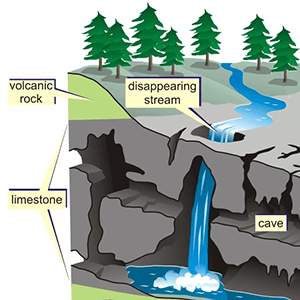
Karst [kahrst] topography is characterized by subterranean limestone caverns, carved by groundwater. It is a landscape shaped by the dissolution of a layer or layers of soluble bedrock, usually carbonate rock such as limestone or dolomite. Due to subterranean drainage, there may be very limited surface water, even to the absence of all rivers and lakes. Many karst regions display distinctive surface features, with sinkholes or dolines being the most common.
Some karst regions include thousands of caves, even though evidence of caves that are big enough for human exploration is not a required characteristic of karst. Serbian geographer, Jovan Cvijić (1865–1927) is recognized as the father of karst geomorphology. The international community has settled on ‘karst,’ the German name for Kras, a region in Slovenia partially extending into Italy, where it is called ‘Carso’ and where the first scientific research of a karst topography was made. The name has an Indo-European origin (from ‘karra’ meaning ‘stone’).
Posted in Language, Science |
Leave a Comment »
March 14, 2011

Rendering is the process of generating an image from a model by means of computer programs. Renders contain geometry, viewpoint, texture, lighting, and shading information as a description of a virtual scene. The term ‘rendering’ may be by analogy with an ‘artist’s rendering’ of a scene. Rendering is one of the major sub-topics of 3D computer graphics, and in practice always connected to the others. In the graphics pipeline, it is the last major step, giving the final appearance to the models and animation.
Rendering may be done slowly, as in pre-rendering, or in real time. Pre-rendering is a computationally intensive process that is typically used for movie creation, while real-time rendering is often done for 3D video games which rely on the use of graphics cards with 3D hardware accelerators.
Posted in Art, Language, Technology |
Leave a Comment »
March 11, 2011

The Ides of March is a day on the Roman calendar that corresponds to March 15th. It was marked by several religious observances, and became notorious as the date of the assassination of Julius Caesar in 44 BCE. In Canada, the day is commemorated with the drinking of Bloody Caesar (a Bloody Mary made with Clamato). In the original Roman calendar, March was the first month of the year. The holidays observed by the Romans from the first through the Ides often reflect their origin as new year celebrations. The Romans did not number days of a month sequentially from the first through the last day.
Instead, they counted back from three fixed points of the month: the Nones (5th or 7th, depending on the length of the month), the Ides (13th or 15th), and the Kalends (1st) of the following month. The Ides occurred near the midpoint, on the 13th for most months, but on the 15th for March, May, July, and October. The Ides were supposed to be determined by the full moon, reflecting the lunar origin of the Roman calendar. On the earliest calendar, the Ides of March would have been the first full moon of the new year.
read more »
Posted in Death, Language, Philosophy |
Leave a Comment »
March 11, 2011


An antigen [ann-tuh-jen] is a protein expressed by a bacteria or virus that is recognized by an immune system as foreign which can stimulate the production of antibodies and combine specifically with them. Usually an antibody is a molecule, perhaps on the cell surface of a bacterium or virus. Antibodies are always ‘foreign’; except in rare cases the system is tolerant of its own molecules. Autoimmune diseases are caused when this safeguard fails. When an antigen is introduced into the body it causes the production of antibodies. Antigens include bacteria, cells of transplanted organs, plant pollen and toxins.
The first time that a new antigen comes into contact with the body the response of the immune system will be a complete immune response. During this first response, the antigen will cause antibodies to be made. The next time the same antigen contacts the body, a full scale immune response is not needed as the body already has a specific antibody available instantly for that antigen. This means that the body can begin fighting an infection much sooner for illnesses it has encountered before, and takes more time to begin to fight an infection in new illnesses.
Posted in Health, Language, Science |
Leave a Comment »




 The Daily Omnivore