March 16, 2011

A nuclear meltdown is an informal term for a severe nuclear reactor accident that results in core damage from overheating. The term is not officially defined by the International Atomic Energy Agency. Meltdown conditions can be created when system failures lead to temperatures and heat generation that exceed cooling capacity to the extent that the nuclear fuel assemblies overheat and melt, either partially or completely.
A meltdown is considered very serious because of the potential that highly intense radioactive materials with long half-lives and lethal threat could be released into the environment. The effects of a nuclear meltdown depend on the safety features designed into a reactor. A modern reactor is designed both to make a meltdown unlikely, and to contain one should it occur.
read more »
Posted in Language, Money, Technology |
Leave a Comment »
March 16, 2011

Hentai is a Japanese word that literally means ‘strange appearance,’ but is also used to mean ‘perverted.’ Hentai, because of this, is a word used by countries outside of Japan to show pornographic and sex-related anime, manga, and video games. The word is not used to mean this in Japan. In Japan, terms such as ‘ecchi’ are used. Since hentai is anime, the performers are not bound by physical laws. Makers of hentai often use this in very creative ways.
Censorship is practiced differently in Japan and in the US. Japanese law discourages showing of genitals in hentai, while the United States is more concerned about forbidding the display of sex acts involving people under 18. Hence, there are censoring mosaics in Japan, and scene removals and different ages of characters in America.
read more »
Posted in Language, Sex, World |
2 Comments »
March 15, 2011
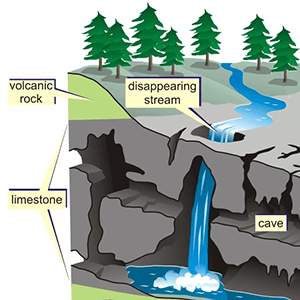
Karst [kahrst] topography is characterized by subterranean limestone caverns, carved by groundwater. It is a landscape shaped by the dissolution of a layer or layers of soluble bedrock, usually carbonate rock such as limestone or dolomite. Due to subterranean drainage, there may be very limited surface water, even to the absence of all rivers and lakes. Many karst regions display distinctive surface features, with sinkholes or dolines being the most common.
Some karst regions include thousands of caves, even though evidence of caves that are big enough for human exploration is not a required characteristic of karst. Serbian geographer, Jovan Cvijić (1865–1927) is recognized as the father of karst geomorphology. The international community has settled on ‘karst,’ the German name for Kras, a region in Slovenia partially extending into Italy, where it is called ‘Carso’ and where the first scientific research of a karst topography was made. The name has an Indo-European origin (from ‘karra’ meaning ‘stone’).
Posted in Language, Science |
Leave a Comment »
March 14, 2011

Rendering is the process of generating an image from a model by means of computer programs. Renders contain geometry, viewpoint, texture, lighting, and shading information as a description of a virtual scene. The term ‘rendering’ may be by analogy with an ‘artist’s rendering’ of a scene. Rendering is one of the major sub-topics of 3D computer graphics, and in practice always connected to the others. In the graphics pipeline, it is the last major step, giving the final appearance to the models and animation.
Rendering may be done slowly, as in pre-rendering, or in real time. Pre-rendering is a computationally intensive process that is typically used for movie creation, while real-time rendering is often done for 3D video games which rely on the use of graphics cards with 3D hardware accelerators.
Posted in Art, Language, Technology |
Leave a Comment »
March 11, 2011

The Ides of March is a day on the Roman calendar that corresponds to March 15th. It was marked by several religious observances, and became notorious as the date of the assassination of Julius Caesar in 44 BCE. In Canada, the day is commemorated with the drinking of Bloody Caesar (a Bloody Mary made with Clamato). In the original Roman calendar, March was the first month of the year. The holidays observed by the Romans from the first through the Ides often reflect their origin as new year celebrations. The Romans did not number days of a month sequentially from the first through the last day.
Instead, they counted back from three fixed points of the month: the Nones (5th or 7th, depending on the length of the month), the Ides (13th or 15th), and the Kalends (1st) of the following month. The Ides occurred near the midpoint, on the 13th for most months, but on the 15th for March, May, July, and October. The Ides were supposed to be determined by the full moon, reflecting the lunar origin of the Roman calendar. On the earliest calendar, the Ides of March would have been the first full moon of the new year.
read more »
Posted in Death, Language, Philosophy |
Leave a Comment »
March 11, 2011


An antigen [ann-tuh-jen] is a protein expressed by a bacteria or virus that is recognized by an immune system as foreign which can stimulate the production of antibodies and combine specifically with them. Usually an antibody is a molecule, perhaps on the cell surface of a bacterium or virus. Antibodies are always ‘foreign’; except in rare cases the system is tolerant of its own molecules. Autoimmune diseases are caused when this safeguard fails. When an antigen is introduced into the body it causes the production of antibodies. Antigens include bacteria, cells of transplanted organs, plant pollen and toxins.
The first time that a new antigen comes into contact with the body the response of the immune system will be a complete immune response. During this first response, the antigen will cause antibodies to be made. The next time the same antigen contacts the body, a full scale immune response is not needed as the body already has a specific antibody available instantly for that antigen. This means that the body can begin fighting an infection much sooner for illnesses it has encountered before, and takes more time to begin to fight an infection in new illnesses.
Posted in Health, Language, Science |
Leave a Comment »
March 10, 2011

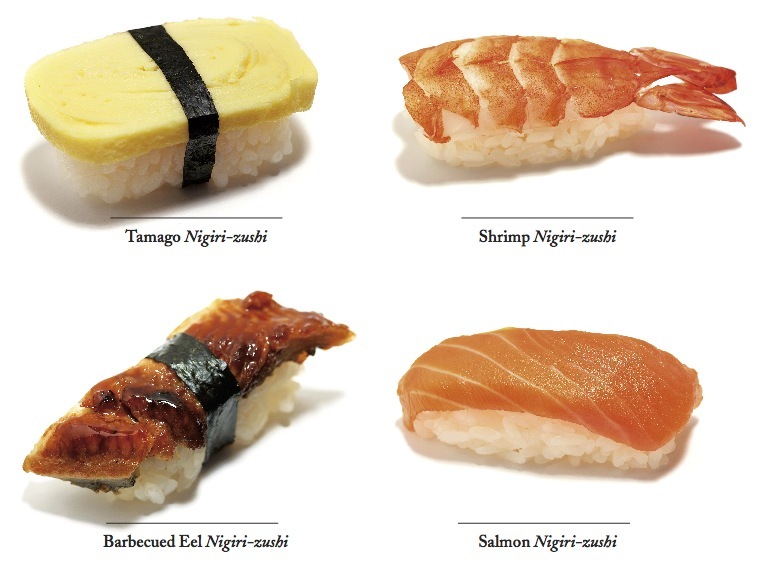
Nigirizushi [ni-geer-ee-zoo-shee] (‘hand-formed sushi’) is an oblong mound of sushi rice that the chef presses into a small rectangular box between the palms of the hands, usually with a bit of wasabi, and a topping draped over it (typically seafood). Certain toppings are bound to the rice with a thin strip of nori (seaweed), most commonly octopus (tako), freshwater eel (unagi), sea eel (anago), squid (ika), and sweet egg (tamago). When ordered separately, nigiri is generally served in pairs. A sushi set (a sampler dish) may contain only one piece of each topping.
Gunkanmaki (‘warship roll’) is a special type of nigirizushi: an oval, hand-formed clump of sushi rice that has a strip of nori wrapped around its perimeter to form a vessel that is filled with some soft, loose or fine-chopped ingredient that requires the confinement of nori such as roe, natto, oysters, sea urchin, corn with mayonnaise, and quail eggs. Temarizushi (‘ball sushi’) is a ball-shaped sushi made by pressing rice and fish into a ball-shaped form by hand using a plastic wrap.
Posted in Food, Language, World |
Leave a Comment »
March 10, 2011

Otaku is a Japanese term used to refer to people with obsessive interests, particularly anime (animation) and manga (graphic novels). The term is derived from a Japanese word for another’s house or family. It appears to have been coined by the humorist and essayist Akio Nakamori in 1983. Common uses are anime otaku, manga otaku, pasokon otaku (personal computers enthusiasts), gēmu otaku (video game players), and wota otaku (extreme fans of idols, heavily promoted singing girls). There are also tetsudō otaku or denshamania (railfans) or gunji otaku (military geeks).
While these are the most common uses, the word can be applied to anything (music otaku, martial arts otaku, cooking otaku, etc.). Some of Japan’s otaku use the term to describe themselves and their friends semi-humorously, accepting their position as fans, and some even use the term proudly, attempting to reclaim it from its negative connotations. In general colloquial usage however, most Japanese would consider it undesirable to be described in a serious fashion as ‘otaku’; many even consider it to be an offensive term.
Posted in Art, Language, World |
Leave a Comment »
March 10, 2011

Ah Beng is a stereotype applied to a certain group of young Chinese men in Southeast Asia, particularly Singapore and Malaysia. The stereotypical view of an Ah Beng is a young Chinese man or teenager who lacks cultural refinement or indulges in criminal activity or is involved in brawls or arguments out of disagreements with other people. Ah Bengs are also sometimes associated with extensively-modified or ‘zhng-ed’ cars, and are stereotypically seen as excessively flashy and show-offish. Ah Bengs are often stereotyped as trying to emulate Japanese street fashion.
In Malaysia, the term ‘Ah Beng’ usually refers to males who have unusual styles and tastes. And the term ‘lala-zai’ refers to males involved in stereotypical gangster activity or fashion such as the dyeing of hair. In Singapore, the term ‘Ah Beng’ is normally used describe gangster wannabes who cannot speak fluent English and have very low education. They commonly speak in Mandarin or Hokkien.
Posted in Language, Money, World |
1 Comment »
March 10, 2011

The story of The Dog in the Manger derives from an old Greek fable: There was a dog lying in a manger who did not eat the grain but who nevertheless prevented the horse from being able to eat anything either. The dog in the manger is a metaphor for those who spitefully prevent others from having something that they themselves have no use for.
Posted in Art, Language, World |
Leave a Comment »
March 10, 2011

Kiasu [kee-ah-soo] (lit: ‘fear of losing’) is a Chinese word describing behavior such as accumulating too much food on one’s plate during a buffet lunch (for fear of there not being enough) or joining a queue many days in advance just to ensure that one successfully gets hold of the limited free tickets to events. This word is so widely used by Singaporeans and Malaysians that it is incorporated into their English vocabulary (in the form of Singlish and Manglish).
It is often used in describing the social attitudes of people, especially about South East Asian society and its values and competitiveness. Kiasu is commonly compared to Kiasi (lit: ‘fear of death’) and both are commonly used to describe optimization behavior. Kiasu-ism means to take extreme measures to achieve success, and Kiasi-ism is doing the same to avoid risk.
Posted in Language, Money, World |
Leave a Comment »
March 10, 2011

The ‘Lost Generation‘ is a term used to refer to the generation that came of age during World War I. It was popularized by Ernest Hemingway who used it as one of two contrasting epigraphs for his novel, ‘The Sun Also Rises.’ In that volume Hemingway credits the phrase to fellow novelist Gertrude Stein, who was then his mentor and patron.
In ‘A Movable Feast,’ which was published after Hemingway and Stein had had a famous feud and fallen apart, and after they were both dead, Hemingway reveals that the phrase was actually originated by the garage owner who repaired Stein’s car. When a young mechanic failed to repair the car in a way satisfactory to Stein, the owner shouted at him, ‘You are all a generation perdue. That is what you are. That’s what you all are…All of you young people who served in the war. You are a lost generation.’
read more »
Posted in Art, Language, Politics |
Leave a Comment »