March 10, 2011

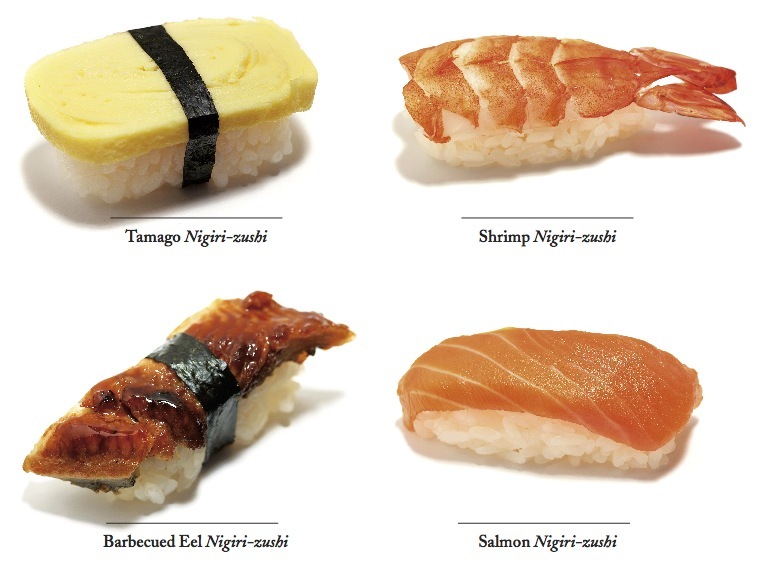
Nigirizushi [ni-geer-ee-zoo-shee] (‘hand-formed sushi’) is an oblong mound of sushi rice that the chef presses into a small rectangular box between the palms of the hands, usually with a bit of wasabi, and a topping draped over it (typically seafood). Certain toppings are bound to the rice with a thin strip of nori (seaweed), most commonly octopus (tako), freshwater eel (unagi), sea eel (anago), squid (ika), and sweet egg (tamago). When ordered separately, nigiri is generally served in pairs. A sushi set (a sampler dish) may contain only one piece of each topping.
Gunkanmaki (‘warship roll’) is a special type of nigirizushi: an oval, hand-formed clump of sushi rice that has a strip of nori wrapped around its perimeter to form a vessel that is filled with some soft, loose or fine-chopped ingredient that requires the confinement of nori such as roe, natto, oysters, sea urchin, corn with mayonnaise, and quail eggs. Temarizushi (‘ball sushi’) is a ball-shaped sushi made by pressing rice and fish into a ball-shaped form by hand using a plastic wrap.
Posted in Food, Language, World |
Leave a Comment »
March 10, 2011

Otaku is a Japanese term used to refer to people with obsessive interests, particularly anime (animation) and manga (graphic novels). The term is derived from a Japanese word for another’s house or family. It appears to have been coined by the humorist and essayist Akio Nakamori in 1983. Common uses are anime otaku, manga otaku, pasokon otaku (personal computers enthusiasts), gēmu otaku (video game players), and wota otaku (extreme fans of idols, heavily promoted singing girls). There are also tetsudō otaku or denshamania (railfans) or gunji otaku (military geeks).
While these are the most common uses, the word can be applied to anything (music otaku, martial arts otaku, cooking otaku, etc.). Some of Japan’s otaku use the term to describe themselves and their friends semi-humorously, accepting their position as fans, and some even use the term proudly, attempting to reclaim it from its negative connotations. In general colloquial usage however, most Japanese would consider it undesirable to be described in a serious fashion as ‘otaku’; many even consider it to be an offensive term.
Posted in Art, Language, World |
Leave a Comment »
March 10, 2011

Ah Beng is a stereotype applied to a certain group of young Chinese men in Southeast Asia, particularly Singapore and Malaysia. The stereotypical view of an Ah Beng is a young Chinese man or teenager who lacks cultural refinement or indulges in criminal activity or is involved in brawls or arguments out of disagreements with other people. Ah Bengs are also sometimes associated with extensively-modified or ‘zhng-ed’ cars, and are stereotypically seen as excessively flashy and show-offish. Ah Bengs are often stereotyped as trying to emulate Japanese street fashion.
In Malaysia, the term ‘Ah Beng’ usually refers to males who have unusual styles and tastes. And the term ‘lala-zai’ refers to males involved in stereotypical gangster activity or fashion such as the dyeing of hair. In Singapore, the term ‘Ah Beng’ is normally used describe gangster wannabes who cannot speak fluent English and have very low education. They commonly speak in Mandarin or Hokkien.
Posted in Language, Money, World |
1 Comment »
March 10, 2011

The story of The Dog in the Manger derives from an old Greek fable: There was a dog lying in a manger who did not eat the grain but who nevertheless prevented the horse from being able to eat anything either. The dog in the manger is a metaphor for those who spitefully prevent others from having something that they themselves have no use for.
Posted in Art, Language, World |
Leave a Comment »
March 10, 2011

Kiasu [kee-ah-soo] (lit: ‘fear of losing’) is a Chinese word describing behavior such as accumulating too much food on one’s plate during a buffet lunch (for fear of there not being enough) or joining a queue many days in advance just to ensure that one successfully gets hold of the limited free tickets to events. This word is so widely used by Singaporeans and Malaysians that it is incorporated into their English vocabulary (in the form of Singlish and Manglish).
It is often used in describing the social attitudes of people, especially about South East Asian society and its values and competitiveness. Kiasu is commonly compared to Kiasi (lit: ‘fear of death’) and both are commonly used to describe optimization behavior. Kiasu-ism means to take extreme measures to achieve success, and Kiasi-ism is doing the same to avoid risk.
Posted in Language, Money, World |
Leave a Comment »
March 10, 2011

The ‘Lost Generation‘ is a term used to refer to the generation that came of age during World War I. It was popularized by Ernest Hemingway who used it as one of two contrasting epigraphs for his novel, ‘The Sun Also Rises.’ In that volume Hemingway credits the phrase to fellow novelist Gertrude Stein, who was then his mentor and patron.
In ‘A Movable Feast,’ which was published after Hemingway and Stein had had a famous feud and fallen apart, and after they were both dead, Hemingway reveals that the phrase was actually originated by the garage owner who repaired Stein’s car. When a young mechanic failed to repair the car in a way satisfactory to Stein, the owner shouted at him, ‘You are all a generation perdue. That is what you are. That’s what you all are…All of you young people who served in the war. You are a lost generation.’
read more »
Posted in Art, Language, Politics |
Leave a Comment »
March 9, 2011

In Computer science, ‘The Cloud‘ is a marketing term for the Internet. In the case of electricity, users can simply use it. They do not need to worry where the electricity is from, how it is generated, or transported. At the end of the month, they will get a bill for the amount of electricity they consumed. The idea behind cloud computing is similar: The user can simply use storage, computing power, or specially crafted development environments, without having to worry how these work internally.
The cloud is a metaphor for the Internet based on how the internet is described in computer network diagrams; which means it is an abstraction hiding the complex infrastructure of the internet.
Posted in Language, Money, Technology |
Leave a Comment »
March 9, 2011

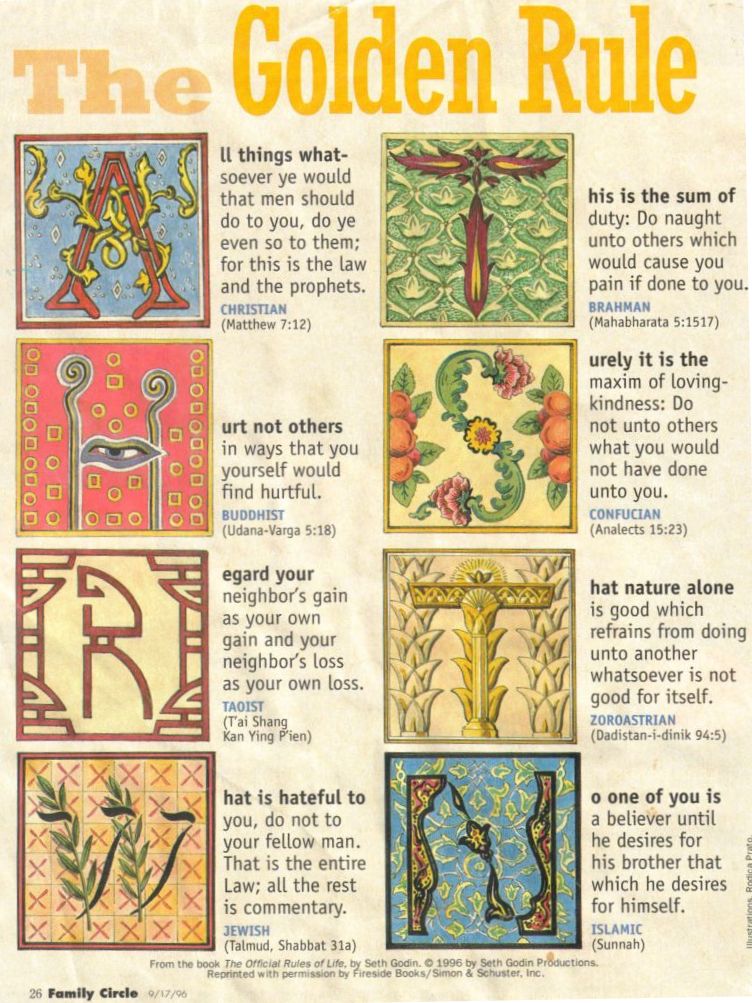
The Golden Rule or ethic of reciprocity is an ethical code: One should treat others as one would like others to treat oneself. It is arguably the basis for the modern concept of human rights, in which each individual has a right to just treatment, and a reciprocal responsibility to ensure justice for others. A key element of the Golden Rule is that a person attempting to live by this rule treats all people with consideration, not just members of his or her in-group.
The ethic of reciprocity was present in certain forms in the philosophies of ancient Babylon, Egypt, Persia, India, Greece, Judea, and China. Examples of statements that mirror the Golden Rule appear in Ancient Egypt, for example in the story of ‘The Eloquent Peasant’ which is dated to the Middle Kingdom of Egypt (c. 2040–1650 BCE): ‘Now this is the command: Do to the doer to cause that he do.’ The label ‘golden’ is believed to have been applied by Confucius (551–479 BCE).
Posted in Language, Philosophy, Politics |
Leave a Comment »
March 9, 2011

Individual sovereignty (or self-ownership) is the concept of property in one’s own person, expressed as the moral or natural right of a person to be the exclusive controller of his own body and life. According to Marxist philosopher G. Cohen, the concept of self-ownership is that ‘each person enjoys, over himself and his powers, full and exclusive rights of control and use, and therefore owes no service or product to anyone else that he has not contracted to supply.’
Sovereign individuals have supreme authority over their own choices, without the interference of governing powers, provided they have not violated the rights of others. This notion is central to classical liberalism, abolitionism, libertarianism, objectivism, and anarchism. Sovereign-minded individuals would then seem to prefer an atmosphere consisting of decentralized administrative organizations acting as servants to the individual.
Posted in Language, Philosophy, Politics |
Leave a Comment »
March 9, 2011

Nadsat is an argot (secret language) used by the teenagers in Anthony Burgess’s novel ‘A Clockwork Orange. ‘In addition to being a novelist, Burgess was also a linguist and he used this background to depict his characters as speaking a form of Russian-influenced English. The name itself comes from the Russian suffix equivalent of -‘teen.’
read more »
Posted in Art, Language |
Leave a Comment »
March 8, 2011


Chip Kidd (b. 1964) is an American author and graphic designer, known for his innovative book covers. He is currently associate art director at Knopf, an imprint of Random House. He first joined the Knopf design team in 1986, as a junior assistant. Kidd also supervises graphic novels at Pantheon.
His output includes cover concepts for books by Bret Easton Ellis, Haruki Murakami, Dean Koontz, Cormac McCarthy, Frank Miller, Alex Ross, David Sedaris, John Updike and others. His design for Michael Crichton’s Jurassic Park novel was carried over into marketing for the film adaptation. Oliver Sacks and other authors have contract clauses stating that Kidd design their books. Kidd is currently working with writer Lisa Birnbach on True Prep, a follow-up to her 1980 book The Official Preppy Handbook.
Posted in Art, Language, Money |
2 Comments »
March 7, 2011

Hungry ghost is a Western translation of an Eastern phrase representing beings who are driven by intense emotional needs in an animalistic way. In Buddhism, they are ghosts only in the sense of not being fully alive; not fully capable of living and appreciating what the moment has to offer. They are phantomlike creatures with withered limbs, grossly bloated bellies, and long thin necks.
They represent a fusion of rage and desire. Tormented by unfulfilled cravings and insatiably demanding of impossible satisfactions, the Hungry Ghosts are searching for gratification for old unfulfilled needs whose time has passed. They are beings who have uncovered a terrible emptiness within themselves, who cannot see the impossibility of correcting something that has already happened. Their ghostlike state represents their attachment to the past.
Posted in Language, Philosophy, World |
Leave a Comment »




 The Daily Omnivore