March 9, 2011

In Computer science, ‘The Cloud‘ is a marketing term for the Internet. In the case of electricity, users can simply use it. They do not need to worry where the electricity is from, how it is generated, or transported. At the end of the month, they will get a bill for the amount of electricity they consumed. The idea behind cloud computing is similar: The user can simply use storage, computing power, or specially crafted development environments, without having to worry how these work internally.
The cloud is a metaphor for the Internet based on how the internet is described in computer network diagrams; which means it is an abstraction hiding the complex infrastructure of the internet.
Posted in Language, Money, Technology |
Leave a Comment »
March 9, 2011

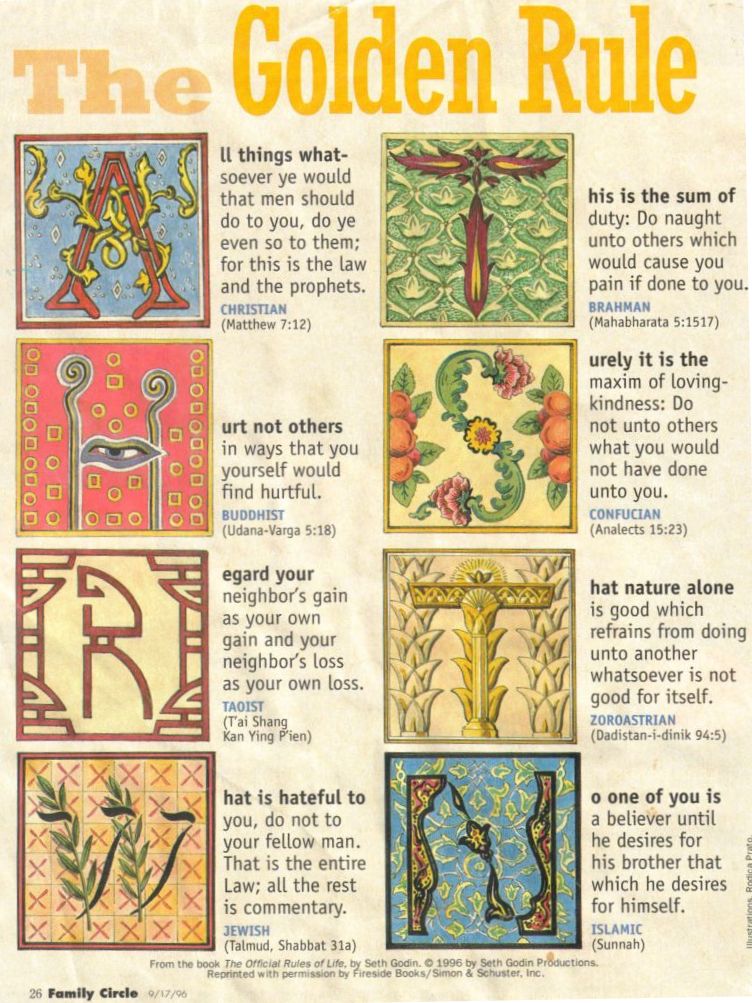
The Golden Rule or ethic of reciprocity is an ethical code: One should treat others as one would like others to treat oneself. It is arguably the basis for the modern concept of human rights, in which each individual has a right to just treatment, and a reciprocal responsibility to ensure justice for others. A key element of the Golden Rule is that a person attempting to live by this rule treats all people with consideration, not just members of his or her in-group.
The ethic of reciprocity was present in certain forms in the philosophies of ancient Babylon, Egypt, Persia, India, Greece, Judea, and China. Examples of statements that mirror the Golden Rule appear in Ancient Egypt, for example in the story of ‘The Eloquent Peasant’ which is dated to the Middle Kingdom of Egypt (c. 2040–1650 BCE): ‘Now this is the command: Do to the doer to cause that he do.’ The label ‘golden’ is believed to have been applied by Confucius (551–479 BCE).
Posted in Language, Philosophy, Politics |
Leave a Comment »
March 9, 2011

Individual sovereignty (or self-ownership) is the concept of property in one’s own person, expressed as the moral or natural right of a person to be the exclusive controller of his own body and life. According to Marxist philosopher G. Cohen, the concept of self-ownership is that ‘each person enjoys, over himself and his powers, full and exclusive rights of control and use, and therefore owes no service or product to anyone else that he has not contracted to supply.’
Sovereign individuals have supreme authority over their own choices, without the interference of governing powers, provided they have not violated the rights of others. This notion is central to classical liberalism, abolitionism, libertarianism, objectivism, and anarchism. Sovereign-minded individuals would then seem to prefer an atmosphere consisting of decentralized administrative organizations acting as servants to the individual.
Posted in Language, Philosophy, Politics |
Leave a Comment »
March 9, 2011

Nadsat is an argot (secret language) used by the teenagers in Anthony Burgess’s novel ‘A Clockwork Orange. ‘In addition to being a novelist, Burgess was also a linguist and he used this background to depict his characters as speaking a form of Russian-influenced English. The name itself comes from the Russian suffix equivalent of -‘teen.’
read more »
Posted in Art, Language |
Leave a Comment »
March 8, 2011


Chip Kidd (b. 1964) is an American author and graphic designer, known for his innovative book covers. He is currently associate art director at Knopf, an imprint of Random House. He first joined the Knopf design team in 1986, as a junior assistant. Kidd also supervises graphic novels at Pantheon.
His output includes cover concepts for books by Bret Easton Ellis, Haruki Murakami, Dean Koontz, Cormac McCarthy, Frank Miller, Alex Ross, David Sedaris, John Updike and others. His design for Michael Crichton’s Jurassic Park novel was carried over into marketing for the film adaptation. Oliver Sacks and other authors have contract clauses stating that Kidd design their books. Kidd is currently working with writer Lisa Birnbach on True Prep, a follow-up to her 1980 book The Official Preppy Handbook.
Posted in Art, Language, Money |
2 Comments »
March 7, 2011

Hungry ghost is a Western translation of an Eastern phrase representing beings who are driven by intense emotional needs in an animalistic way. In Buddhism, they are ghosts only in the sense of not being fully alive; not fully capable of living and appreciating what the moment has to offer. They are phantomlike creatures with withered limbs, grossly bloated bellies, and long thin necks.
They represent a fusion of rage and desire. Tormented by unfulfilled cravings and insatiably demanding of impossible satisfactions, the Hungry Ghosts are searching for gratification for old unfulfilled needs whose time has passed. They are beings who have uncovered a terrible emptiness within themselves, who cannot see the impossibility of correcting something that has already happened. Their ghostlike state represents their attachment to the past.
Posted in Language, Philosophy, World |
Leave a Comment »
March 7, 2011

Brain lateralization [lat-er-uh-luh-zey-shuhn] is the distribution of function into right and left hemispheres. In most brains the left hemisphere is the center of language, logic, and rationality and controls the right side of the body, and the right hemisphere is the focus of creativity, intuition, holistic thought, and controls the left side of the body. In common speech lateralization is referred to as handedness, the preference for using either the left or the right side of the body for certain things.
Lateralization occurs in animals when one side of the brain is stronger (more dominant) than the other. Until fairly recently it was thought humans preferred the left or right sides of their body was because they could speak. However, it was later discovered that many nonverbal species display lateralization. For example, elephants often have preferences for whether they swing their trunks to the left or the right. Honeybees have right antennas that are more sensitive to smells. Parrots can be left- or right-footed, and some are ambidextrous. Chickens and minnows like to look for food with one eye and look out for predators with the other.
Posted in Health, Language, Science |
Leave a Comment »
March 6, 2011

Warchalking is the drawing of symbols in public places to advertise an open Wi-Fi wireless network. Inspired by hobo symbols, the warchalking marks were conceived by a group of friends in June 2002 and publicized by Matt Jones who designed the set of icons and produced a downloadable document containing them. Having found a Wi-Fi node, the warchalker draws a special symbol on a nearby object, such as a wall, the pavement, or a lamp post. Those offering Wi-Fi service might also draw such a symbol to advertise the availability of their Wi-Fi location, whether commercial or personal.
The word is formed by analogy to wardriving, the practice of driving around an area in a car to detect open Wi-Fi nodes. That term in turn is based on wardialing, the practice of dialing many phone numbers hoping to find a modem.
Posted in Language, Technology |
Leave a Comment »
March 6, 2011

Wardialing is a technique of using a modem to automatically scan a list of telephone numbers, usually dialing every number in a local area code to search for computers, Bulletin board systems and fax machines. Hackers use the resulting lists for various purposes, hobbyists for exploration, and crackers – hackers that specialize in computer security – for password guessing.
The popular name for this technique originated in the 1983 film WarGames. In the film, the protagonist programmed his computer to dial every telephone number in Sunnyvale, California to find other computer systems. Prior to the movie’s release, this technique was known as ‘hammer dialing’ or ‘demon dialing.’
Posted in Language, Money, Technology |
Leave a Comment »
March 6, 2011

Social Engineering describes methods of influencing people with the goal of illegally obtaining sensitive data (e.g. passwords, credit card information). Social Engineers observe the personal environment of their victims and use fake identities to gain secret information or free services. In most cases Social Engineering is used to infiltrate third party computer systems to spy on sensitive data; in that case social engineering is also called Social Hacking.
read more »
Posted in Language, Money, Technology |
Leave a Comment »
March 4, 2011

A joe job is a spamming technique that sends out unsolicited e-mails using spoofed (falsified) sender data. Early joe jobs aimed at tarnishing the reputation of the apparent sender or inducing the recipients to take action against him, but they are now typically used by commercial spammers to conceal the true origin of their messages.
The name ‘joe job’ originated from such a spam attack on Joe Doll, webmaster of Joe’s Cyberpost. One user’s joes.com account was removed due to advertising through spam. In retaliation, the user sent another spam with the ‘reply-to’ headers forged to make it appear to be from Joe Doll. Besides prompting angry replies, it also caused joes.com to fall prey to denial-of-service attacks that temporarily took the web site down.
Posted in Language, Money, Technology |
Leave a Comment »
March 4, 2011

False flag operations are covert operations designed to deceive the public in such a way that the operations appear as though they are being carried out by other entities.
The name is derived from the military concept of flying false colors; that is, flying the flag of a country other than one’s own. False flag operations are not limited to war and counter-insurgency operations, and can be used in peace-time.
Posted in Language, Politics, War |
Leave a Comment »