February 14, 2011
Emily Post (1872 – 1960) was an American author on etiquette. She wrote in various styles, including humorous travel books, early in her career. In 1922 her book Etiquette (full title Etiquette in Society, in Business, in Politics, and at Home) was a best seller, and updated versions continued to be popular for decades. In 1946, she founded The Emily Post Institute which continues her work. She died in 1960 in her New York City apartment at the age of 87.
Today, The Emily Post Institute, located in Burlington, Vermont, provides etiquette experts and advice to news outlets and other corporations. The authors at the Emily Post Institute write books and columns, conduct seminars and workshops, give speeches, and act as spokespeople for select corporations. They give media interviews each year on a variety of topics. Emily Post’s name has become synonymous, at least in North America, with proper etiquette and manners. Nearly half a century after her death, her name is still used in titles of etiquette books.
Posted in Language, Money |
Leave a Comment »
February 14, 2011
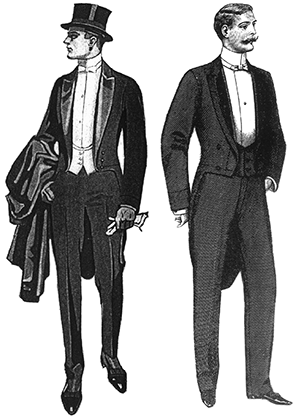
Tuxedo Park is a village in New York, about 50 miles north of New York City in Orange County from which the formal attire of the same name originates. The population was 731 at the 2000 census.The name is derived from a Native American word of the Lenape language, tucsedo, which means either ‘place of the bear’ or ‘clear flowing water.’ Tuxedo Park is a village within the southern part of the Town of Tuxedo (pop. 3,334).
read more »
Posted in Art, Language, Money |
Leave a Comment »
February 13, 2011

A skeuomorph [skyoo-uh-mawrf] is a derivative object that retains ornamental design cues to a structure that was necessary in the original. They may be deliberately employed to make the new look comfortably old and familiar, such as copper cladding on zinc pennies or computer printed postage with circular town name and cancellation lines. Historically, high-status items, such as metal tableware, were often recreated for the mass market using ceramics, which were a cheaper material. In certain cases, efforts were made to recreate the rivets in the metal originals by adding pellets of clay to the pottery version.
In the modern era, cheaper plastic items often attempt to mimic more expensive wooden and metal products though they are only skeuomorphic if new ornamentation references original functionality, such as molded screw heads in molded plastic items. Blue jeans have authentic-looking brass rivet caps covering the functional steel rivet beneath, and a pocket watch pocket; digital cameras play a recorded audio clip of a conventional SLR camera mirror slap and shutter opening and closing. Such ornamentation is not necessarily non-functional: the watch pocket is now used for coins, and the camera shutter sound is used to indicate to subject and photographer when the taking of the picture is complete.
Posted in Language, Money, Technology |
Leave a Comment »
February 13, 2011

The Levant [li-vant] describes, traditionally, the Eastern Mediterranean at large, but can be used as a geographical term that denotes a large area in Western Asia formed by the lands bordering the eastern shores of the Mediterranean, roughly bounded on the north by the Taurus Mountains, on the south by the Arabian Desert, and on the west by the Mediterranean Sea, while on the east it extends towards the Zagros Mountains. The Levant includes modern Lebanon, Syria, Jordan, Israel and the Palestinian territories, similar to the historic area called Syria or Greater Syria. Occasionally Cyprus, Sinai and Iraq are included.
Posted in Language, World |
Leave a Comment »
February 13, 2011

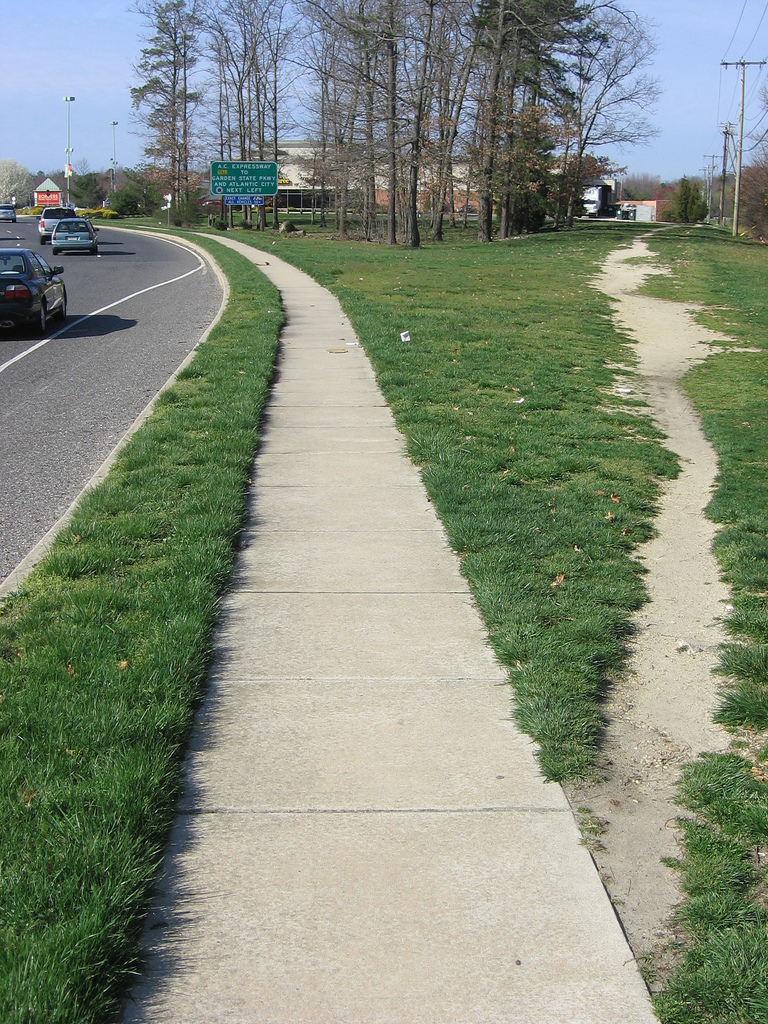
A desire path (also known as a social trail) is a path developed by erosion caused by animal or human footfall. The path usually represents the shortest or most easily navigated route between an origin and destination. The width and amount of erosion of the line represents the amount of demand. Desire paths can usually be found as shortcuts where constructed pathways take a circuitous route.
Posted in Language |
1 Comment »
February 12, 2011


Borscht Belt, or Jewish Alps, is a colloquial term for the mostly defunct summer resorts of the Catskill Mountains in upstate New York that were a popular vacation spot for New York City Jews from the 1920s through the 1960s. The name comes from borscht, a beet soup that is popular in many Central and Eastern European countries and was brought from these regions by Ashkenazi Jewish and Slavic immigrants to the United States, where it remains a popular dish in these ethnic communities as well.
read more »
Posted in Humor, Language, Money |
Leave a Comment »
February 12, 2011

The Geneva drive is a gear mechanism that translates a continuous rotation into an intermittent rotary motion. The rotating drive wheel has a pin that reaches into a slot of the driven wheel advancing it by one step. The drive wheel also has a raised circular blocking disc that locks the driven wheel in position between steps. The name derives from the device’s earliest application in mechanical watches, Switzerland and Geneva being an important center of watchmaking. The geneva drive is also commonly called a Maltese cross mechanism due to the visual resemblance.
Posted in Language, Technology |
Leave a Comment »
February 12, 2011

A script kiddie or skiddie, is a derogatory term used to describe those who use scripts or programs developed by others to attack computer systems and networks and deface websites. Script kiddies have at their disposal a large number of effective, easily downloadable malicious programs capable of breaching computers and networks.
They vandalize websites both for the thrill of it and to increase their reputation among their peers, but they lack, or are only developing, coding skills sufficient to understand the effects and side effects of their work. As a result, they leave significant traces which lead to their detection, or directly attack companies which have detection and countermeasures already in place.
Posted in Language, Technology |
Leave a Comment »
February 11, 2011
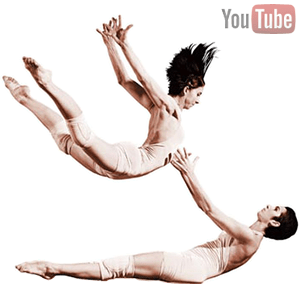
In ballet, a pas de deux [pahduh due] (French, steps of two) is a duet in which ballet dancers perform the dance together. It usually consists of an entrée (introduction), adagio (a slow portion), two variations (one for each dancer), and a coda (literally ‘tail’). The coda is a passage which brings a movement or a separate piece to a conclusion. In ballet, the coda is usually the ‘Finale,’ a set of dances known as the Grand Pas or Grand Pas d’action and brings almost all the dancers onto the stage. A particularly large or complex coda may be called a coda Grande.
Posted in Art, Language |
Leave a Comment »
February 11, 2011

Omni wheels (or poly wheels) are wheels with small discs around the circumference which are perpendicular to the rolling direction. The effect is that the wheel will roll with full force, but will also slide laterally with great ease. These wheels are often employed in holonomic drive systems (those with ability to move in all direction and rotate independently). Although omniwheels are capable of movement in many directions, they are not true omni-directional wheels, a classification reserved for spherical wheels such as ball transfer units.
A platform employing three omni wheels in a triangular configuration is generally called Kiwi Drive. The Killough platform is similar; so named after Stephen Killough’s work with omnidirectional platforms at Oak Ridge National Laboratory. They are often used in small robots. In leagues such as Robocup, many robots use these wheels to have the ability to move in all directions. Omniwheels combined with conventional wheels provide interesting performance properties, such as on a six wheel vehicle employing two conventional wheels on a center axle and four omniwheels on front and rear axles.
Posted in Language, Technology |
Leave a Comment »
February 10, 2011

Shoegazing (also known as shoegaze) is a subgenre of alternative rock that emerged from the United Kingdom in the late 1980s. It lasted there until the mid 1990s, with a critical zenith reached in 1990 and 1991. The British music press named this style shoegazing because the musicians in these bands stood relatively still during live performances in a detached, introspective, non-confrontational state, hence the idea that they were gazing at their shoes. The heavy use of effects pedals also contributed to the image of performers looking down at their feet (shoegazing) during concerts.
Posted in Art, Language |
Leave a Comment »
February 10, 2011

Ingsoc is the political ideology of the totalitarian government of Oceania in George Orwell’s dystopian science fiction novel ‘Nineteen Eighty-Four.’ Ingsoc (‘English Socialism’) originated after the socialist party took over, but, because The Party continually rewrites history, it is impossible to establish the precise origin of the movement. Ingsoc demands the complete submission – mental, moral and physical – of the people, and will torture to achieve it. It is a masterfully complex system of psychological control that compels confession to imagined crimes and the forgetting of rebellious thought in order to love ‘Big Brother’ and The Party over oneself.
From the novel: ‘The German Nazis and the Russian Communists came very close to us in their methods, but they never had the courage to recognize their own motives. They pretended, perhaps they even believed, that they had seized power unwillingly and for a limited time, and that just round the corner there lay a paradise where human beings would be free and equal. We are not like that. We know that no one ever seizes power with the intention of relinquishing it. Power is not a means, it is an end. One does not establish a dictatorship in order to safeguard a revolution; one makes the revolution in order to establish the dictatorship. The object of persecution is persecution. The object of torture is torture. The object of power is power.’
Posted in Language, Politics |
Leave a Comment »



 The Daily Omnivore