February 12, 2011

The Geneva drive is a gear mechanism that translates a continuous rotation into an intermittent rotary motion. The rotating drive wheel has a pin that reaches into a slot of the driven wheel advancing it by one step. The drive wheel also has a raised circular blocking disc that locks the driven wheel in position between steps. The name derives from the device’s earliest application in mechanical watches, Switzerland and Geneva being an important center of watchmaking. The geneva drive is also commonly called a Maltese cross mechanism due to the visual resemblance.
Posted in Language, Technology |
Leave a Comment »
February 12, 2011

A script kiddie or skiddie, is a derogatory term used to describe those who use scripts or programs developed by others to attack computer systems and networks and deface websites. Script kiddies have at their disposal a large number of effective, easily downloadable malicious programs capable of breaching computers and networks.
They vandalize websites both for the thrill of it and to increase their reputation among their peers, but they lack, or are only developing, coding skills sufficient to understand the effects and side effects of their work. As a result, they leave significant traces which lead to their detection, or directly attack companies which have detection and countermeasures already in place.
Posted in Language, Technology |
Leave a Comment »
February 11, 2011
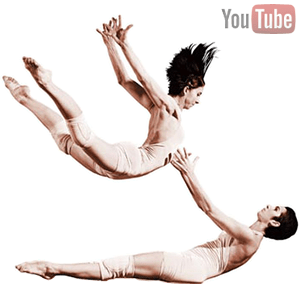
In ballet, a pas de deux [pahduh due] (French, steps of two) is a duet in which ballet dancers perform the dance together. It usually consists of an entrée (introduction), adagio (a slow portion), two variations (one for each dancer), and a coda (literally ‘tail’). The coda is a passage which brings a movement or a separate piece to a conclusion. In ballet, the coda is usually the ‘Finale,’ a set of dances known as the Grand Pas or Grand Pas d’action and brings almost all the dancers onto the stage. A particularly large or complex coda may be called a coda Grande.
Posted in Art, Language |
Leave a Comment »
February 11, 2011

Omni wheels (or poly wheels) are wheels with small discs around the circumference which are perpendicular to the rolling direction. The effect is that the wheel will roll with full force, but will also slide laterally with great ease. These wheels are often employed in holonomic drive systems (those with ability to move in all direction and rotate independently). Although omniwheels are capable of movement in many directions, they are not true omni-directional wheels, a classification reserved for spherical wheels such as ball transfer units.
A platform employing three omni wheels in a triangular configuration is generally called Kiwi Drive. The Killough platform is similar; so named after Stephen Killough’s work with omnidirectional platforms at Oak Ridge National Laboratory. They are often used in small robots. In leagues such as Robocup, many robots use these wheels to have the ability to move in all directions. Omniwheels combined with conventional wheels provide interesting performance properties, such as on a six wheel vehicle employing two conventional wheels on a center axle and four omniwheels on front and rear axles.
Posted in Language, Technology |
Leave a Comment »
February 10, 2011

Shoegazing (also known as shoegaze) is a subgenre of alternative rock that emerged from the United Kingdom in the late 1980s. It lasted there until the mid 1990s, with a critical zenith reached in 1990 and 1991. The British music press named this style shoegazing because the musicians in these bands stood relatively still during live performances in a detached, introspective, non-confrontational state, hence the idea that they were gazing at their shoes. The heavy use of effects pedals also contributed to the image of performers looking down at their feet (shoegazing) during concerts.
Posted in Art, Language |
Leave a Comment »
February 10, 2011

Ingsoc is the political ideology of the totalitarian government of Oceania in George Orwell’s dystopian science fiction novel ‘Nineteen Eighty-Four.’ Ingsoc (‘English Socialism’) originated after the socialist party took over, but, because The Party continually rewrites history, it is impossible to establish the precise origin of the movement. Ingsoc demands the complete submission – mental, moral and physical – of the people, and will torture to achieve it. It is a masterfully complex system of psychological control that compels confession to imagined crimes and the forgetting of rebellious thought in order to love ‘Big Brother’ and The Party over oneself.
From the novel: ‘The German Nazis and the Russian Communists came very close to us in their methods, but they never had the courage to recognize their own motives. They pretended, perhaps they even believed, that they had seized power unwillingly and for a limited time, and that just round the corner there lay a paradise where human beings would be free and equal. We are not like that. We know that no one ever seizes power with the intention of relinquishing it. Power is not a means, it is an end. One does not establish a dictatorship in order to safeguard a revolution; one makes the revolution in order to establish the dictatorship. The object of persecution is persecution. The object of torture is torture. The object of power is power.’
Posted in Language, Politics |
Leave a Comment »
February 9, 2011

A bat phone, in business jargon, is a private telephone number that is handled at a higher priority than a public line. The name derives from Commissioner Gordon’s secure line to the ‘Batphone’ in the Batman television show of 1966–68. Bat phones are common in many industries. The phone numbers are typically given to key customers so that they may reach important individuals in case of emergencies or critical situations. Bat phones can also provide direct access to politicians or notable people.
Another example of their use is for Internet service providers offering a selection of Internet services that range from dial-up access to secure web server hosting. Customers using the secure web hosting facility would be given access to a 24-hour bat phone for prompt resolution of technical issues, while dialup customers seeking technical support would be required to wait on hold and/or call only during business hours.
Posted in Art, Language, Technology |
Leave a Comment »
February 8, 2011

Joe Cool could refer to: Snoopy of Peanuts fame, whose aliases included Joe Cool, generally while wearing dark sunglasses and hanging around the student union. Joe Montana, a former NFL quarterback who earned the nickname for his undaunted poise in adverse, high-pressure game situations. Or, a New-York-based jazz-fusion band of the 1980’s featuring Rob Mounsey, Jeff Mironov, Will Lee, and Christopher Parker.
Posted in Art, Humor, Language |
Leave a Comment »
February 8, 2011

Coitus reservatus (also known as sexual continence) is commonly thought of as a form of sexual intercourse in which the man does not attempt to ejaculate within his partner, but instead attempts to remain at the plateau phase of intercourse for as long as possible avoiding the orgasm and seminal emission. Another term used for this kind of relationship is the word karezza.
Posted in Language, Sex |
Leave a Comment »
February 8, 2011

Neotantra is a term used to describe the modern, western use of the word Tantra (one of the later Hindu or Buddhist scriptures dealing especially with techniques and rituals including meditative and sexual practices). Neotantra refers to both the New Age and modern Western interpretations of traditional Indian tantra. Some of its proponents refer to ancient and traditional texts and principles, and many others use tantra as a catch-all phrase for ‘sacred sexuality,’ and may incorporate unorthodox practices. In addition, not all of the elements of Indian tantra are used in neotantric practices, in particular the reliance on a guru, or teacher.
Posted in Language, Philosophy, Sex |
Leave a Comment »
February 8, 2011
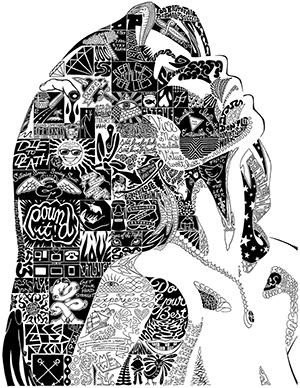
La petite mort, French for ‘the little death,’ is a metaphor for orgasm. More widely, it can refer to the spiritual release that comes with orgasm or to a short period of melancholy or transcendence as a result of the expenditure of the ‘life force,’ the feeling whereof is caused by the release of oxytocin in the brain after the occurrence of the orgasm. The term does not only apply to sexual experiences.
Literary critic Roland Barthes spoke of la petite mort as the chief objective of reading literature. He metaphorically used the concept to describe the feeling one should get when experiencing any great literature. It can also be used when some undesired thing has happened to a person and has affected them so much that ‘a part of them dies inside.’
Posted in Language, Sex, World |
Leave a Comment »
February 8, 2011
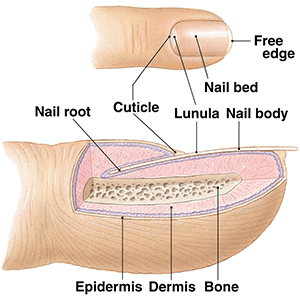
The lunula [loo-nyuh-luh] (‘little moon’ in Latin) is the crescent-shaped whitish area of the bed of a fingernail or toenail. The lunula is the visible part of the nail matrix (i.e. the root of the nail). In humans, it appears by week 14 of gestation, and has a primary structural role in defining the free edge of the distal nail plate (the part of the nail that grows outward). The lunula is most noticeable on the thumb, however, not everyone’s lunula is visible. In some cases, the eponychium may partially or completely cover the lunula.
It is located at the end of the nail (that is closest to the skin of the finger), but it still lies under the nail. It is not actually white, but it only appears so, when it is seen through the nail. Outlining the nail matrix, the lunula is a very delicate part of the nail structure. If one damages the lunula, the nail will permanently be deformed. Even when the totality of the nail is removed, the lunula remains in place and is similar in appearance to another smaller fingernail embedded in the nail bed.
Posted in Health, Language, Science |
Leave a Comment »