December 7, 2010

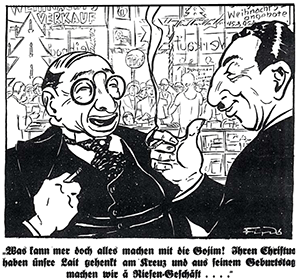
Der Stürmer (literally, ‘The Stormer;’ or more accurately, ‘The Attacker’) was a weekly Nazi newspaper published from 1923 to the end of World War II in 1945. It was a significant part of the Nazi propaganda machinery and was vehemently anti-Semitic. Unlike the ‘Völkischer Beobachter’ (‘The People’s Observer’), the official party paper which gave itself an outwardly serious appearance, the tabloid-style ‘Der Stürmer’ often ran obscene materials such as anti-Semitic caricatures and accusations of blood libel, pornography, anti-Catholic, anti-capitalist and anti-reactionary propaganda. The paper originated at Nuremberg; the first copy was published April 20, 1923. Its circulation grew over time, distributing to a large percentage of the German population as well as Argentina, Brazil, Canada and the United States.
‘Der Stürmer’ was best-known for its effective anti-semitic caricatures, which revealed Jews as ugly characters with exaggerated facial features and misshapen bodies. Many of these drawing were the work of Philipp Rupprecht, known as Fips, who was one of the best-known anti-Semitic cartoonists, his virulent attacks wedding ‘Jewish capitalists’ with ‘Jewish Communism.’ At the bottom of the title page there was always the motto ‘Die Juden sind unser Unglück!’ (‘The Jews are our misfortune!’), coined by German historian, Heinrich von Treitschke in the 1880s. The paper’s other motto was: ‘Deutsches Wochenblatt zum Kampfe um die Wahrheit’ (‘German Weekly Newspaper in the Fight for Truth’).
Posted in Language, Politics, War |
Leave a Comment »
December 7, 2010

A folk devil is a person or group of people who are portrayed in folklore or the media as outsiders and deviant, and are blamed for crimes or other sorts of social problems. The pursuit of folk devils frequently intensifies into a mass movement that is called a moral panic. When a moral panic is in full swing, the folk devils are the subject of loosely organized but pervasive campaigns of hostility through gossip and the spreading of urban legends. The concept of the folk devil was introduced by sociologist Stanley Cohen in 1972, in his study ‘Folk Devils and Moral Panics,’ which analyzed media controversies concerning the Mods and Rockers subcultures in the United Kingdom of the 1960s.
The basic pattern of agitations against folk devils can be seen in the history of witch hunts and similar manias of persecution (Christian Europeans branded adherents of the rival faiths folk devils). Minorities and immigrants have often been seen as folk devils; in the long history of anti-Semitism, which frequently targeted Jews with allegations of dark, murderous practices, such as blood libel; or the Roman persecution of Christians (blaming the military reverses suffered by the Roman Empire on the Christians’ abandonment of paganism). In modern times, political and religious leaders in many nations have sought to present atheists and secularists as deviant outsiders who threaten the social and moral order.
Posted in Language, Politics, War |
Leave a Comment »
December 7, 2010

Tongue-in-cheek is a figure of speech used to imply that a statement or other production is humorously or otherwise not seriously intended, and it should not be taken at face value. The facial expression typically indicates that one is joking or making a mental effort. In the past, it may also have indicated contempt, but that is no longer common. By 1842, the phrase had acquired its contemporary meaning. Early users of the phrase include Sir Walter Scott in his 1828 novel ‘The Fair Maid of Perth.’ The ironic usage originates with the idea of suppressed mirth—biting one’s tongue to prevent an outburst of laughter.
Putting one’s tongue into a cheek was formerly used to signify contempt. For example, in Scottish author Tobias George Smollett’s ‘The Adventures of Roderick Random,’ which was published in 1748, the eponymous hero is taking a coach to Bath and apprehends a highwayman. This provokes an altercation with a less brave passenger: ‘He looked black and pronounced with a faultering voice, ‘O! ’tis very well—damn my blood! I shall find a time.’ I signified my contempt of him by thrusting my tongue in my cheek, which humbled him so much, that he scarce swore another oath aloud during the whole journey.’
Posted in Humor, Language |
Leave a Comment »
December 7, 2010

(With) a grain of salt is a literal translation of a Latin phrase, ‘(cum) grano salis.’ It is often used to show that intelligence and personal judgment are needed, as in ‘I drink wine cum grano salis since I must drive’ (with care, moderately) or ‘please, repair this electric cable cum grano salis’ (aware of the dangers). ‘Cum grano salis’ also means, like in modern English, that something should not be taken too literally. In Italy ‘to have salt on your pumpkin’ (pumpkin being your head) means to have intelligence and reasoning capabilities.
The phrase comes from Pliny the Elder’s ‘Naturalis Historia,’ regarding the discovery of a recipe for an antidote to a poison. In the antidote, one of the ingredients was a grain of salt. Threats involving the poison were thus to be taken ‘with a grain of salt’ and therefore less seriously. An alternative account says that the Roman general Pompey believed he could make himself immune to poison by ingesting small amounts of various poisons, and he took this treatment with a grain of salt to help him swallow the poison. In this version, the salt is not the antidote, it was taken merely to assist in swallowing the poison.
Posted in Food, Humor, Language |
Leave a Comment »
December 7, 2010

Pruno, or prison wine, is an alcoholic liquid variously made from apples, oranges, fruit cocktail, ketchup, sugar, and possibly other ingredients, including bread. Pruno originated in (and remains largely confined to) prisons, where it can be produced cheaply, easily, and discreetly. The concoction can be made using only a plastic bag, hot running water, and a towel or sock to conceal the pulp during fermentation. The end result has been colorfully described as a ‘vomit-flavored wine-cooler.’ Depending on the time spent fermenting, the sugar content, and the quality of the ingredients and preparation, pruno’s alcohol content by volume can range from 2 – 14%.
Typically, the fermenting mass of fruit — called the motor in prison parlance (from ‘promoter’) – is retained from batch to batch to make the fermentation start faster. Increasing sugar results in more alcohol until the waste products of fermentation kill the motor. This also causes the taste of the end product to suffer. Ascorbic acid or Vitamin C powder is sometimes used to stop the fermentation, which, combined with the tartness of the added acid, counteracts the cloyingly sweet flavor. In an effort to eradicate pruno, some wardens have gone as far as banning all fresh fruit from prison cafeterias. In such cases, inmates often resort to using sauerkraut and orange juice.
Posted in Drugs, Food, Language |
2 Comments »
December 6, 2010

Skiffle is a type of popular music with jazz, blues, folk, roots and country influences, usually using homemade or improvised instruments. Originating as a term in the United States in the first half of the twentieth century, it became popular again in the UK in the 1950s, where it was mainly associated with musician Lonnie Donegan and played a major part in beginning the careers of later eminent jazz, pop, blues, folk and rock musicians.
Improvised jug bands playing blues and jazz were common across the American South in the early decades of the twentieth century. They used instruments such as the washboard, jugs, tea chest bass, cigar-box fiddle, musical saw, and comb-and-paper kazoos, as well as more conventional instruments such as acoustic guitar and banjo.The term skiffle was originally one of many slang phrases for a rent party, a social event with a small charge designed to pay rent on a house.
Posted in Art, Language |
Leave a Comment »
December 3, 2010

In 1938 American engineer, Buckminster Fuller coined the term ephemeralization to describe the increasing tendency of physical machinery to be replaced by what is now called software. It describes the ability of technological advancement to do ‘more and more with less and less until eventually you can do everything with nothing.’ Fuller’s vision was that ephemeralization will result in ever-increasing standards of living for an ever-growing population despite finite resources. The concept is a counterargument to Malthusian philosophy, where that the dangers of population growth (famine, disease, etc.) would preclude endless progress towards a utopian society.
Fuller uses Henry Ford’s assembly line as an example of how ephemeralization can continuously lead to better products at lower cost with no upper bound on productivity. Another example is found in length measurement technologies: ruler > rod > rope > telescope > radio. The technological progression is a continuing increase in length-measuring ability per pound of instrument, with no apparent upper limit according to Fuller. However, increasing system complexity and information overload make it difficult and stressful for the people who must control the ephemeralized systems. This can negate the advantages of ephemeralization.
Posted in Language, Technology |
Leave a Comment »
December 1, 2010
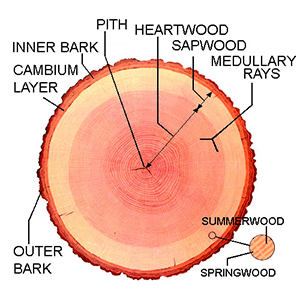
Pith is a substance that is found in vascular plants. It consists of soft, spongy cells, and is located either in the center of the stem or the center of the roots in flowering plants. It is encircled by a ring of xylem (woody tissue), and outside that, a ring of phloem (bark tissue). In some plants the pith is solid, but for most it is soft. A few plants, such as walnuts, have distinctive chambered pith with numerous short cavities.
The word comes from the Old English word piþa, meaning substance, akin to Middle Dutch pit, meaning the pit of a fruit. The modern word pithy (concise and forcefully expressive) derives from it. The inner rind of citrus fruits and other hesperidium is also called pith. The pith and the peel are where about three quarters of the nutrients of an orange are. The pith itself is bitter and is usually added to marmalade or otherwise prepared to be eaten.
Posted in Language, Science |
Leave a Comment »
December 1, 2010


Teetotalism [tee-toht-l-iz-uhm] refers to either the practice of or the promotion of complete abstinence from alcoholic beverages. A person who practices or advocates teetotalism is called a teetotaler (plural teetotalers or teetotalli). The teetotalism movement was first started in Preston, England in the early 19th century. Some common reasons for choosing teetotalism are religious, health, family, philosophical, or social reasons, and, sometimes, as simply a matter of taste or preference.
Contemporary and colloquial usage has somewhat expanded teetotalism to include strict abstinence from most recreational intoxicants (legal and illegal). Most teetotaler organizations also demand from their members that they do not promote or produce alcoholic intoxicants.
read more »
Posted in Drugs, Language, Politics |
Leave a Comment »
November 30, 2010

Hedcut is a term referring to a style of drawing, associated with ‘The Wall Street Journal’ half-column portrait illustrations. They use the stipple method of many small dots and the hatching method of small lines to create an image, and are designed to emulate the look of woodcuts from old-style newspapers, and engravings on certificates and currency. The phonetic spelling of ‘hed’ may be based on newspapers’ use of the term ‘hed’ for ‘headline.’ The ‘Wall Street Journal’ adopted the current form of this portraiture in 1979 when freelance artist Kevin Sprouls approached the paper with some ink dot illustrations he’d created. The front page editor felt that the drawings complemented the paper’s classical feeling and gave it a sense of stability. Additionally, they are generally more legible than photographs of the same size would be.
Sprouls was subsequently hired as a staff illustrator and remained there until 1987. Today, there are six hedcut artists on staff. Each drawing takes between three and five hours to produce. First, a high quality photograph must be secured. This photograph is scanned, converted to grayscale, and the contrast is adjusted. The photograph is then printed and placed on a light table, and overlaid with tracing vellum. The illustrators then trace directly over this image with ink pens, recreating the source photo using specific dot and line patterns. Women are sometimes more difficult to depict than men as they tend to have more complicated haircuts, which are often cropped for simplicity.
Posted in Art, Language |
Leave a Comment »
November 22, 2010

At sufficiently high doses of the drug ketamine (half a gram or more), it is common to experience a ‘K-hole.’ This is a slang term for a state of dissociation from the body which may mimic the phenomenology of schizophrenia. Experience of the K-hole may include distortions in bodily awareness, such as the feeling that one’s body is being tugged, or is gliding on silk, flying, or has grown very large or distended. Users have reported the sensation of their soul leaving their human body.
read more »
Posted in Drugs, Language, Science |
Leave a Comment »
November 22, 2010
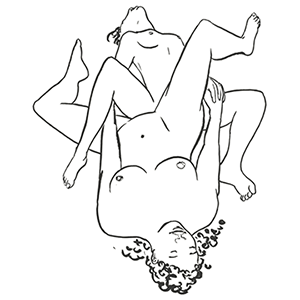
Tribadism [trib-uh-diz-uhm] (also known as tribbing or scissoring) is a form of non-penetrative sex in which a woman rubs her vulva against her partner’s body for sexual stimulation. This may involve female-to-female genital contact or a female rubbing her vulva against her partner’s thigh, arm, palm or stomach, and does not always reflect a scissoring motion (a missionary position may also be acted upon); the term can also refer to a masturbation technique in which a woman rubs her vulva against an inanimate object such as a bolster, in an effort to achieve orgasm.
In the sexuality of the ancient Romans, a tribas (a Greek loan-word) was a woman or hermaphrodite who actively penetrated another woman. Until the 20th century, the term was used to refer to lesbian sexual practices in general. Therefore, lesbians were occasionally called tribades. This position is not exclusive to humans. Female bonobo monkeys, found in the Democratic Republic of the Congo, also engage in female-female genital sex, usually known as GG rubbing (genito-genital).
Posted in Language, Sex |
Leave a Comment »





