November 9, 2010

A spider hole is U.S. military parlance for a camouflaged one-man foxhole, used for observation. They are typically a shoulder-deep, protective, round hole, often covered by a camouflaged lid, in which a soldier can stand and fire a weapon. A spider hole differs from a foxhole in that a foxhole is usually deeper and designed to emphasize cover rather than concealment.
The term is usually understood to be an allusion to the camouflaged hole constructed by the trapdoor spider. According to United States Marine Corps historian Major Chuck Melson, the term originated in the American Civil War, when it meant a hastily-dug foxhole. Spider holes were used during World War II by Japanese forces in many Pacific battlefields, including Leyte in the Philippines and Iwo Jima. The Japanese called them ‘octopus pots.’ On 13 December 2003, U.S. troops in Iraq undertaking Operation Red Dawn discovered Iraqi dictator Saddam Hussein hiding in what was characterized as a spider hole in a farmhouse near his hometown of Tikrit.
Posted in Language, War, World |
Leave a Comment »
November 8, 2010

Agnotology is the study of culturally-induced ignorance or doubt, particularly the publication of inaccurate or misleading scientific data. The neologism was coined by Robert N. Proctor, a Stanford University professor specializing in the history of science and technology. More generally, the term also highlights the increasingly common condition where more knowledge of a subject leaves one more uncertain than before. Proctor studied the tobacco industry’s conspiracy to manufacture doubt about the cancer risks of tobacco use. Under the banner of science, the industry produced research about everything except tobacco hazards to exploit public uncertainty.
Some of the root causes for culturally-induced ignorance are media neglect, corporate or governmental secrecy and suppression, document destruction, and myriad forms of inherent or avoidable culturopolitical selectivity, inattention, and forgetfulness. Agnotology also focuses on how and why diverse forms of knowledge do not ‘come to be’,’ or are ignored or delayed. For example, knowledge about plate tectonics was delayed for at least a decade because key evidence was classified military information related to underseas warfare.
Posted in Language, Science |
Leave a Comment »
November 8, 2010

A snowclone is a type of cliché and phrasal template originally defined as ‘a multi-use, customizable, instantly recognizable, time-worn, quoted or misquoted phrase or sentence that can be used in an entirely open array of different variants.’
An example of a snowclone is ‘grey is the new black,’ a version of the template ‘X is the new Y.’ Both the generic formula and the new phrases produced from it are called snowclones.
read more »
Posted in Language |
Leave a Comment »
November 8, 2010
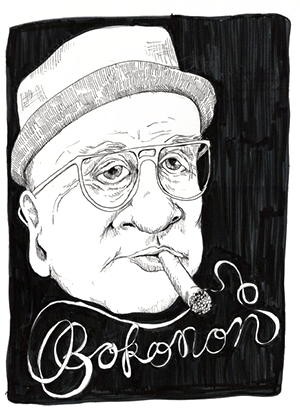
Bokononism is a fictional religion practiced by many of the characters in Kurt Vonnegut’s novel ‘Cat’s Cradle.’ It is based on the concept of ‘foma,’ which are defined as harmless untruths. The primary tenet of Bokononism is to ‘Live by the foma that make you brave and kind and healthy and happy.’
Many of the sacred texts of Bokononism were written in the form of calypsos. The foundation of Bokononism is that all religion, including Bokononism and all its texts, is formed entirely of lies; however, one who believes and adheres to these lies will at least have peace of mind, and perhaps live a good life.
read more »
Posted in Humor, Language, Philosophy |
Leave a Comment »
November 8, 2010

In the novel Nineteen Eighty-Four, doublethink is the act of simultaneously accepting as correct two mutually contradictory beliefs. It is related to, but distinct from, hypocrisy and neutrality. Its opposite is cognitive dissonance, where the two beliefs cause conflict in one’s mind.
Posted in Language, Politics |
Leave a Comment »
November 7, 2010

Progressivism [pruh-gres-uh-viz-uhm] is a political attitude advocating changes or reform through governmental action. Progressivism is often viewed in opposition to conservative or reactionary ideologies. The Progressive Movement began in cities with settlement workers and reformers who were interested in regulating tenement housing and child labor.
read more »
Posted in Language, Politics |
Leave a Comment »
November 7, 2010

Secular Humanism is a philosophy that espouses reason, ethics, and the search for human fulfillment, and specifically rejects supernatural and religious dogma as the basis of morality and decision-making. Secular Humanism is a life stance that focuses on the way human beings can lead happy and functional lives. The term was coined in the 20th century by British worker’s rights advocate George Holyoake.
Fundamental to the concept is the strongly held belief that ideology—be it religious or political—must be examined by each individual and not simply accepted or rejected on faith. Along with this belief, an essential part of Secular Humanism is a continually adapting search for truth, primarily through science and philosophy. The humanist stance emphasises the unique responsibility facing humanity and the ethical consequences of human decisions.
Posted in Language, Philosophy, Politics |
Leave a Comment »
November 4, 2010

A blivet [bliv-it], also known as a poiuyt, devil’s fork or widget, is an undecipherable figure, an optical illusion and an impossible object. It appears to have three cylindrical prongs at one end which then mysteriously transform into two rectangular prongs at the other end.
In traditional U.S. Army slang dating back to the Second World War, a blivet was defined as ‘ten pounds of manure in a five pound bag’ (a proverbial description of anything egregiously ugly or unmanageable); it was applied to an unmanageable situation, a crucial but substandard or damaged tool, or a self-important person. In some areas of the U.S., it refers to a juvenile prank, clearly connected with the original military usage: a sack full of excrement is ignited on the victim’s porch, while the pranksters ring the doorbell and run. The victim attempts to put the flames out by stamping on the bag.
Posted in Humor, Language, Science |
Leave a Comment »
November 4, 2010

A labret [ley-bret] is form of body piercing; taken literally, it is any type of adornment that is attached to the facial lip (labrum). However, the term usually refers to a piercing that is below the bottom lip, above the chin. It is sometimes referred to as a ‘tongue pillar.’ Among the ancient Aztecs and Mayans, labret piercing was reserved for male members of the higher castes. The name derives from the Latin labrum ‘lip’ and the diminutive suffix -et. However, many in the body-piercing industry incorrectly give it a French pronunciation, though it is not a French word.
There are several different labret variations based on precisely where the piercing is positioned on the lower lip. These include a vertical labret (through the top of the lower lip), snake bites (dual piercings close together reminiscent of fangs), spiderbites (dual piercings very close together on the same side of the face), and a lowbret, which is placed as low as possible toward the chin. The initial piercing is usually done at 1.2 , 1.6 or 2.0 mm diameter. After initial healing, the piercing can then be (gradually) further stretched. Some people chose to stretch to sizes over 10 mm, and the jewelry worn at these larger sizes is then usually a round or oval ‘labret plug.’
Posted in Art, Language |
12 Comments »
November 4, 2010

PayPal Mafia is an informal term for the community of American businesspeople and investors centered in Silicon Valley, who were early employees of e-commerce service PayPal before founding a series of other technology companies. Paypal was founded by Max Levchin and Peter Thiel in 1998 and was aquired by eBay for $1.5 billion in 2002. The PayPal Mafia are often credited with inspiring Web 2.0, and for the re-emergence of consumer-focused Internet companies after the dot com bust of 2001.
read more »
Posted in Language, Money, Technology |
Leave a Comment »
November 2, 2010

Pantheism [pan-thee-iz-uhm] is the view that the Universe (Nature) and God are identical. Pantheists thus do not believe in a personal, anthropomorphic or creator god. Although there are divergences within Pantheism, the central ideas found in almost all versions are the Cosmos as an all-encompassing unity and the sacredness of Nature.
The term ‘pantheist’ — from which the word ‘Pantheism’ was derived — was purportedly first used in English by Irish writer John Toland in his 1705 work, ‘Socinianism Truly Stated, by a pantheist.’ However, many earlier writers, schools of philosophy, and religious movements expressed pantheistic ideas such as Heraclitus and Anaximander, and the early Taoism of Laozi and Zhuangzi is also pantheistic.
Posted in Language, Philosophy |
Leave a Comment »
October 27, 2010

The clean and jerk is one of two olympic weightlifting events (the other being the snatch). It is a highly technical lift that is known as ‘the king of lifts’ because more weight can be lifted above one’s head as compared to any other known weightlifting technique. The clean portion of the lift refers to the lifter explosively pulling the weight from the floor to a racked position across deltoids and clavicles.
In early twentieth century weightlifting competitions, a variant movement called the ‘Continental’ (because it was practiced by Germans rather than the British) allowed the lifter to pull the barbell up to his belt, where it could rest. Then with several successive flips, the bar would be moved up the torso until it reached the position for the overhead jerk. The Continental gained a reputation as clumsy, slow, and nonathletic compared to the swift coordinated movement required to lift the bar ‘clean.’ Hence, the clean movement was adopted by the early weightlifting federations as the official movement.
Posted in Games, Health, Language |
Leave a Comment »




 The Daily Omnivore