January 18, 2016

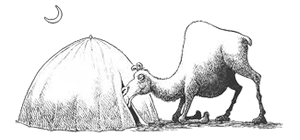
For Want of a Nail is a proverb, having numerous variations over several centuries, reminding that seemingly unimportant acts or omissions can have grave and unforeseen consequences: ‘For want of a nail the shoe was lost. For want of a shoe the horse was lost. For want of a horse the rider was lost. For want of a rider the message was lost. For want of a message the battle was lost. For want of a battle the kingdom was lost. And all for the want of a horseshoe nail.’
The earliest reference to the full proverb may refer to the death of Richard III of England at the Battle of Bosworth Field in 1485. This short variation of the proverb was published in ‘Fifty Famous People’ by James Baldwin. Richard III is unhorsed in the rhyme, but, historically Richard’s horse was merely mired in the mud. The reference to losing a horse is directly linked to the titular character famously shouting ‘A Horse! A Horse! My Kingdom for a Horse!,’ in Shakespeare’s ‘Richard III’ (c. 1591).
read more »
Posted in Language, Philosophy, War |
Leave a Comment »
January 5, 2016

In rhetoric, parrhesia [puh-reez-ee-uh] refers to speaking candidly or asking forgiveness for so speaking. Its nominal form, is translated from Latin to ‘free speech.’ The term first appears in Greek literature in the tragic plays of ‘Euripides.’ The term is borrowed from the Greek word meaning ‘to speak everything’ and by extension ‘to speak freely,’ ‘to speak boldly,’ or ‘boldness.’ It implies not only freedom of speech, but the obligation to speak the truth for the common good, even at personal risk.
In Ancient Greece, rhetoric and parrhesia were understood to be in opposition of each other through the dialogues written by Plato. There are two major philosophies during this time one being Sophistry and one being Dialectic. Sophistry is most commonly associated with the uses of rhetoric or means of persuasion to teach or persuade an audience. In its opposition is the practice of dialectic, supported by Plato and his mentor Socrates, which practices using dialogue to break apart complex issues in search of absolute truth or knowledge.
read more »
Posted in Language, Philosophy, Politics |
Leave a Comment »
January 1, 2016

Visual brand language is the unique ‘alphabet’ of design elements – such as shape, color, materials, finish, typography and composition – which directly and subliminally communicate a company’s values and personality through compelling imagery and design style. This ‘alphabet,’ properly designed, results in an emotional connection between the brand and the consumer. Visual brand language is a key ingredient necessary to make an authentic and convincing brand strategy that can be applied uniquely and creatively in all forms of brand communications to both employees and customers.
For example, the BMW ‘split grill’ has come to represent the brand. While the grill size and design details evolve over time, the underlying idea is constant and memorable. The use of color is also a powerful associative element for consistent imagery, as exemplified by the comprehensive application of orange by The Home Depot across all its brand materials.
read more »
Posted in Art, Language, Money |
Leave a Comment »
December 10, 2015

Prolefeed is a Newspeak term in the novel ‘Nineteen Eighty-Four’ by George Orwell. It was used to describe the deliberately superficial literature, movies and music that were produced by Prolesec, a section of the Ministry of Truth, to keep the ‘proles’ (i.e., proletariat) content and to prevent them from becoming too knowledgeable. The ruling Party believes that too much knowledge could motivate the proles to rebel against them.
The term is used occasionally to describe shallow entertainment in the real world. For example, Theodore Dalrymple wrote in the ‘The Spectator’ that ‘France …. is less dominated by mass distraction (known here as popular culture, but in ‘Nineteen Eighty-Four’ as prolefeed) than Britain is.’ The term has also been applied to fast food, such as that of McDonald’s: ‘Once seen as the all-American corporation, ‘McDonald’s’ is now shorthand for a globalist mass culture that provides cheap, unhealthy food to lower-class people. McDonald’s is, quite literally, prolefeed. Part of this image was a deliberate choice by the corporation.’
read more »
Posted in Language, Money, Politics |
Leave a Comment »
December 8, 2015

A pastiche [pa-steesh] is a work of visual art, literature, theatre, or music that imitates the style or character of the work of one or more other artists. Unlike parody, pastiche celebrates, rather than mocks, the work it imitates. The word pastiche is a French cognate of the Italian noun ‘pasticcio,’ which is a pâté or pie-filling mixed from diverse ingredients.
Metaphorically, pastiche and pasticcio describe works that are either composed by several authors, or that incorporate stylistic elements of other artists’ work. They are examples of eclecticism in art. Pastiche is sometimes confused with allusion, but a literary allusion may refer to another work, but it does not reiterate it. Moreover, allusion requires the audience to share in the author’s cultural knowledge. Both allusion and pastiche are mechanisms of intertextuality (the shaping of a text’s meaning by another text).
read more »
Posted in Art, Language |
Leave a Comment »
December 2, 2015
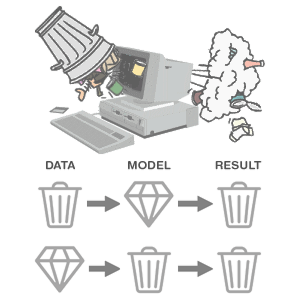
Garbage in, garbage out (GIGO) in the field of computer science or information and communications technology refers to the fact that computers, since they operate by logical processes, will unquestioningly process unintended, even nonsensical, input data (‘garbage in’) and produce undesired, often nonsensical, output (‘garbage out’). The principle applies to other fields as well.
The underlying principle was noted by the inventor of the first programmable computing device design: ‘On two occasions I have been asked, ‘Pray, Mr. Babbage, if you put into the machine wrong figures, will the right answers come out?’ … I am not able rightly to apprehend the kind of confusion of ideas that could provoke such a question.’
read more »
Posted in Humor, Language, Technology |
Leave a Comment »
November 30, 2015

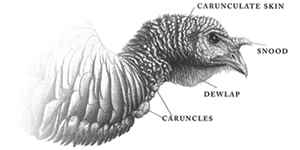
A dewlap [doo-lap] is a longitudinal flap of skin that hangs beneath the lower jaw or neck of many vertebrates. While the term is usually used in this specific context, it can also be used to include other structures occurring in the same body area with a similar aspect, such as those caused by a double chin or the submandibular vocal sac of a frog. In a more general manner, the term refers to any pendulous mass of skin, such as a fold of loose skin on an elderly person’s neck, or the wattle of a bird, a drooping protuberance hanging from various parts of the head or neck.
Many reptiles have dewlaps, most notably the anole species of lizard, which have large skin dewlaps which they can extend and retract. These dewlaps are usually of a different color from the rest of their body and when enlarged make the lizard seem much larger. They display them when indicating territorial boundaries and to attract females. Lizards usually accompany their dewlap movement with head bobs and other displays. Though much uncertainty resides around the purpose of these displays, the color of the dewlap and the head bobs are thought to be a means of contrasting background noise.
read more »
Posted in Language, Science |
Leave a Comment »
November 23, 2015

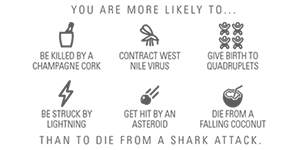
The Summer of the Shark refers to the coverage of shark attacks by American news media in the summer of 2001. The sensationalist coverage of shark attacks began in early July following the Fourth of July weekend shark attack on 8-year-old Jessie Arbogast, and continued almost unabated—despite no evidence for an actual increase in attacks—until the September 11 terrorist attacks shifted the media’s attention away from beaches. The ‘Summer of the Shark’ has since been remembered as an example of tabloid television perpetuating a story with no real merit beyond its ability to draw ratings.
In mid-August, many networks were showing footage captured by helicopters of hundreds of sharks coalescing off the southwest coast of Florida. Beach-goers were warned of the dangers of swimming, despite the fact that the swarm was likely part of an annual shark migration. The repeated broadcasts of the shark group has been criticized as blatant fear mongering, leading to the unwarranted belief of a so-called shark ‘epidemic.’
read more »
Posted in Death, Language, Money |
Leave a Comment »
November 17, 2015
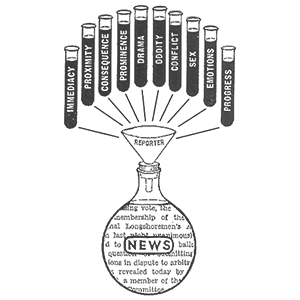
News values, or ‘news criteria,’ determine how much prominence a news story is given by a media outlet, and the attention it garners from its audience. These values are not universal and can vary widely between different cultures. In Western practice, decisions on the selection and prioritization of news are ostensibly made by editors on the basis of their experience and intuition.
However, a seminal analysis by Norwegian sociologists Johan Galtung and Mari Ruge in the ‘Journal of Peace Research’ in 1965 showed that several factors are common, such as familiarity (stories that ‘hit close to home’), negativity (‘if it bleeds, it leads’), and Unexpectedness (‘don’t report on fire in a furnace’). Basing his judgement on many years as a newspaper journalist Tim Hetherington has said that ‘anything which threatens people’s peace, prosperity, and well being is news and likely to make headlines.’
read more »
Posted in Language, Money, Politics |
1 Comment »
November 13, 2015


Political correctness (PC) means using words or behavior which will not offend any group of people. The term arose in the 1970s as a way of encouraging the replacement of bygone phrases such as ‘colored.’ By the 1990s, it had taken on pejorative and mocking overtones, and was described as symptomatic of excessive liberalism and the ‘nanny state.’ The phrase was widely used in the debate about the 1987 book ‘The Closing of the American Mind’ by philosopher Allan Bloom, and gained further currency in response to social commentator Roger Kimball’s ‘Tenured Radicals’ (1990).
Conservative author Dinesh D’Souza’s ‘Illiberal Education’ duology of books (1991, 1992) condemned what he saw as liberal efforts to advance victimization, multiculturalism through language, and affirmative action. Advocates of political correctness, however, argue that libertarians made an issue of the term in order to divert attention from more substantive matters of discrimination and as part of a broader culture war against liberalism. They have also said that the right wing has it own forms of political correctness.
read more »
Posted in Language, Politics |
Leave a Comment »
November 9, 2015

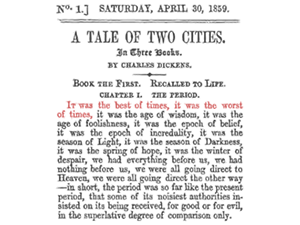
‘Once upon a time‘ is a stock phrase used to introduce a narrative of past events, typically in fairy tales and folktales. It has been used in some form since at least 1380 in storytelling in the English language and has opened many oral narratives since 1600. These stories often then end with ‘and they all lived happily ever after,’ or, originally, ‘happily until their deaths.’
The phrase is particularly common in fairy tales for younger children, where it is almost always the opening line of a tale. It was commonly used in the original translations of the stories of Charles Perrault as a translation for the French ‘il était une fois,’ of Hans Christian Andersen as a translation for the Danish ‘der var engang,’ (literally ‘there was once’), the Brothers Grimm as a translation for the German ‘es war einmal’ (literally ‘it was once’). An alternative German fairy tale opening translates to: ‘Back in the days when it was still of help to wish for a thing…’
Posted in Art, Language |
Leave a Comment »
October 29, 2015

You ain’t gonna need it (YAGNI) is a principle of extreme programming (XP) that states a programmer should not add functionality until deemed necessary. XP co-founder Ron Jeffries said: ‘Always implement things when you actually need them, never when you just foresee that you need them.’ Jeffries argues that prematurely adding features leads to software bloat, feature creep, and takes time away from core functionality improvement.
YAGNI is a principle behind the XP practice of ‘do the simplest thing that could possibly work’ (DTSTTCPW). It is meant to be used in combination with several other practices, such as continuous refactoring (code reorganization), continuous automated unit testing, and continuous integration (conforming code segments work within the larger codebase). However, the efficacy of YAGNI, even when considered in combination with safeguards, is controversial.
Posted in Humor, Language, Technology |
Leave a Comment »



