August 10, 2010


In economics, a monopsony [muh-nop-suh-nee] is a market form in which only one buyer faces many sellers. It is an example of imperfect competition, similar to a monopoly, in which only one seller faces many buyers. As the only purchaser of a good or service, the ‘monopsonist’ may dictate terms to its suppliers in the same manner that a monopolist controls the market for its buyers.
The term was first introduced by Joan Robinson in her influential book, ‘The Economics of Imperfect Competition.’ Robinson credits classics scholar Bertrand Hallward of Peterhouse College, Cambridge with coining the term. A single-payer universal health care system, in which the government is the only ‘buyer’ of health care services, is an example of a monopsony. It has also been argued that Wal-Mart, in the United States, functions as a monopsony in certain market segments, as its buying power for a given item may dwarf the remaining market. The Canadian Wheat Board, established by the Parliament of Canada in 1935 as a producer marketing system, is a monopsonistic buyer of wheat and barley.
Posted in Language, Money, Politics |
Leave a Comment »
August 9, 2010
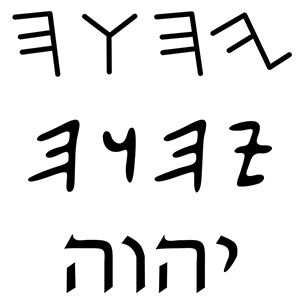
Ineffability [in-ef-fuh-bil-uh-tee] is concerned with ideas that cannot or should not be expressed in spoken words (or language in general), often being in the form of a taboo or incomprehensible term. Illogical statements, principles, reasons, and arguments are intrinsically ineffable along with impossibilities, contradictions, and paradoxes.
Terminology describing the nature of experience cannot be properly conveyed in symbolic language; it is believed that this knowledge is only held by the individual from which it originates. Obscene profanity and vulgarisms, however, can easily (and clearly) be stated – but they simply should not be and so are still considered ineffable.
Posted in Language, Philosophy |
Leave a Comment »
August 9, 2010
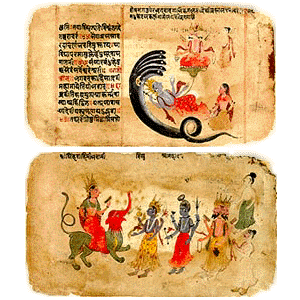
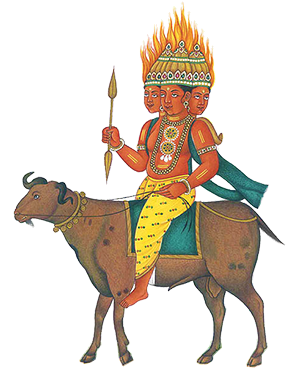
The Vedas [vey-duhs] (Sanskrit for ‘knowledge’) are a large body of texts originating in ancient India, which constitute the oldest Sanskrit literature (1500–1000 BCE) and the oldest scriptures of Hinduism. The texts are aggregated around the four canonical Vedas:.Rig Veda, Sama Veda, Yajur Veda, and Atharva Veda. Together they make up a sacred collection of hymns, incantations, and liturgical rites. The Atharva Veda is less predominant than other Vedas and is little used in solemn ritual. According to Hindu tradition, the Vedas are, ‘not of human agency.’ The individual verses contained in these compilations are known as mantras. Some selected Vedic mantras are still recited at prayers, religious functions and other auspicious occasions in contemporary Hinduism.
The various Indian philosophies and sects have taken differing positions on the Vedas. Schools of Indian philosophy which cite them as their scriptural authority are classified as orthodox. Other traditions, notably Buddhism, Sikhism, and Jainism, which did not regard the Vedas as authorities are referred to by traditional Hindu texts as heterodox schools.
Posted in Language, Philosophy, World |
Leave a Comment »
August 4, 2010
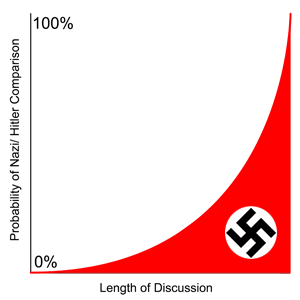
Godwin’s law is a humorous observation made by Mike Godwin in 1990 which has become an Internet adage. It states: ‘As an online discussion grows longer, the probability of a comparison involving Nazis or Hitler approaches 1.’ In other words, given enough time, all discussions —regardless of topic or scope —inevitably wind up being about Hitler and the Nazis. Also the poster who mentioned Nazis loses all debates/discussions they had in said topic, and their insults are nullified. Godwin’s law is often cited in online discussions as a deterrent against the use of arguments in the widespread reductio ad Hitlerum form.
The rule does not make any statement about whether any particular reference or comparison to Adolf Hitler or the Nazis might be appropriate, but only asserts that the likelihood of such a reference or comparison arising increases as the discussion progresses. It is precisely because such a comparison or reference may sometimes be appropriate, Godwin has argued that overuse of Nazi and Hitler comparisons should be avoided, because it robs the valid comparisons of their impact. Although in one of its early forms Godwin’s law referred specifically to Usenet newsgroup discussions, the law is now applied to any threaded online discussion: electronic mailing lists, message boards, chat rooms, and more recently blog comment threads, wiki talk pages, and social networking sites.
Posted in Humor, Language, War |
Leave a Comment »
August 2, 2010
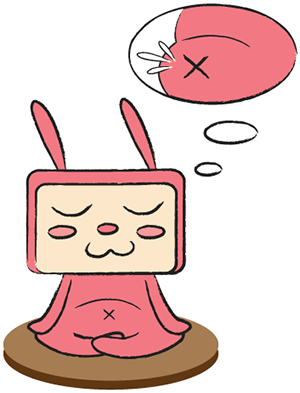
Omphaloskepsis [om-fuh-loh-skep-sis] is the contemplation of one’s navel as an aid to meditation. It can also be used as a pejorative referring to excessive introspection, self-absorption, or concentration on a single issue. This criticism is also often leveled at professions which are interested in themselves (e.g. movies about Hollywood or television shows about television writers). The word has several other forms, such as omphalism used to describe the spiritual practice; omphaloskeptic or omphaloskeptical, for someone who engages in navel-gazing; and omphalocentric meaning to be in a self-absorbed state.
Posted in Language, Philosophy |
Leave a Comment »
August 1, 2010

Sir John Falstaff is a fictional character who appears in three plays by William Shakespeare as a companion to Prince Hal, the future King Henry V. A fat, vainglorious, and cowardly knight, Falstaff leads the apparently wayward Prince Hal into trouble, and is ultimately repudiated after Hal becomes king. To describe someone as falstaffian is to say they are characterized by joviality and conviviality.
Posted in Art, Humor, Language |
Leave a Comment »
July 20, 2010

Dada [dah-dah] or Dadaism is a movement in art and literature based on deliberate irrationality and negation of traditional artistic values. It began in Zürich, Switzerland, during World War I and peaked from 1916 to 1922. The movement primarily involved visual arts, literature—poetry, art manifestoes, art theory—theatre, and graphic design, and concentrated its anti-war politics through a rejection of the prevailing standards in art through anti-art cultural works.
Its purpose was to ridicule what its participants considered to be the meaninglessness of the modern world. In addition to being anti-war, dada was also anti-bourgeois and anarchistic in nature. The movement influenced later styles like the avant-garde and downtown music movements, and groups including surrealism, Nouveau réalisme, pop art, Fluxus and punk rock.
Posted in Art, Language |
Leave a Comment »
July 17, 2010

A kōan [koh-ahn] is a fundamental part of the history and lore of Zen Buddhism. It consists of a story, dialogue, question, or statement, the meaning of which cannot be understood by rational thinking but may be accessible through intuition. One widely known kōan is ‘what is the sound of one hand clapping.’ The word kōan, the name by which practice is known to the West, comes from the Japanese pronunciation of the Chinese characters.
Posted in Language, Philosophy, World |
Leave a Comment »
July 17, 2010

Ylem is a term coined in the late 1940s by cosmologist Ralph Alpher for a hypothetical original substance or condensed state of matter, which became subatomic particles and elements as we understand them today.
Posted in Language, Science |
Leave a Comment »
July 17, 2010

The rod of Asclepius [uh-sklee-pee-uhs] is an ancient symbol associated with astrology, the Greek god Asclepius, and with medicine and healing. It consists of a serpent entwined around a staff. The name of the symbol derives from its early and widespread association with Asclepius, the son of Apollo, who was a practitioner of medicine in ancient Greek mythology. Hippocrates himself was a worshipper of Asclepius.
Posted in Health, Language |
Leave a Comment »
July 17, 2010

The caduceus [kuh-doo-see-uhs] is a herald’s staff, a symbolic object representing Hermes (or the Roman Mercury), and by extension trades, occupations or undertakings associated with the god. It is today typically depicted as a short staff entwined by two serpents in the form of a double helix, and is sometimes surmounted by wings. The caduceus is sometimes used as a symbol of medicine and/or medical practice, especially in North America, due to widespread confusion with the traditional medical symbol, the rod of Asclepius, which has only a single snake and no wings.
Posted in Health, Language |
Leave a Comment »
July 12, 2010

Cryptozoology [krip-toh-zoh-ol-uh-jee] refers to the pseudo-scientific investigation of animals which are considered to be legendary or otherwise nonexistent by mainstream biology.
This includes looking for living examples of animals which are extinct, such as dinosaurs; animals whose existence lacks physical support but which appear in myths, legends, or are reported, such as Bigfoot and Chupacabra; and wild animals dramatically outside of their normal geographic ranges, such as so-called phantom cats. The animals they study are often referred to as cryptids.
Posted in Humor, Language, Science |
Leave a Comment »



 The Daily Omnivore