May 9, 2015
Holy Roller is a derogatory term for some Christian churchgoers of the Methodist, Holiness, and Pentecostal traditions. The term is sometimes used derisively by those outside these denominations, as if to describe people literally rolling on the floor in an uncontrolled manner. However, those within these Wesleyan traditions have reclaimed it as a badge of honor; for example William Branham wrote: ‘And what the world calls today holy-roller, that’s the way I worship Jesus Christ.’ Gospel singer Andrae Crouch stated, ‘They call us holy rollers, and what they say is true. But if they knew what we were rollin’ about, they’d be rollin’ too.’
Merriam-Webster traces the word to 1841. The Oxford English Dictionary cites an 1893 memoir by American humorist Charles Godfrey Leland, in which he says ‘When the Holy Spirit seized them … the Holy Rollers … rolled over and over on the floor.’ Similar disparaging terms directed at outspoken Christians but later embraced by them include ‘Jesus freaks’ or, from former centuries, Methodists, Quakers, and Shakers.
Posted in Language, Philosophy |
Leave a Comment »
May 1, 2015

Leaves of Grass is a collection of poetry by Walt Whitman praising sensuality, the material world, nature, and the experience of the senses. The book was published at Whitman’s own expense in 1855, a period where poetry focused on the soul and organized religion, and was a failure at first. Whitman spent most of his professional life writing and rewriting the book, revising it multiple times until his death. This resulted in vastly different editions over four decades—the first a small book of twelve poems and the last a compilation of over 400.
The collection is notable for its discussion of delight in carnal pleasures during a time when such candid displays were considered immoral. Where much previous poetry, especially English, relied on symbolism, allegory, and meditation on the religious and spiritual, ‘Leaves of Grass’ (particularly the first edition) exalted the physical form and ephemera. Influenced by Ralph Waldo Emerson and the Transcendentalist movement, itself an offshoot of Romanticism, Whitman’s poetry praises nature and the individual’s role in it. However, much like Emerson, Whitman does not diminish the role of the mind or the spirit; rather, he elevates the human form and mind, deeming both worthy of poetic praise.
read more »
Posted in Art, Language, Philosophy |
Leave a Comment »
April 28, 2015

An anti-proverb or a ‘perverb’ is the transformation of a standard proverb for humorous effect. Paremiologist (proverb scholar) Wolfgang Mieder defines them as ‘parodied, twisted, or fractured proverbs that reveal humorous or satirical speech play with traditional proverbial wisdom.’ They have also been defined as ‘an allusive distortion, parody, misapplication, or unexpected contextualization of a recognized proverb, usually for comic or satiric.’
To have full effect, an anti-proverb must be based on a known proverb. For example, ‘If at first you don’t succeed, quit’ is only funny if the hearer knows the standard proverb ‘If at first you don’t succeed, try, try again.’ Anti-proverbs are used commonly in advertising, such as ‘Put your burger where your mouth is’ from Red Robin. Anti-proverbs are also common on T-shirts, such as ‘Taste makes waist’ and ‘If at first you don’t succeed, skydiving is not for you.’
read more »
Posted in Humor, Language |
2 Comments »
April 23, 2015
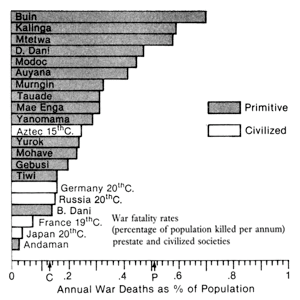
‘War Before Civilization: the Myth of the Peaceful Savage’ is a 1996 book by Lawrence H. Keeley, an archeology professor at the University of Illinois at Chicago who specializes in prehistoric Europe. The book deals with warfare conducted throughout human history by societies with little technology. In the book, Keeley aims to stop the apparent trend in seeing civilization as bad.
According to Keeley, modern western societies are not more violent or war-prone than (historical) tribes. He conducted an investigation of the archaeological evidence for prehistoric violence, including murder and massacre as well as war. He also looked at nonstate societies of more recent times. It has long been known, for example, that many tribes of South America’s tropical forest engage in frequent and horrific warfare, but some scholars had attributed their addiction to violence to baneful Western influences.
read more »
Posted in Death, Language, War |
Leave a Comment »
April 17, 2015
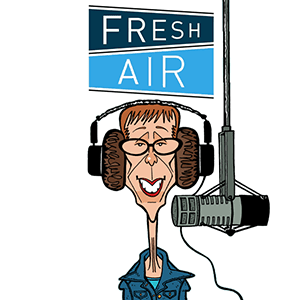
Terry Gross (b. 1951) is the host and co-executive producer of ‘Fresh Air,’ an interview format radio show produced by ‘WHYY-FM,’ the flagship National Public Radio (NPR) station in Philadelphia. The show is broadcast nationally by NPR. Gross has won praise over the years for her low-key and friendly yet often probing interview style and for the diversity of her guests. She has a reputation for researching her guests’ work largely the night before an interview, often asking them unexpected questions about their early careers.
Gross grew up in a Jewish family in Sheepshead Bay, Brooklyn. She earned a bachelor’s degree in English and a master’s degree in communications from SUNY, Buffalo. She began a teaching career, but said that she was ‘totally unequipped’ for the job, and was fired after only six weeks. Gross began her radio career in 1973 at ‘WBFO,’ a public radio station in Buffalo, where she had been volunteering. In 1975, she moved to WHYY-FM in Philadelphia to host and produce ‘Fresh Air,’ which was a local interview program at the time. In 1985, the show went national, being distributed weekly by NPR. It became a daily program two years later.
read more »
Posted in Art, Language, Politics |
1 Comment »
April 10, 2015

In terms of fiction, a quibble [kwib-uhl] is a plot device, used to fulfill the exact verbal conditions of an agreement in order to avoid the intended meaning. Typically quibbles are used in legal bargains and, in fantasy, magically enforced ones. In one of the best known examples, William Shakespeare used a quibble in ‘The Merchant of Venice.’ Portia saves Antonio in a court of law by pointing out that the agreement called for a pound of flesh, but no blood, and therefore Shylock can collect only if he sheds no blood.
A ‘pact with the Devil’ commonly contains clauses that allow the devil to quibble over what he grants, and equally commonly, the maker of the pact finds a quibble to escape the bargain. In Norse mythology, Loki, having bet his head with Brokk and lost, forbids Brokk to take any part of his neck, saying he had not bet it; Brokk is able only to sew his lips shut.
read more »
Posted in Humor, Language, Politics |
1 Comment »
April 9, 2015
Coprolalia [kop-ruh-ley-lee-uh] is involuntary swearing or the involuntary utterance of obscene words or socially inappropriate and derogatory remarks. Coprolalia comes from the Greek ‘kopros’ meaning ‘feces’ and ‘lalia,’ ‘to talk.’ The term is often used as a clinomorphism (a simplification or amplification of the term for a medical condition), with ‘compulsive profanity’ inaccurately referred to as being Tourette syndrome (an inherited neurological disorder characterized by involuntary speech and movements). Related terms are ‘copropraxia,’ performing obscene or forbidden gestures, and ‘coprographia,’ making obscene writings or drawings.
Coprolalia encompasses words and phrases that are culturally taboo or generally unsuitable for acceptable social use, when used out of context. The term is not used to describe contextual swearing. It is usually expressed out of social or emotional context, and may be spoken in a louder tone or different cadence or pitch than normal conversation. It can be a single word, or complex phrases. A person with coprolalia may repeat the word mentally rather than saying it out loud; these subvocalizations can be very distressing.
read more »
Posted in Health, Language |
Leave a Comment »
April 6, 2015


Goose bumps (‘cutis anserina,’ also called ‘goose pimples’ or ‘goose flesh’) are bumps that develop on human skin at the base of body hairs in response to cold. They can also occur involuntarily as the result of strong emotions such as fear, nostalgia, pleasure, euphoria, awe, admiration, or sexual arousal. The same effect is manifested in the root word ‘horror’ in English, which is derived from Latin ‘horrere,’ which means ‘to bristle,’ and ‘be horrified,’ because of the accompanying hair reaction.
The reflex of producing goose bumps is known as ‘arasing,’ ‘piloerection,’ or the ‘pilomotor reflex.’ It occurs in many mammals besides humans; a prominent example is porcupines, which raise their quills when threatened, or sea otters when they encounter sharks or other predators. Small muscles at the follicles raise the body’s hair to make the animal appear larger and more imposing when facing predators. The formation of goose bumps in humans under stress is considered by some to be a vestigial reflex. In furred animals, the cold response erects hairs to trap air, creating a layer of insulation.
read more »
Posted in Health, Language, Science |
1 Comment »
March 25, 2015

Basic bitch (or simply ‘basic’) is a slang term in American popular culture used to pejoratively describe people who like popular, mainstream products or music. Interpretations of the term vary and its use has been criticized for being an overly vague and a misogynistic insult. Their male counterparts are usually termed ‘basic bros.’
The term was created by comedian Lil’ Duval in 2010. Over the next two years, it appeared in several American rap songs. In the songs ‘Hard in the Paint’ by Tyga and ‘I’m a Human Being’ by Lil Wayne, the singers insist that they are not basic bitches, while in the song ‘Basic Bitch’ by The Game, the singer warns others to avoid basic bitches because they are ‘fake.’ In 2011, rapper Kreayshawn debuted her song ‘Gucci Gucci,’ which included the chorus: ‘Gucci Gucci, Louis Louis, Fendi, Fendi Prada … basic bitches wear that shit so I don’t even bother.’
read more »
Posted in Humor, Language |
Leave a Comment »
March 13, 2015

‘Why Zebras Don’t Get Ulcers‘ is a 1994 (2nd ed. 1998, 3rd ed. 2004) book by Stanford University biologist Robert M. Sapolsky. The book proclaims itself as a ‘Guide to Stress, Stress-Related Diseases, and Coping’ on the front cover of its third and most recent edition. The title derives from Sapolsky’s idea that for animals such as zebras, stress is generally episodic (e.g., running away from a lion), while for humans, stress is often chronic (e.g., worrying about financial burdens). Therefore, many wild animals are less susceptible than humans to chronic stress-related disorders such asulcers, hypertension, decreased neurogenesis and increased hippocampal neuronal atrophy. However, chronic stress occurs in some social primates (Sapolsky studies baboons) for individuals on the lower side of the social dominance hierarchy.
Sapolsky focuses on the effects of glucocorticoids (a class of steroid hormones) on the human body, stating that they may be useful to animals in the wild escaping their predators during the fight-or-flight response, but the effects on humans, when secreted at high quantities or over long periods of time, are much less desirable. He relates the history of endocrinology, how the field reacted at times of discovery, and how it has changed through the years. While most of the book focuses on the biological machinery of the body, the last chapter of the book focuses on self-help. He also explains how social phenomena such as child abuse and the chronic stress of poverty affect biological stress, leading to increased risk of disease and disability.
Posted in Health, Language |
Leave a Comment »
March 12, 2015

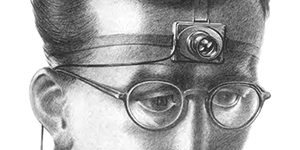
‘As We May Think‘ is an essay by engineer and Raytheon founder Vannevar Bush, first published in ‘The Atlantic’ in July 1945, and republished again as an abridged version two months later — before and after the atomic bombings of Hiroshima and Nagasaki. Bush expresses his concern for the direction of scientific efforts toward destruction, rather than understanding, and explicates a desire for a sort of collective memory machine with his concept of the memex that would make knowledge more accessible, believing that it would help fix these problems. Through this machine, Bush hoped to transform an information explosion into a knowledge explosion.
The article was a reworked and expanded version of Bush’s 1939 essay ‘Mechanization and the Record’ where he described a machine that would combine lower level technologies to achieve a higher level of organized knowledge (like human memory processes). Shortly after the publication of this essay, Bush coined the term ‘memex’ in a letter written to the editor of ‘Fortune’ magazine. That letter became the body of ‘As We May Think,’ adding only an introduction and conclusion.
read more »
Posted in Language, Technology, War |
Leave a Comment »
February 22, 2015
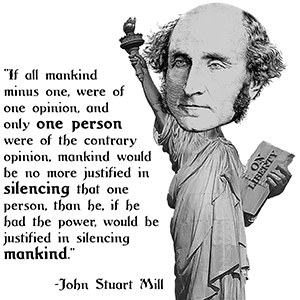
The ‘marketplace of ideas’ is a rationale for freedom of expression based on an analogy to the economic concept of a free market. The ‘marketplace of ideas’ belief holds that the truth will emerge from the competition of ideas in free, transparent public discourse. This concept is often applied to discussions of patent law as well as freedom of the press and the responsibilities of the media in a liberal democracy.
The general idea is that free speech should be tolerated because it will lead toward the truth. English poet John Milton suggested that restricting speech was not necessary because ‘in a free and open encounter,’ truth would prevail. President Thomas Jefferson argued that it is safe to tolerate ‘error of opinion … where reason is left free to combat it.’ Journalism professor Fredrick Siebert echoed the idea that free expression is self-correcting in ‘Four Theories of the Press’: ‘Let all with something to say be free to express themselves. The true and sound will survive. The false and unsound will be vanquished. Government should keep out of the battle and not weigh the odds in favor of one side or the other.’
read more »
Posted in Language, Money, Politics |
Leave a Comment »


 The Daily Omnivore