June 29, 2015

‘Character Strengths and Virtues‘ (CSV) is a 2004 book by psychologists Christopher Peterson and Martin Seligman that presents humanist ideals of virtue in an empirical, rigorously scientific manner. Seligman describes it as a ‘positive’ counterpart to the Diagnostic and Statistical Manual of Mental Disorders (DSM). While the DSM focuses on what can go wrong, CSV is designed to look at what can go right.
In their research they looked across cultures and time to distill a manageable list of virtues that have been highly valued from ancient China and India, through Greece and Rome, to contemporary Western cultures. Their list includes six character strengths: wisdom/knowledge, courage, humanity, justice, temperance, and transcendence. Each of these has three to five sub-entries; for instance, temperance includes forgiveness, humility, prudence, and self-regulation. The authors do not believe that there is a hierarchy for the six virtues; no one is more fundamental than or a precursor to the others.
read more »
Posted in Health, Language, Science |
Leave a Comment »
June 23, 2015
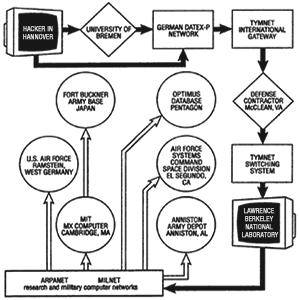
‘The Cuckoo’s Egg: Tracking a Spy Through the Maze of Computer Espionage’ is a 1989 book written by Clifford Stoll, an astronomer turned systems administrator of the computer center of the Lawrence Berkeley Laboratory (LBL) in California. It is his first-person account of the hunt for a computer hacker who broke into a computer at the lab.
In August of 1986 his supervisor asked him to resolve a US$0.75 accounting error in the computer usage accounts. He traced the error to an unauthorized user who had apparently used up nine seconds of computer time and not paid for it, and eventually realized that the unauthorized user was a hacker who had acquired root (high-level) access to the LBL system by exploiting a vulnerability in the movemail function of the original GNU Emacs (an open-source computer program that moves a user’s mail to another file).
read more »
Posted in Language, Technology, War |
Leave a Comment »
May 30, 2015
‘The Magic of Reality: How We Know What’s Really True’ is a 2011 book by British biologist Richard Dawkins, with illustrations by Dave McKean. It is a science book aimed primarily at children and young adults. He addresses topics that range from his most familiar territory, evolutionary biology and speciation (how the tree of life creates new branches), to physical phenomena such as atomic theory, optics, planetary motion, gravitation, stellar evolution (the life cycle of stars), spectroscopy (the study of the interactions of matter and electromagnetic radiation), and plate tectonics, as well as speculation on exobiology (alien life).
Most chapters begin with quick retellings of historical creation myths that emerged as attempts to explain the origin of particular observed phenomena. These myths are chosen from all across the world including Babylonian, Judeo-Christian, Aztec, Maori, Ancient Egyptian, Australian Aboriginal, Nordic, Hellenic, Chinese, Japanese, and other traditions, including contemporary alien abduction mythology.
read more »
Posted in Education, Language, Philosophy |
Leave a Comment »
May 20, 2015


‘How to Lie with Statistics‘ is a book written by Darrell Huff in 1954 presenting an introduction to statistics for the general reader. Huff was a journalist who wrote many ‘how to’ articles as a freelancer, but was not a statistician. The book is a brief, breezy, illustrated volume outlining errors when it comes to the interpretation of statistics, and how these errors lead to incorrect conclusions. In the 1960s and ’70s it became a standard textbook introduction to the subject of statistics for many college students. It has become one of the best-selling statistics books in history, with over one and a half million copies sold in the English-language edition, and has also been widely translated.
Themes of the book include ‘Correlation does not imply causation’ and ‘Using random sampling.’ It also shows how statistical graphs can be used to distort reality, for example by truncating the bottom of a line or bar chart, so that differences seem larger than they are, or by representing one-dimensional quantities on a pictogram by two- or three-dimensional objects to compare their sizes, so that the reader forgets that the images do not scale the same way the quantities do. The original edition contained humorous illustrations by artist Irving Geis. In a UK edition these were replaced with cartoons by Mel Calman.
Posted in Language, Science |
1 Comment »
May 18, 2015

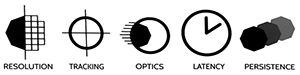
Presence is the illusion that a virtual experience is real. Today, it often considers the effect that people experience when they interact with a computer-mediated or computer-generated environment. This use of the term derives from the word ‘telepresence,’ coined by MIT professor Marvin Minsky in 1980, which he described as the manipulation of objects in the real world through remote access technology. For example, a surgeon may use a computer to control robotic arms to perform minute procedures on a patient in another room. Or a NASA technician may use a computer to control a rover to collect rock samples on Mars.
As technologies progressed, the need for an expanded term arose. Thomas Sheridan (also of MIT, and a pioneer of robotics and remote control technology) extrapolated Minsky’s original definition. Using the shorter ‘presence,’ Sheridan explained that the term refers to the effect felt when controlling real world objects remotely as well as the effect people feel when they interact with and immerse themselves in virtual reality or virtual environments.
read more »
Posted in Games, Language, Technology |
Leave a Comment »
May 11, 2015

Small talk is an informal type of discourse that does not cover any functional topics of conversation or any transactions that need to be addressed. Small talk is conversation for its own sake. The phenomenon of small talk was initially studied in 1923 by Polish anthropologist Bronislaw Malinowski, who coined the term ‘phatic communication’ to describe it. For example: ‘You’re welcome’ is not intended to convey the message that the hearer is welcome; it is a phatic response to being thanked, which in turn is a phatic whose function is to acknowledge the receipt of a benefit. The ability to conduct small talk is a social skill; hence, small talk is part of social communication.
While seeming to have little useful purpose, small talk is a bonding ritual and a strategy for managing interpersonal distance. It serves many functions in helping to define the relationships between friends, work colleagues, and new acquaintances. In particular, it helps new acquaintances to explore and categorize each other’s social position. Small talk is closely related to the need for people to maintain positive face — to feel approved-of by those who are listening to them. It lubricates social interactions in a very flexible way, although the desired function is often dependent on the point in the conversation at which the small talk occurs (e.g. conversation openers are very different than closers).
read more »
Posted in Language, World |
1 Comment »
May 9, 2015
Holy Roller is a derogatory term for some Christian churchgoers of the Methodist, Holiness, and Pentecostal traditions. The term is sometimes used derisively by those outside these denominations, as if to describe people literally rolling on the floor in an uncontrolled manner. However, those within these Wesleyan traditions have reclaimed it as a badge of honor; for example William Branham wrote: ‘And what the world calls today holy-roller, that’s the way I worship Jesus Christ.’ Gospel singer Andrae Crouch stated, ‘They call us holy rollers, and what they say is true. But if they knew what we were rollin’ about, they’d be rollin’ too.’
Merriam-Webster traces the word to 1841. The Oxford English Dictionary cites an 1893 memoir by American humorist Charles Godfrey Leland, in which he says ‘When the Holy Spirit seized them … the Holy Rollers … rolled over and over on the floor.’ Similar disparaging terms directed at outspoken Christians but later embraced by them include ‘Jesus freaks’ or, from former centuries, Methodists, Quakers, and Shakers.
Posted in Language, Philosophy |
Leave a Comment »
May 1, 2015

Leaves of Grass is a collection of poetry by Walt Whitman praising sensuality, the material world, nature, and the experience of the senses. The book was published at Whitman’s own expense in 1855, a period where poetry focused on the soul and organized religion, and was a failure at first. Whitman spent most of his professional life writing and rewriting the book, revising it multiple times until his death. This resulted in vastly different editions over four decades—the first a small book of twelve poems and the last a compilation of over 400.
The collection is notable for its discussion of delight in carnal pleasures during a time when such candid displays were considered immoral. Where much previous poetry, especially English, relied on symbolism, allegory, and meditation on the religious and spiritual, ‘Leaves of Grass’ (particularly the first edition) exalted the physical form and ephemera. Influenced by Ralph Waldo Emerson and the Transcendentalist movement, itself an offshoot of Romanticism, Whitman’s poetry praises nature and the individual’s role in it. However, much like Emerson, Whitman does not diminish the role of the mind or the spirit; rather, he elevates the human form and mind, deeming both worthy of poetic praise.
read more »
Posted in Art, Language, Philosophy |
Leave a Comment »
April 28, 2015

An anti-proverb or a ‘perverb’ is the transformation of a standard proverb for humorous effect. Paremiologist (proverb scholar) Wolfgang Mieder defines them as ‘parodied, twisted, or fractured proverbs that reveal humorous or satirical speech play with traditional proverbial wisdom.’ They have also been defined as ‘an allusive distortion, parody, misapplication, or unexpected contextualization of a recognized proverb, usually for comic or satiric.’
To have full effect, an anti-proverb must be based on a known proverb. For example, ‘If at first you don’t succeed, quit’ is only funny if the hearer knows the standard proverb ‘If at first you don’t succeed, try, try again.’ Anti-proverbs are used commonly in advertising, such as ‘Put your burger where your mouth is’ from Red Robin. Anti-proverbs are also common on T-shirts, such as ‘Taste makes waist’ and ‘If at first you don’t succeed, skydiving is not for you.’
read more »
Posted in Humor, Language |
2 Comments »
April 23, 2015
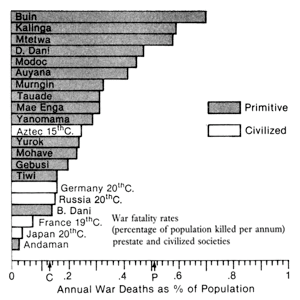
‘War Before Civilization: the Myth of the Peaceful Savage’ is a 1996 book by Lawrence H. Keeley, an archeology professor at the University of Illinois at Chicago who specializes in prehistoric Europe. The book deals with warfare conducted throughout human history by societies with little technology. In the book, Keeley aims to stop the apparent trend in seeing civilization as bad.
According to Keeley, modern western societies are not more violent or war-prone than (historical) tribes. He conducted an investigation of the archaeological evidence for prehistoric violence, including murder and massacre as well as war. He also looked at nonstate societies of more recent times. It has long been known, for example, that many tribes of South America’s tropical forest engage in frequent and horrific warfare, but some scholars had attributed their addiction to violence to baneful Western influences.
read more »
Posted in Death, Language, War |
Leave a Comment »
April 17, 2015

Terry Gross (b. 1951) is the host and co-executive producer of ‘Fresh Air,’ an interview format radio show produced by ‘WHYY-FM,’ the flagship National Public Radio (NPR) station in Philadelphia. The show is broadcast nationally by NPR. Gross has won praise over the years for her low-key and friendly yet often probing interview style and for the diversity of her guests. She has a reputation for researching her guests’ work largely the night before an interview, often asking them unexpected questions about their early careers.
Gross grew up in a Jewish family in Sheepshead Bay, Brooklyn. She earned a bachelor’s degree in English and a master’s degree in communications from SUNY, Buffalo. She began a teaching career, but said that she was ‘totally unequipped’ for the job, and was fired after only six weeks. Gross began her radio career in 1973 at ‘WBFO,’ a public radio station in Buffalo, where she had been volunteering. In 1975, she moved to WHYY-FM in Philadelphia to host and produce ‘Fresh Air,’ which was a local interview program at the time. In 1985, the show went national, being distributed weekly by NPR. It became a daily program two years later.
read more »
Posted in Art, Language, Politics |
1 Comment »
April 10, 2015

In terms of fiction, a quibble [kwib-uhl] is a plot device, used to fulfill the exact verbal conditions of an agreement in order to avoid the intended meaning. Typically quibbles are used in legal bargains and, in fantasy, magically enforced ones. In one of the best known examples, William Shakespeare used a quibble in ‘The Merchant of Venice.’ Portia saves Antonio in a court of law by pointing out that the agreement called for a pound of flesh, but no blood, and therefore Shylock can collect only if he sheds no blood.
A ‘pact with the Devil’ commonly contains clauses that allow the devil to quibble over what he grants, and equally commonly, the maker of the pact finds a quibble to escape the bargain. In Norse mythology, Loki, having bet his head with Brokk and lost, forbids Brokk to take any part of his neck, saying he had not bet it; Brokk is able only to sew his lips shut.
read more »
Posted in Humor, Language, Politics |
1 Comment »



