December 4, 2014
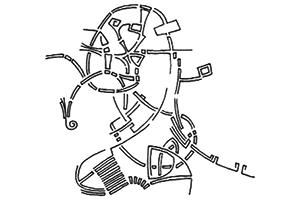
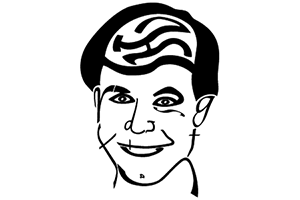
Metamagical [met-uh-maj-i-kuhl] Themas [thee-muhs] is an eclectic collection of articles that cognitive scientist Douglas Hofstadter wrote for ‘Scientific American’ during the early 1980s. The title is an anagram of Martin Gardner’s ‘Mathematical Games,’ the column that preceded Hofstadter’s. The anthology was published in 1985. Major themes include: self-reference in memes (ideas that spread within cultures), language, art and logic; discussions of philosophical issues important in cognitive science/AI; analogies and what makes something similar to something else (specifically what makes, for example, an uppercase letter ‘A’ recognizable as such); and lengthy discussions of the work of political scientist Robert Axelrod on the prisoner’s dilemma (a game theory problem).
There are three articles centered on the Lisp programming language, where Hofstadter first details the language itself, and then shows how it relates to Gödel’s incompleteness theorem. Two articles are devoted to Rubik’s Cube and other such puzzles. Many other topics are also mentioned, all in Hofstadter’s usual easy, approachable style. Many chapters open with an illustration of an extremely abstract alphabet, yet one which is still recognizable as such. The game of ‘Nomic’ (in which the rules of the game include mechanisms for the players to change those rules) was first introduced to the public in this column, in June 1982.
Posted in Language, Philosophy, Science |
1 Comment »
December 2, 2014
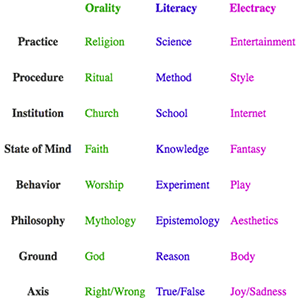

Electracy [ee-lek-truh-see] is a theory by Gregory Ulmer, a professor of English and electronic languages, that describes the skills necessary to access and utilize electronic media such as multimedia (audio, visual, and text), hypermedia (linked material), social networks, and virtual worlds. According to Ulmer, electracy ‘is to digital media what literacy is to print.’ However, ‘If literacy focused on universally valid methodologies of knowledge (sciences), electracy focuses on the individual state of mind within which knowing takes place (arts).’ It is his attempt to describe the transition from a culture of print literacy to a culture saturated with electronic media.
Ulmer sees this shift as a positive step, writing, ‘The near absence of art in contemporary schools is the electrate equivalent of the near absence of science in medieval schools for literacy. The suppression of empirical inquiry by religious dogmatism during the era sometimes called the ‘dark ages’ (reflecting the hostility of the oral apparatus to literacy), is paralleled today by the suppression of aesthetic play by empirical utilitarianism (reflecting the hostility of the literate apparatus to electracy). The ambivalent relation of the institutions of school and entertainment today echoes the ambivalence informing church-science relations throughout the era of literacy.’ He concludes that the sociological changes will be profound: ‘What literacy is to the analytical mind, electracy is to the affective body: a prosthesis that enhances and augments a natural or organic human potential. Alphabetic writing is an artificial memory that supports long complex chains of reasoning impossible to sustain within the organic mind. Digital imaging similarly supports extensive complexes of mood atmospheres beyond organic capacity.’
Posted in Language, Philosophy, Technology |
Leave a Comment »
November 23, 2014
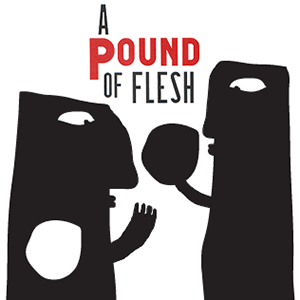
To have ‘skin in the game’ is to have incurred monetary risk by being invested in achieving a goal. In the phrase, ‘skin’ is a synecdoche (a part that represents the whole) for the person involved, and ‘game’ is the metaphor for the actions on whatever field of play is at reference. The aphorism is common in finance, gambling, and politics. The origin of the phrase is unknown. It has been attributed to Warren Buffett since in Buffett’s first fund he raised $105,000 from 11 doctors, himself placing a token sum of $100.00 as his ‘skin in the game’ (though New York Times columnist William Safire dispelled the Buffett origin). Another possible explanation is that the phrase is derived from William Shakespeare’s ‘The Merchant of Venice’; in which a money lender demands a pound of actual flesh from a borrower should they default.
The term is used to ask or convey a principals undefined but significant equity stake in an investment vehicle where outside investors are solicited to invest. The theory is that principal’s equity contribution is directly related to the stability of the investment and confidence that management has in the venture and is also (falsely) strongly correlated to the expected yield of the investment. Research has shown that there tends to be a negative correlation between excess ‘skin’ and negative returns. The main issues is the principal–agent problem whereby transparency and fiduciary obligations are disregarded by principals who have capital or excess capital (skin) tied into an entity. Many banks and other financial institutions bar employees from having any ‘skin’ where client capital is managed, principally to address the issue of commingled funds. Hedge funds, private equity, Trusts, and Mutual funds are legally limited to a minority investment positions.
Posted in Language, Money |
Leave a Comment »
November 20, 2014

Alan Moore (b. 1953) is an English writer primarily known for his work in comic books including ‘Watchmen,’ ‘V for Vendetta,’ and ‘From Hell.’ Frequently described as the best graphic novel writer in history (though he prefers the term ‘comic’ to ‘graphic novel’), he has been called ‘one of the most important British writers of the last fifty years.’ He has occasionally used such pseudonyms as Curt Vile, Jill de Ray, and Translucia Baboon.
Moore is an occultist, ceremonial magician, and anarchist, and features such themes in his fiction, as well as performing avant-garde spoken word occult ‘workings’ with ‘The Moon and Serpent Grand Egyptian Theatre of Marvels,’ some of which have been released on CD. Despite his own personal objections, his books have provided the basis for a number of Hollywood films. He has stated that much of his work is designed to be ‘unfilmable’ to expose difference in the two mediums.
read more »
Posted in Art, Language |
1 Comment »
November 17, 2014
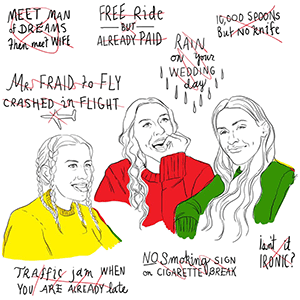
Irony is when something happens that is opposite from what is expected. In literature, it is sometimes used for comedic effect, but it is also used in tragedies. There are many types of irony, such as ‘dramatic irony’ (when the audience knows something is going to happen on stage that the characters on stage do not), ‘Socratic irony’ (when a teacher feigns ignorance to his students), ‘cosmic irony’ (when something that everyone thinks will happen actually happens very differently — as opposed to ‘situational irony’ that only affects a small group or individual), ‘verbal irony’ (an absence of expression and intention or the use of sarcasm), and ‘ironic fate’ (misfortune as the result of fate or chance).
The word ‘irony’ comes from Ancient Greek (‘eironeia’: ‘dissimulation, feigned ignorance’), in specific terms it is a rhetorical device, literary technique, or event characterized by an incongruity, or contrast, between what the expectations of a situation are and what is really the case, with a third element, that defines that what is really the case is ironic because of the situation that led to it. Verbal, dramatic, and situational irony are often used to underscore the assertion of a truth. The ironic form of simile, used in sarcasm, and some forms of litotes (understatement used to emphasize a point by denying the opposite) can highlight one’s meaning by the deliberate use of language which states the opposite of the truth, denies the contrary of the truth, or drastically and obviously understates a factual connection.
read more »
Posted in Art, Humor, Language |
1 Comment »
November 14, 2014


The curse of knowledge is a cognitive bias that leads better-informed parties to find it extremely difficult to think about problems from the perspective of lesser-informed parties. It is related to public policy engineer Baruch Fischhoff’s work on the hindsight bias (the knew-it-all-along effect). In economics the bias is studied to understand why the assumption that better informed agents can accurately anticipate the judgments of lesser informed agents is not inherently true, as well as to support the finding that sales agents who are better informed about their products may, in fact, be at a disadvantage against other, less-informed agents. It is believed that better informed agents fail to ignore the privileged knowledge that they possess, thus ‘cursed’ and unable to sell their products at a value that more naïve agents would deem acceptable.
In one experiment, one group of subjects ‘tapped’ a well-known song on a table while another listened and tried to identify the song. Some ‘tappers’ described a rich sensory experience in their minds as they tapped out the melody. Tappers on average estimated that 50% of listeners would identify the specific tune; in reality only 2.5% of listeners could. Related to this finding is the phenomenon experienced by players of charades: The actor may find it frustratingly hard to believe that his or her teammates keep failing to guess the secret phrase, known only to the actor, conveyed by pantomime.
Posted in Education, Language, Money |
Leave a Comment »
November 12, 2014
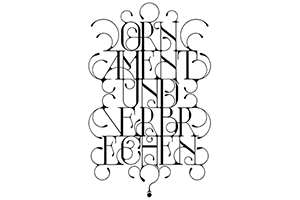

Form follows function, a principle associated with modernist architecture and industrial design in the 20th century, holds that the shape of a building or object should be primarily based upon its intended purpose, not aesthetics or tradition. The authorship of the phrase is often, though wrongly, ascribed to the American sculptor Horatio Greenough, whose thinking to a large extent predates the later functionalist approach to architecture. Greenough’s writings were for a long time largely forgotten, and were rediscovered only in the 1930s; in 1947 a selection of his essays was published under the title ‘Form and Function: Remarks on Art by Horatio Greenough.’
American architect, Louis Sullivan, Greenough’s much younger compatriot, who admired rationalist thinkers like Greenough, Thoreau, Emerson, Whitman, and Melville, coined the phrase in his article ‘The Tall Office Building Artistically Considered’ in 1896 (some fifty years after Greenough’s death), though Sullivan later attributed the core idea to Marcus Vitruvius Pollio the Roman architect, engineer and author who first asserted in his book ‘De architectura’ that a structure must exhibit the three qualities of ‘firmitas, utilitas, venustas’ – that is, it must be solid, useful, beautiful. Here Sullivan actually said ‘form ever follows function,’ but the simpler (and less emphatic) phrase is the one usually remembered.
read more »
Posted in Art, Language, Technology |
1 Comment »
November 12, 2014

An affordance is something that provides the opportunity to perform an action. It is often described as a relationship between an object (or environment) and an organism. For example, a knob affords twisting, and perhaps pushing, while a cord affords pulling. As a relation, an affordance exhibits the possibility of some action, and is not a property of either an organism or its environment alone.
Different definitions of the term have developed. The original definition described all actions that are physically possible, but was later limited to only those an actor is aware of. The term has further evolved for use in the context of human–computer interaction (HCI) to indicate the easy discoverability of possible actions. The concept has application in several fields: perceptual, cognitive, and environmental psychology, industrial design, instructional design, science, technology and society (STS), and artificial intelligence.
read more »
Posted in Language, Science, Technology |
Leave a Comment »
November 11, 2014
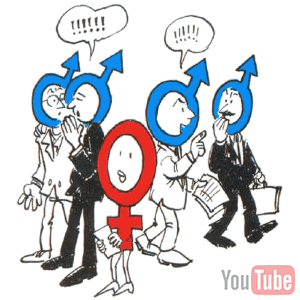
The Master suppression techniques (also known as domination techniques), articulated in 1945 by Norwegian psychologist and philosopher Ingjald Nissen, is an outline of ways to indirectly suppress and humiliate opponents. In the late 1970s the framework was popularized by Norwegian social psychologist Berit Ås, who reduced Nissen’s original nine means to five, and claimed this was a technique mostly used in the workplace by men against women. Master suppression techniques are defined as strategies of social manipulation by which a dominant group maintains such a position in a (established or unexposed) hierarchy. They are very prominent in Scandinavian scholarly and public debate.
The five master suppression techniques are: Making Invisible (silencing or otherwise marginalizing persons in opposition by ignoring them), Ridiculing (portraying opponents and their arguments as absurd and worthy of mocking), Withholding Information (excluding opponents from the decision making process, or limiting their access to information so as to make them less able to make an informed choice), Double Binding (punishing or otherwise belittling the actions of opponents, regardless of how they act), and Blaming and Shaming (embarrassing opponents by insinuating that they are themselves to blame for their position).
read more »
Posted in Language, Politics, World |
Leave a Comment »
November 10, 2014
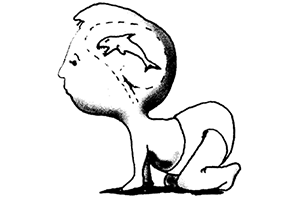
‘Prometheus Rising‘ is a book by Robert Anton Wilson first published in 1983. It is a guide book of ‘how to get from here to there,’ an amalgam of psychonaut Timothy Leary’s 8-circuit model of consciousness, spiritualist Georges Gurdjieff’s self-observation exercises, Polish semiotician Alfred Korzybski’s general semantics, occultist Aleister Crowley’s magical theorems, Sociobiology (the study of the evolutionary bases of behavior), Yoga, relativity, and quantum mechanics among other approaches to understanding the world around us. Wilson describes it as an ‘owner’s manual for the human brain.’
The book, which examines many aspects of social mind control and mental imprinting, provides mind exercises at the end of every chapter, with the goal of giving the reader more control over how one’s mind works. Wilson also discusses the effect of certain psychoactive substances and how these affect the brain, tantric breathing techniques, and other methods and holistic approaches to expanding consciousness. The book’s take on transactional analysis became the main seed thought for ‘The Sekhmet Hypothesis’ (suggesting a link between the emergence of youth culture archetypes in relation to the 11 year solar cycle), specifically the idea of applying the life scripts to pop cultural trends.
Posted in Art, Language, Philosophy |
Leave a Comment »
November 9, 2014
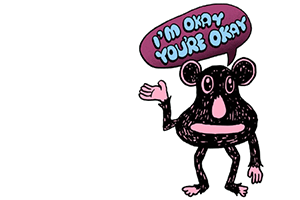
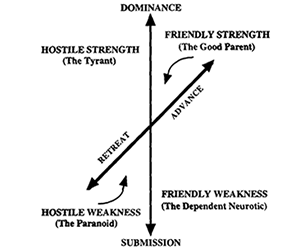
The Sekhmet Hypothesis was first published in 1995 by author Iain Spence. It suggested a possible link between the emergence of youth culture archetypes in relation to the 11 year solar cycles. The hypothesis was published again in 1997 in ‘Towards 2012’ and covered in 1999 in ‘Sleazenation’ magazine. Spence eventually abandoned the idea as not based in scientific fact, pointing to Strauss-Howe generational theory as a better model of social change.
The origins of the hypothesis can be traced back to philosopher Robert Anton Wilson’s book, ‘Prometheus Rising,’ in which he makes a singular correlation between the archetype of the flower child with the mood of friendly weakness. Spence extended the comment into a study of various youth archetypes and linked in their behavior to transactional analysis (a theory of human interaction). The idea of linking pop culture to the solar cycles had been influenced from remarks made by modern occultist Peter J. Carroll, in his book, ‘Psychonaut.’ Sekhmet is the Egyptian goddess of the sun.
read more »
Posted in Art, Language, Philosophy |
Leave a Comment »
November 6, 2014

In American suburban communities, McMansion is a pejorative for a type of large, new luxury house which is judged to be oversized for the parcel or incongruous and out-of-place for its neighborhood. Alternatively, a McMansion can be a large, new house in a subdivision of similarly large houses, which all seem mass-produced and lacking in distinguishing characteristics, as well as appearing at odds with the traditional local architecture.
The neologism seems to have been coined sometime in the early 1980s. It first appeared in print the ‘Los Angeles Times’ in 1990. Related terms include ‘Persian palace,’ ‘garage Mahal,’ ‘starter castle,’ and ‘Hummer house.’ Marketing parlance often uses the term ‘tract mansion’ or ‘executive home.’ An example of a McWord, ‘McMansion’ associates the generic quality of these luxury homes with that of mass-produced fast food by evoking the McDonald’s restaurant chain.
read more »
Posted in Language, Money |
Leave a Comment »



 The Daily Omnivore