Home sign (or kitchen sign) is a gestural communication system developed by deaf children who lack input from a language model in the family, such as those with hearing parents who are isolated from a sign language community.
While not developing into a complete language (as linguists understand the term), home sign systems show some of the same characteristics of sign and oral languages, and are quite distinguishable from the gestures that accompany speech. Words and simple sentences are formed, often in similar patterns despite different home sign systems being developed in isolation from each other. Comparisons can be made between home sign and pidgins (a simplified language that develops between two or more groups that do not have a common tongue).
read more »
Home Sign
Human Universals
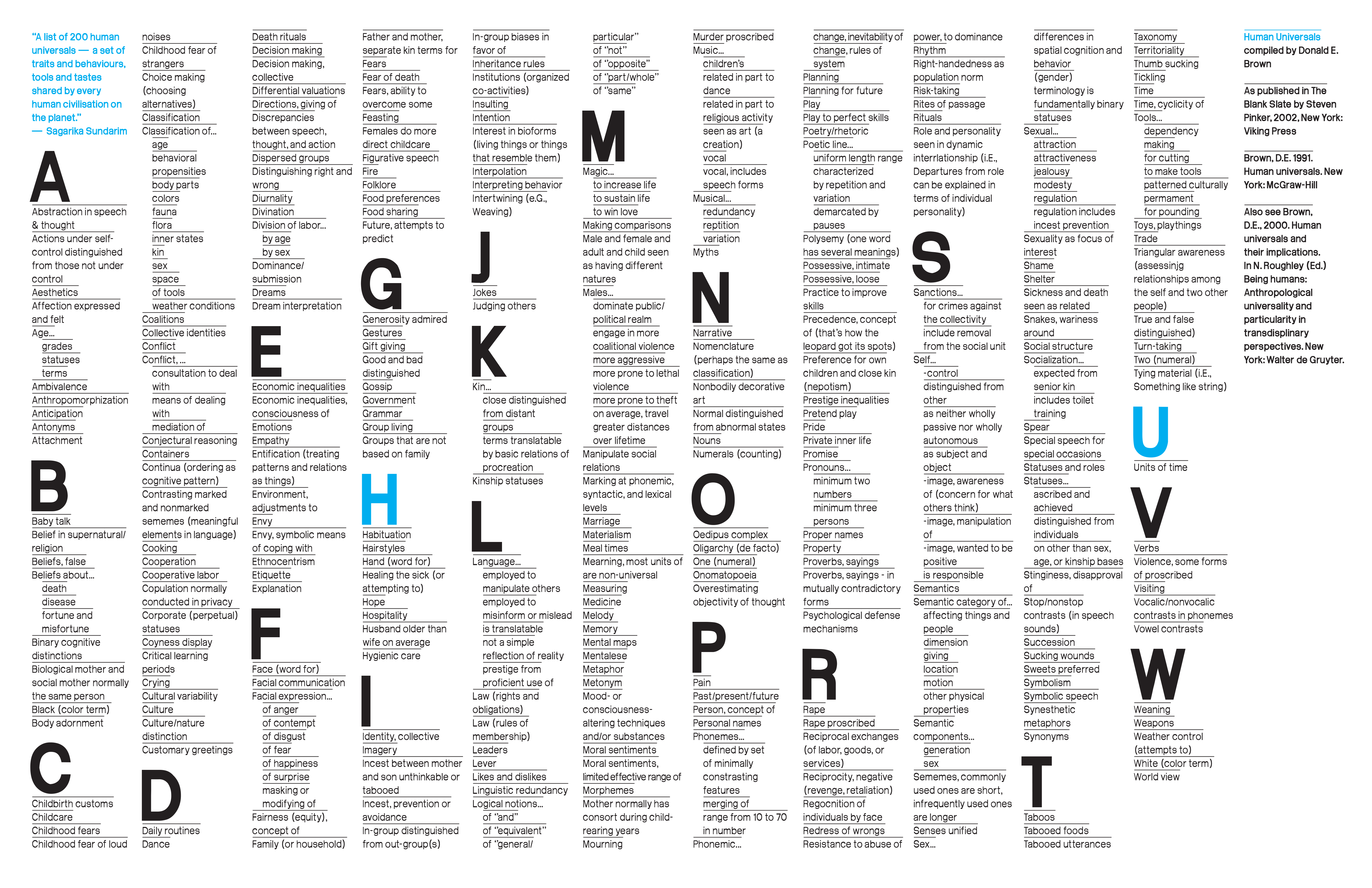
‘Human Universals‘ is a 1991 nonfiction book by Donald Brown, an American professor of anthropology (emeritus) at UC, Santa Barbara. Brown says human universals, ‘comprise those features of culture, society, language, behavior, and psyche for which there are no known exception.’
Universals include: age-grading, athletic sports, bodily adornment, calendar, cleanliness training, community organization, cooking, cooperative labor, cosmology, courtship, dancing, decorative art, divination, division of labor, dream interpretation, education, eschatology, ethics, ethno-botany, etiquette, faith healing, family feasting, fire-making, folklore, food taboos, funeral rites, games, gestures, gift-giving, government, greetings, hair styles, hospitality, housing, hygiene, incest taboos, inheritance rules, joking, kin groups, kinship nomenclature, language, law, luck superstitions, magic, marriage, mealtimes, medicine, obstetrics, penal sanctions, personal names, population policy, postnatal care, pregnancy usages, property rights, propitiation of supernatural beings, puberty customs, religious ritual, residence rules, sexual restrictions, soul concepts, status differentiation, surgery, tool-making, trade, visiting, weather control, weaving.
Visiting Card
A visiting card, also known as a calling card, is a small paper card with one’s name printed on it, and often bearing an artistic design. In 18th century Europe the footmen of aristocrats and royalty would deliver these first European visiting cards to the servants of their prospective hosts solemnly introducing the arrival of their owners.
Visiting cards became an indispensable tool of etiquette, with sophisticated rules governing their use. The essential convention was that one person would not expect to see another person in her own home (unless invited or introduced) without first leaving his visiting card for the person at her home. Upon leaving the card, he would not expect to be admitted at first, but might receive a card at his own home in response. This would serve as a signal that a personal visit and meeting at home would be welcome. On the other hand, if no card were forthcoming, or if a card were sent in an envelope, a personal visit was thereby discouraged.
read more »
Hendiatris
Hendiatris [hen-die-uh-tris] (from the Greek: ‘one through three’) is a figure of speech used for emphasis, in which three words are used to express one idea (e.g. ‘sex, drugs and rock and roll’ to capture the life of a rock star). It is an isocolon, a sentence composed of two or more parts (cola) perfectly equivalent in structure, length and rhythm (called a bicolon, tricolon, or tetracolon depending on whether they are two, three, or four parts).
A well-known example of tricolon is Julius Caesar’s ‘Veni, vidi, vici’ (‘I came; I saw; I conquered’), which is also a hendiatris and known in English as a ‘tripartite motto.’ If the units involved are not single words, and if they are not in any way synonyms but rather circumnavigate the one idea expressed, the figure may be described more correctly, precisely, and succinctly as a ‘triad.’
read more »
Haecceity
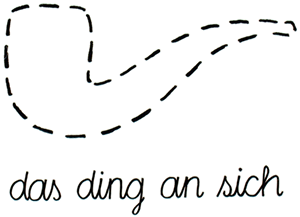
Haecceity [hek-see-i-tee] (from the Latin ‘haecceitas’: ‘thisness’) is a term from medieval philosophy first coined by thirteenth century Scottish theologian Duns Scotus which denotes the discrete qualities, properties or characteristics of a thing which make it a particular thing. Haecceity is a person or object’s ‘thisness,’ the individualizing difference between, for example, the concept ‘a man’ and the concept ‘Socrates’ (a specific person).
American philosopher Charles Sanders Peirce later used the term as a non-descriptive reference to an individual. It may also be defined in some dictionaries as simply the ‘essence’ of a thing, or as a simple synonym for quiddity (‘whatness’) or hypokeimenon (‘underlying thing’). However, such a definition deprives the term of its subtle distinctiveness and utility. Whereas haecceity refers to aspects of a thing which make it a particular thing, quiddity refers to the universal qualities of a thing, or the aspects shares with other things (which is relevant to taxonomy, the science of classification).
read more »
Nonviolent Communication
Nonviolent Communication (NVC) is an interpersonal communicative process developed by psychologist Marshall Rosenberg beginning in the 1960s. NVC often functions as a conflict resolution process. It focuses on three aspects of communication: self-empathy (a deep and compassionate awareness of one’s own inner experience), empathy (listening to another with deep compassion), and honest self-expression (expressing oneself authentically in a way that is likely to inspire compassion in others).
NVC is based on the idea that all human beings have the capacity for compassion and only resort to violence or behavior that harms others when they don’t recognize more effective strategies for meeting needs. Habits of thinking and speaking that lead to the use of violence (psychological and physical) are learned through culture. NVC theory supposes all human behavior stems from attempts to meet universal human needs and that these needs are never in conflict. Rather, conflict arises when strategies for meeting needs clash. NVC proposes that if people can identify their needs, the needs of others, and the feelings that surround these needs, harmony can be achieved.
read more »
Unspoken Rule
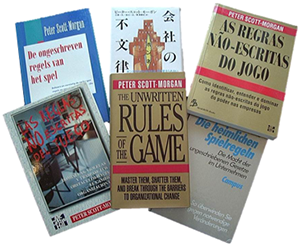
Unspoken rues are behavioral constraints imposed in organizations or societies that are not voiced or written down. They usually exist in unspoken and unwritten format because they form a part of the logical argument or course of action implied by tacit assumptions. Examples include unwritten and unofficial organizational hierarchies, organizational culture, and acceptable behavioral norms governing interactions between organizational members.
For example, the captain of a ship is always expected to be the last to evacuate it in a disaster. Or, as Vince Waldron wrote, ‘A pet, once named, instantly becomes an inseparable member of the family.’
read more »
Reinventing the Wheel
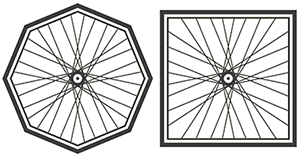
To reinvent the wheel is to duplicate a basic method that has already previously been created or optimized by others. The inspiration for this idiomatic metaphor lies in the fact that the wheel is the archetype of human ingenuity, both by virtue of the added power and flexibility it affords its users, and also in the ancient origins which allow it to underlie much, if not all, of modern technology. As it has already been invented, and is not considered to have any operational flaws, an attempt to reinvent it would be pointless and add no value to the object, diverting the investigator’s resources from possibly more worthy goals which his skills could advance more substantially.
‘Reinventing the wheel’ may itself be an ironic cliche—-it is not clear when the wheel itself was actually invented. The modern ‘invention’ of the wheel might actually be a ‘re-invention’ of an age-old invention. Additionally, many different wheels featuring enhancements on existing wheels (such as the many types of available tires) are regularly developed and marketed. The metaphor emphasizes understanding existing solutions, but not necessarily settling for them.
read more »
Letter and Spirit of the Law
The letter of the law versus the spirit of the law is an idiomatic antithesis (a common expression where two opposites are introduced for contrasting effect): When one obeys the letter of the law but not the spirit, one is obeying the literal interpretation of the words (the ‘letter’) of the law, but not the intent of those who wrote the law. Conversely, when one obeys the spirit of the law but not the letter, one is doing what the authors of the law intended, though not necessarily adhering to the literal wording.
‘Law’ originally referred to legislative statute, but in the idiom may refer to any kind of rule. Intentionally following the letter of the law but not the spirit may be accomplished through exploiting technicalities, loopholes, and ambiguous language.
read more »
Chronocentrism
Chronocentrism has been defined as ‘the egotism that one’s own generation is poised on the very cusp of history.’ The term had been used earlier in a study about attitudes to ageing in the workplace. Chronocentricity (‘only seeing the value of one’s own age cohort’) described the tendency for younger managers to hold negative perceptions of the abilities or other work-related competencies of older employees. This type of discrimination is a form of ageism.
Another usage is related to ethnocentrism (judging another culture solely by the values and standards of one’s own culture). By comparison, chronocentrism is perceiving and judging a culture’s historical values in terms of contemporary standards. An example of this usage is racism. In times prior to the advances of the civil rights movement, racist views and public expression were much more acceptable than they are today. This results in a tendency to judge those then making such statements in a harsher light.
The Machine Stops
‘The Machine Stops’ is a science fiction short story written in 1909 by E. M. Forster, who known for his ironic and well-plotted novels examining class difference and hypocrisy in early 20th-century British society. After initial publication in ‘The Oxford and Cambridge Review,’ the story was republished in Forster’s ‘The Eternal Moment and Other Stories’ in 1928. It is particularly notable for predicting new technologies such as instant messaging and the Internet.
Forster describes a world in which most of the human population has lost the ability to live on the surface of the Earth. Individuals lives in isolation below ground in a standard ‘cell,’ with all bodily and spiritual needs met by the omnipotent, global ‘Machine.’ Travel is permitted but unpopular and rarely necessary. Communication is made via a kind of instant messaging/video conferencing machine called the speaking apparatus, with which people conduct their only activity: the sharing of ideas and what passes for knowledge.
read more »
A Modern Utopia
Because of the complexity and sophistication of its narrative structure, H.G. Wells’s 1905 novel ‘A Modern Utopia‘ (1905) has been called ‘not so much a modern as a postmodern utopia.’ The book is best known for its notion that a voluntary order of nobility known as the Samurai could effectively rule a ‘kinetic and not static’ world state so as to solve ‘the problem of combining progress with political stability.’
In terms of Northrop Frye’s classification of literary genres, ‘A Modern Utopia’ is not a novel but an anatomy, a book that divides a topic into parts for detailed examination or analysis. Frye, narrowed the definition of the word to mean a work resembling a ‘Menippean satire,’ which ridicules foolish or undisciplined mental attitudes instead of specific individuals.
read more »