July 8, 2014
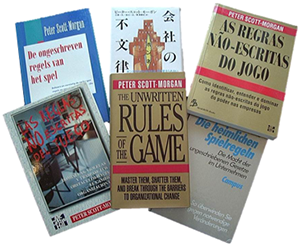

Unspoken rues are behavioral constraints imposed in organizations or societies that are not voiced or written down. They usually exist in unspoken and unwritten format because they form a part of the logical argument or course of action implied by tacit assumptions. Examples include unwritten and unofficial organizational hierarchies, organizational culture, and acceptable behavioral norms governing interactions between organizational members.
For example, the captain of a ship is always expected to be the last to evacuate it in a disaster. Or, as Vince Waldron wrote, ‘A pet, once named, instantly becomes an inseparable member of the family.’
read more »
Posted in Language |
Leave a Comment »
June 25, 2014

To reinvent the wheel is to duplicate a basic method that has already previously been created or optimized by others. The inspiration for this idiomatic metaphor lies in the fact that the wheel is the archetype of human ingenuity, both by virtue of the added power and flexibility it affords its users, and also in the ancient origins which allow it to underlie much, if not all, of modern technology. As it has already been invented, and is not considered to have any operational flaws, an attempt to reinvent it would be pointless and add no value to the object, diverting the investigator’s resources from possibly more worthy goals which his skills could advance more substantially.
‘Reinventing the wheel’ may itself be an ironic cliche—-it is not clear when the wheel itself was actually invented. The modern ‘invention’ of the wheel might actually be a ‘re-invention’ of an age-old invention. Additionally, many different wheels featuring enhancements on existing wheels (such as the many types of available tires) are regularly developed and marketed. The metaphor emphasizes understanding existing solutions, but not necessarily settling for them.
read more »
Posted in Education, Language, Technology |
1 Comment »
June 17, 2014
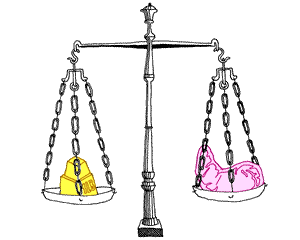
The letter of the law versus the spirit of the law is an idiomatic antithesis (a common expression where two opposites are introduced for contrasting effect): When one obeys the letter of the law but not the spirit, one is obeying the literal interpretation of the words (the ‘letter’) of the law, but not the intent of those who wrote the law. Conversely, when one obeys the spirit of the law but not the letter, one is doing what the authors of the law intended, though not necessarily adhering to the literal wording.
‘Law’ originally referred to legislative statute, but in the idiom may refer to any kind of rule. Intentionally following the letter of the law but not the spirit may be accomplished through exploiting technicalities, loopholes, and ambiguous language.
read more »
Posted in Language, Philosophy, Politics |
Leave a Comment »
June 13, 2014

Chronocentrism has been defined as ‘the egotism that one’s own generation is poised on the very cusp of history.’ The term had been used earlier in a study about attitudes to ageing in the workplace. Chronocentricity (‘only seeing the value of one’s own age cohort’) described the tendency for younger managers to hold negative perceptions of the abilities or other work-related competencies of older employees. This type of discrimination is a form of ageism.
Another usage is related to ethnocentrism (judging another culture solely by the values and standards of one’s own culture). By comparison, chronocentrism is perceiving and judging a culture’s historical values in terms of contemporary standards. An example of this usage is racism. In times prior to the advances of the civil rights movement, racist views and public expression were much more acceptable than they are today. This results in a tendency to judge those then making such statements in a harsher light.
Posted in Language, Philosophy, Politics |
1 Comment »
June 3, 2014

‘The Machine Stops’ is a science fiction short story written in 1909 by E. M. Forster, who known for his ironic and well-plotted novels examining class difference and hypocrisy in early 20th-century British society. After initial publication in ‘The Oxford and Cambridge Review,’ the story was republished in Forster’s ‘The Eternal Moment and Other Stories’ in 1928. It is particularly notable for predicting new technologies such as instant messaging and the Internet.
Forster describes a world in which most of the human population has lost the ability to live on the surface of the Earth. Individuals lives in isolation below ground in a standard ‘cell,’ with all bodily and spiritual needs met by the omnipotent, global ‘Machine.’ Travel is permitted but unpopular and rarely necessary. Communication is made via a kind of instant messaging/video conferencing machine called the speaking apparatus, with which people conduct their only activity: the sharing of ideas and what passes for knowledge.
read more »
Posted in Language, Philosophy, Technology |
1 Comment »
June 2, 2014

Because of the complexity and sophistication of its narrative structure, H.G. Wells’s 1905 novel ‘A Modern Utopia‘ (1905) has been called ‘not so much a modern as a postmodern utopia.’ The book is best known for its notion that a voluntary order of nobility known as the Samurai could effectively rule a ‘kinetic and not static’ world state so as to solve ‘the problem of combining progress with political stability.’
In terms of Northrop Frye’s classification of literary genres, ‘A Modern Utopia’ is not a novel but an anatomy, a book that divides a topic into parts for detailed examination or analysis. Frye, narrowed the definition of the word to mean a work resembling a ‘Menippean satire,’ which ridicules foolish or undisciplined mental attitudes instead of specific individuals.
read more »
Posted in Language, Philosophy |
Leave a Comment »
June 2, 2014

The genre of Menippean [meh-nip-pee-uhn] satire is a form of satire (ridicule of foolishness and moral failings), usually in prose, which has a length and structure similar to a novel and is characterized by attacking mental attitudes instead of specific individuals. Other features found in Menippean satire are different forms of parody and mythological burlesque (humorous caricatures of the gods), a critique of the myths inherited from traditional culture, a rhapsodic nature, a fragmented narrative, the combination of many different targets, and the rapid moving between styles and points of view.
The term is used by classical grammarians and by philologists mostly to refer to satires in prose. Typical mental attitudes attacked and ridiculed by Menippean satires are ‘pedants, bigots, cranks, parvenus, virtuosi, enthusiasts, rapacious and incompetent professional men of all kinds,’ which are treated as diseases of the intellect. The term Menippean satire distinguishes it from the earlier satire pioneered by Aristophanes, which was based on personal attacks.
read more »
Posted in Art, Humor, Language |
1 Comment »
May 21, 2014

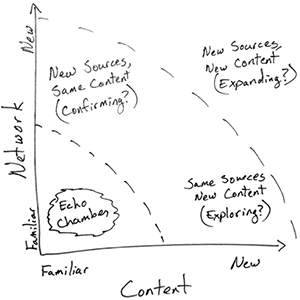
In source criticism, circular reporting or false confirmation is a situation where a piece of information appears to come from multiple independent sources, but in fact is coming from only one source. In most cases, the problem happens mistakenly through sloppy intelligence gathering practices, but in a few cases, the situation is intentionally caused by the original source. This problem occurs in variety of fields, including intelligence gathering, journalism, and scholarly research. It is of particular concern in military intelligence because the original source has a higher likelihood of wanting to pass on misinformation, and because the chain of reporting is more liable to being obscured.
Wikipedia is sometimes criticized for being used as a source of circular reporting, and thus advises all researchers and journalists to be wary of using it as a direct source, and to instead focus on verifiable information found in an article’s cited references. In 2008 an American student edited wikipedia in jest, writing that the coati (a small mammal in the raccoon family) was ‘also known as….the Brazilian aardvark,’ resulting in many subsequently citing and using that unsubstantiated nickname as part of the general consensus, including an article in ‘The Independent.’
Posted in Language, Technology |
Leave a Comment »
May 13, 2014

Mirrors for princes refers to a genre of political writing during the Middle Ages (5th to the 15th century) and the Renaissance (14th to the 17th century). They are best known in the form of textbooks which directly instruct kings or lesser rulers on certain aspects of rule and behavior, but in a broader sense, the term is also used to cover histories or literary works aimed at creating images of kings for imitation or avoidance.
They were often composed at the accession of a new king, when a young and inexperienced ruler was about to come to power. They could be viewed as a species of self-help book. Possibly the best known European ‘mirror’ is ‘Il Principe’ (‘The Prince’) (c. 1513) by Machiavelli, although this was not a typical example.
Posted in Language, Politics |
Leave a Comment »
May 13, 2014


Wisdom literature is a genre of literature common to the Ancient Near East characterized by sayings of wisdom intended to teach about divinity and about virtue. While techniques of traditional storytelling are used, books also presume to offer insight and wisdom about nature and reality.
The genre of ‘mirrors for princes’ (textbooks which directly instruct monarchs on certain aspects of rule and behavior), which has a long history in Islamic and Western Renaissance literature, represents a secular cognate of biblical wisdom literature. In Classical Antiquity, the advice poetry of Hesiod, particularly his ‘Works and Days’ (ca. 700 BCE, a farmer’s almanac in which Hesiod instructs his brother Perses in the agricultural arts) has been seen as a like-genre to Near Eastern wisdom literature.
read more »
Posted in Language, Philosophy |
1 Comment »
April 23, 2014

‘The Metamorphoses’ by Apuleius (Lucius Apuleius Madaurensis, a Roman writer) which St. Augustine referred to as ‘The Golden Ass‘ (Asinus aureus), is the only Ancient Roman novel in Latin to survive in its entirety. The protagonist of the novel is called Lucius, like the author. At the end of the novel, he is revealed to be from Madaurus (present day Algeria), the hometown of Apuleius himself.
The plot revolves around the protagonist’s curiosity (curiositas) and insatiable desire to see and practice magic. While trying to perform a spell to transform into a bird, he is accidentally transformed into an ass. This leads to a long journey, literal and metaphorical, filled with inset tales (short stories told by characters encountered by the protagonist; some act as independent narratives, while others interlock with plot developments). He finally finds salvation through the intervention of the goddess Isis, whose cult he joins.
read more »
Posted in Art, Language |
Leave a Comment »
April 22, 2014

Neil Gaiman (b. 1960) is an English author of short fiction, novels, comic books, graphic novels, audio theatre and films. His notable works include the comic book series ‘The Sandman’ and novels ‘Stardust,’ ‘American Gods,’ ‘Coraline,’ and ‘The Graveyard Book.’
Though his work is frequently seen as exemplifying the monomyth structure laid out by mythologist Joseph Campbell, Gaiman says that he started reading Campbell’s book on the common structure of myths but refused to finish it: ‘I think I got about halfway through ‘The Hero with a Thousand Faces’ and found myself thinking if this is true – I don’t want to know. I really would rather not know this stuff. I’d rather do it because it’s true and because I accidentally wind up creating something that falls into this pattern than be told what the pattern is.’
read more »
Posted in Art, Language |
1 Comment »



