June 6, 2013

Inscape, in visual art, is a term especially associated with certain works of Chilean artist Roberto Matta, but it is also used in other senses within the visual arts. Though the term has been applied to stylistically diverse artworks, it usually conveys some notion of representing the artist’s psyche as a kind of interior landscape. The word inscape can therefore be read as a kind of portmanteau, combining interior (or inward) with landscape.
According to Professor Claude Cernuschi, Matta’s use of the term inscape for a series of landscape-like abstract or surrealist paintings reflects ‘the psychoanalytic view of the mind as a three-dimensional space: the ‘inscape.” The ‘inscape’ concept is particularly apt for Matta’s works of the late 1930s. As art historian Dawn Ades writes, ‘A series of brilliant oil paintings done during the years of his [Matta’s] first association with the Surrealists explore visual metaphors for the mental landscape.’
read more »
Posted in Art, Language, Philosophy |
Leave a Comment »
June 6, 2013

Biomorphism is an art movement that began in the 20th century. It models artistic design elements on naturally occurring patterns or shapes reminiscent of nature.
Taken to its extreme it attempts to force naturally occurring shapes onto functional devices, often with mixed results.
read more »
Posted in Art, Language |
Leave a Comment »
June 5, 2013

‘Juicy‘ is a single by American hip hop artist The Notorious B.I.G. and his solo debut single from his 1994 debut album ‘Ready to Die.’ It was produced by Poke of Trackmasters & Sean ‘Puffy’ Combs. It is a sample of Mtume’s ‘Juicy Fruit,’ but samples from the song’s ‘Fruity Instrumental’ mix, and has an alternative chorus sung by girl group Total.
The song is considered one of the greatest hip hop songs of all time. After the death of The Notorious B.I.G. in 1997, a tribute version of this song was made in his honor by the R&B musical group Next with new lyrics.
read more »
Posted in Art, Language, Money |
Leave a Comment »
June 5, 2013

Lookism is a term used to refer to the positive stereotypes, prejudice, and preferential treatment given to physically attractive people, or more generally to people whose appearance matches cultural preferences.
The pejorative term ‘body fascism’ is also used as a synonym and educator and activist Warren Farrell has proposed the term ‘genetic celebrity’ to describe adoration of the attractive.
read more »
Posted in Language, Politics, Sex |
Leave a Comment »
June 3, 2013

Stetson Kennedy (1916 – 2011) was an American author and human rights activist. One of the pioneer folklore collectors during the first half of the 20th century, he is remembered for having infiltrated the Ku Klux Klan in the 1940s, exposing its secrets to authorities and the outside world.
His actions led to the 1947 revocation by the state of Georgia of the Klan’s national corporate charter. Kennedy wrote or co-wrote ten books.
read more »
Posted in Language, Politics |
Leave a Comment »
June 3, 2013

In 1946, human rights activist Stetson Kennedy infiltrated the KKK. Concerned that the organization had links to police forces, Kennedy decided to use his findings to strike at the Klan in a different way. He contacted the producers of the ‘Superman’ radio show and proposed a story where the superhero battles the Klan. Looking for new villains, the producers eagerly agreed.
To that end, he provided information—including secret codewords and details of Klan rituals—to the writers. The result was a series of episodes, ‘Clan of the Fiery Cross,’ in which Superman took on the Klan. Kennedy intended to strip away the Klan’s mystique. The trivialization of the Klan’s rituals and codewords was perceived to have had a negative impact on Klan recruiting and membership. Reportedly, Klan leaders denounced the show and called for a boycott of Kellogg’s products. However, the story arc earned spectacular ratings, and the food company stood by its support of the show.
Posted in Language, Politics |
Leave a Comment »
May 31, 2013
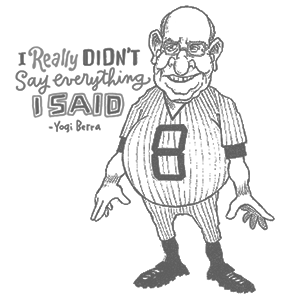
A howler is a glaring blunder, typically an amusing one. Eric Partridge’s ‘A Dictionary of Slang and Unconventional English’ (1951) defined it in part as: ‘… A glaring (and amusing) blunder: from before 1890; … also, a tremendous lie … Literally something that howls or cries for notice, or perhaps … by way of contracting howling blunder.’ Another common interpretation of this usage is that a howler is a mistake fit to make one howl with laughter.
All over the world, probably in all natural languages, there are many informal terms for blunders; the English term ‘howler’ occurs in many translating dictionaries. There are other colloquial English words for howler, in particular the mainly United States and Canadian slang term ‘boner’ which has various interpretations, including that of blunder. Like howler, boner can be used in any sense to mean an ignominious and usually laughable blunder, and also like howler, it has been used in the titles of published collections of largely schoolboy blunders since at least the 1930s.
read more »
Posted in Humor, Language |
Leave a Comment »
May 31, 2013
Kathryn Schulz is an American journalist and author, and the book critic for ‘New York’ magazine. She also wrote ‘The Wrong Stuff,’ a blog on ‘Slate,’ and contributes to the ‘Freakonomics blog’ at ‘The New York Times.’ Schulz began her career in journalism writing for the now-defunct ‘Feed Magazine,’ one of the earliest online magazines. From 2001 to 2006, she was the editor of the online environmental magazine ‘Grist.’
Before that, she was a reporter and editor for ‘The Santiago Times,’ of Santiago, Chile, where she covered environmental, labor, and human rights issues. She was a 2004 recipient of the Pew Fellowship in International Journalism (now the International Reporting Project), and has reported from throughout Central and South America, Japan and the Middle East. Schulz is a graduate of Brown University. Schulz was born and raised in Shaker Heights, Ohio, and currently resides in New York state.
Posted in Language |
Leave a Comment »
May 30, 2013
Post-feminism is a reaction against some perceived contradictions and absences of second-wave feminism (a period of feminist activity that first began in the early 1960s in the United States, and eventually spread throughout the Western world). The term post-feminism is ill-defined and is used in inconsistent ways.
However, it generally connotes the belief that feminism has succeeded in its goal of ameliorating sexism, making it fundamentally opposed to the third-wave intention of broadening feminist struggle by focusing on diversity and change.
read more »
Posted in Language, Politics, Sex |
1 Comment »
May 29, 2013
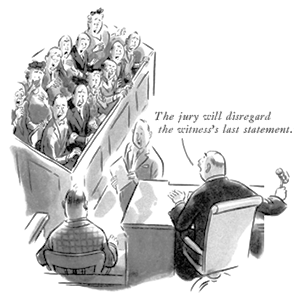
In law, unring the bell is an analogy used to suggest the difficulty of forgetting information once it is known. When discussing jury trials, the phrase is sometimes used to describe the judge’s instructions to the jury to ignore inadmissible evidence or statements they have heard. It may also be used if inadmissible evidence has been brought before a jury and the judge subsequently declares a mistrial.
Commenting on Court TV about the pre-trial release of nearly 200 pages of documents from a hearing on the sexual activities of the accuser in the Kobe Bryant sexual assault case, jury consultant Idgi D’Andrea said, ‘It’s really hard to unring the bell, once that bell has been rung, and ask people to forget what they’ve heard.’ In a more recent case, judge Reggie Walton said that he could not ‘unring the bell’ when he declared a mistrial in the Roger Clemens perjury trial.
read more »
Posted in Language, Politics |
1 Comment »
May 29, 2013
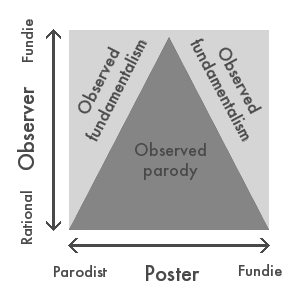
Poe’s law is an Internet adage reflecting the idea that without a clear indication of the author’s intent, it is difficult or impossible to tell the difference between an expression of sincere extremism and a parody of extremism. A corollary of Poe’s law is the reverse phenomenon: sincere fundamentalist beliefs can be mistaken for a parody of those beliefs.
The statement was formulated in 2005 by Nathan Poe on the website christianforums.com in a debate about creationism. The original sentence read: ‘Without a winking smiley or other blatant display of humor, it is utterly impossible to parody a Creationist in such a way that someone won’t mistake [it] for the genuine article.’
read more »
Posted in Humor, Language, Philosophy |
Leave a Comment »
May 24, 2013

‘The Ethical Slut: A Guide to Infinite Sexual Possibilities’ is a 1997 non-fiction book written by family therapist Dossie Easton and sex educator Janet Hardy (given as pseudonym Catherine A. Liszt for the book’s first edition).
The book discusses consensual non-monogamy as a lifestyle, and provides practical guidance on how such long-term relationships work and are put into practice.
read more »
Posted in Health, Language, Sex |
1 Comment »


 The Daily Omnivore