March 13, 2013


Role suction is a term introduced in the USA by pyschologist Fritz Redl in the mid-twentieth century to describe the power of a social group to allocate roles willy-nilly to its members. British psychoanalyst W. R. Bion’s group dynamics further explored the ways whereby the group (unconsciously) allocates particular functions to particular individuals in order to have its covert emotional needs met; and the process has recently been highlighted anew within the ‘Systems Centered Therapy’ of Yvonne Agazarian (a form of group therapy).
Among regularly occurring group roles are those of the ‘scapegoat’ for the group’s troubles; the ‘joker’; the ‘peacemaker’; the ‘critic/spokesperson’ for group standards; the ‘idol,’ or upholder of the group ideal; and the ‘identified patient’ (the person in a dysfunctional group who has been subconsciously selected to act out the group’s inner conflicts as a diversion). In mixed gender groups, women may be disproportionately pressured by role suction into playing a nurturing/peacemaker role.
read more »
Posted in Health, Language, Science |
Leave a Comment »
March 13, 2013
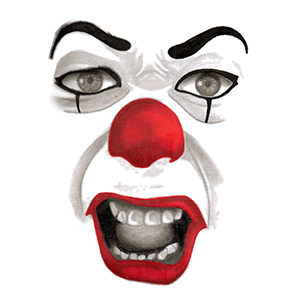
Coulrophobia [kool-ruh-foh-bee-uh] is a fear of clowns. The term is of recent origin, probably dating from the 1980s, and according to one analyst, ‘has been coined more on the Internet than in printed form because it does not appear in any previously published, psychiatric, unabridged, or abridged dictionary.’ However, the author later notes, ‘regardless of its less-than-verifiable etymology, coulrophobia exists in several lists.’ The prefix ‘coulro-‘ may be a neologism derived from an Ancient Greek word meaning ‘stilt-walker,’ although the concept of a clown as a figure of fun was unknown in classical Greek culture, stiltwalking was practiced.
According to a psychology professor at California State University, Northridge, young children are ‘very reactive to a familiar body type with an unfamiliar face.’ A study conducted by the University of Sheffield found that the children did not like clown décor in the hospital or physicians’ office settings. The survey was about children’s opinions on décor for an upcoming hospital redesign. Dr Penny Curtis, a researcher, stated ‘We found that clowns are universally disliked by children. Some found the clown images to be quite frightening and unknowable.’
Posted in Health, Humor, Language |
1 Comment »
March 13, 2013

A pocket universe is a concept in inflationary theory, proposed by theoretical physicist Alan Guth. It defines a realm like the one that contains the observable universe as only one of many inflationary zones. Astrophysicist Jean-Luc Lehners, of the Princeton Center for Theoretical Science, has argued that an inflationary universe produces pockets.
As he wrote in 2012, ‘Eternal inflation produces pocket universes with all physically allowed vacua and histories. Some of these pocket universes might contain a phase of slow-roll inflation, some might undergo cycles of cosmological evolution, and some might look like the Galilean genesis or other ’emergent’ universe scenarios. Which one of these types of universe we are most likely to inhabit depends on the measure we choose in order to regulate the infinities inherent in eternal inflation.’
read more »
Posted in Art, Language, Science |
Leave a Comment »
March 13, 2013

An Identicon is a visual representation of a hash value, usually of an IP address, that serves to identify a user of a computer system as a form of avatar while protecting the users’ privacy.
The original Identicon was a 9-block graphic, and the representation has been extended to other graphic forms by third parties.
read more »
Posted in Language, Technology |
Leave a Comment »
March 12, 2013
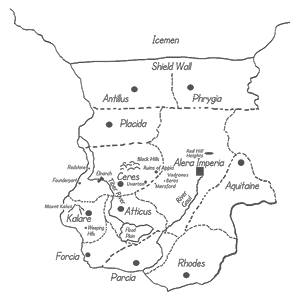
‘Codex Alera‘ is a fantasy book series by novelist Jim Butcher. The series chronicles the coming-of-age of a young man named Tavi in the realm of Alera, an empire similar to Rome, on the world of Carna. Every Aleran has some degree of command over elemental forces or spirits called furies, save for Tavi, who is considered unusual for his lack of one. As the aging First Lord struggles to maintain his hold on a realm on the brink of civil war, Tavi must use all of his intelligence to save Alera.
The inspiration for the series came from a bet Jim was challenged to by a member of the Delray Online Writer’s Workshop. The challenger bet that Jim could not write a good story based on a lame idea, and Jim countered that he could do it using two lame ideas of the challenger’s choosing. The ‘lame’ ideas given were ‘Lost Roman Legion,’ and ‘Pokémon.’
Posted in Art, Humor, Language |
Leave a Comment »
March 12, 2013

A national myth is an inspiring narrative or anecdote about a nation’s past. Such myths often serve as an important national symbol and affirm a set of national values. A national myth may sometimes take the form of a national epic. A considerable amount of related material is at civil religion. A national myth may be a legend or fictionalized narrative, which has been elevated to serious mythological, symbolical and esteemed level so as to be true to the nation.
It might simply over-dramatize true incidents, omit important historical details, or add details for which there is no evidence; or it might simply be a fictional story that no one takes to be true literally, but contains a symbolic meaning for the nation. The national folklore of many nations includes a founding myth, which may involve a struggle against colonialism or a war of independence. In some cases, the meaning of the national myth may become disputed among different parts of the population.
read more »
Posted in Language, Politics, World |
Leave a Comment »
March 12, 2013

A comfort object, transitional object, or security blanket is an item used to provide psychological comfort, especially in unusual or unique situations, or at bedtime for small children. Among toddlers, comfort objects may take the form of a blanket, a stuffed animal, or a favorite toy, and may be referred to by English-speaking toddlers as ‘blankey’ or ‘lovey.’ Stuffed toys are sometimes equipped in emergency vehicles and police patrol cars, to be given to victims involved in an accident or traumatic shock, to provide them comfort.
Paramedics are trained to treat physical shock with a wide array of blankets designed to preserve heat, blood, and wounds for life threatening traumas. Often charities will provide comfort objects such as blankets and quilts to survivors of disasters. Psychologists are experimenting with the use of heavy thick fleece blankets to replace restraints such as straitjackets. They have noted through experiments with autistic children that weighted blankets have a desirable soothing effect to help calm agitated patients.
read more »
Posted in Health, Language |
Leave a Comment »
March 9, 2013
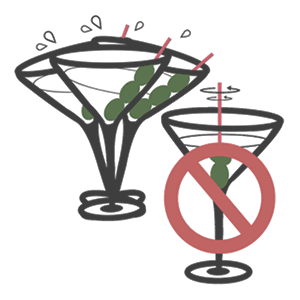
‘Shaken, not stirred‘ is a catchphrase of Ian Fleming’s fictional British Secret Service agent James Bond, and his preference for how he wished his martini prepared. The phrase first appears in the novel ‘Diamonds Are Forever’ (1956), though Bond does not actually say the line until ‘Dr. No’ (1958) but says it ‘shaken and not stirred’ instead of ‘shaken, not stirred.’ It was first uttered in the films by Sean Connery in Goldfinger in 1964 (though the villain Dr. Julius No offers this drink and utters those words in the first film, Dr. No, in 1962).
It was used in numerous Bond films thereafter with the notable exceptions of ‘You Only Live Twice,’ in which the drink is offered stirred, not shaken (Bond, ever the gentleman, ignores his host’s gaffe, telling him the drink is perfect), and ‘Casino Royale,’ in which Bond, after losing millions of dollars in a game of poker, is asked if he wants his martini shaken or stirred, and snaps, ‘Do I look like I give a damn?’
read more »
Posted in Food, Language |
Leave a Comment »
March 7, 2013
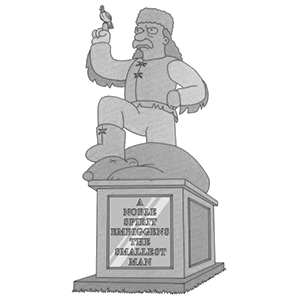
A neologism [nee-ol-uh-jiz-uhm] is a newly coined term, word, or phrase, that may be in the process of entering common use, but has not yet been accepted into mainstream language. Neologisms are often directly attributable to a specific person, publication, period, or event. The term is first attested in English in 1772, borrowed from French ‘néologisme.’ In psychiatry, the term is used to describe the use of words that have meaning only to the person who uses them, independent of their common meaning.
This tendency is considered normal in children, but in adults can be a symptom of psychopathy or a thought disorder (e.g. schizophrenia). People with autism also may create neologisms. Additionally, use of neologisms may be related to aphasia (sudden loss of language comprehension) acquired after brain damage resulting from a stroke or head injury. In theology, a ‘neologism’ is a relatively new doctrine (e.g. Transcendentalism). In this sense, a neologist is one who proposes either a new doctrine or a new interpretation of source material such as religious texts.
read more »
Posted in Health, Language |
Leave a Comment »
March 7, 2013

The Style Invitational, or Invite, is a long-running humor contest that ran first in the Style section of the Sunday ‘Washington Post’ before moving to Saturday’s Style and later returning to the Sunday paper. Started in 1993, it has run weekly, except for a hiatus in late 1999. In that time, it has had two anonymous head judges who select winning entries: ‘The Czar’ abdicated in late 2003, leaving the contest in the hands of his former associate, ‘The Empress.’
The humor ranges from an intellectual vein to a less mature style, and frequently touches on sophisticated political or historical allusions. While the contest theme changes every week, some popular contests are periodically repeated. The S.I. has a loyal following of self-proclaimed ‘Losers,’ who refer to having a contest entry published as ‘getting ink.’
read more »
Posted in Games, Humor, Language |
1 Comment »
March 6, 2013

Thomas Frank (b. 1965) is an American political analyst, historian, and journalist. He co-founded and edited ‘The Baffler magazine.’ He is a former columnist for the ‘Wall Street Journal,’ authoring ‘The Tilting Yard’ from 2008 to 2010. Frank is a historian of culture and ideas and analyzes trends in American electoral politics and propaganda, advertising, popular culture, mainstream journalism and economics.
With his writing, he explores the rhetoric and impact of the ‘Culture Wars’ in American political life, and the relationship between politics and culture in the United States. Frank started his political journey as a College Republican, but has come to be highly critical of conservatism, especially the presidency of George W. Bush. Frank summarized the thesis of his book ‘The Wrecking Crew: How Conservatives Rule’ as ‘Bad government is the natural product of rule by those who believe government is bad.’
Posted in Language, Money, Politics |
Leave a Comment »
March 5, 2013
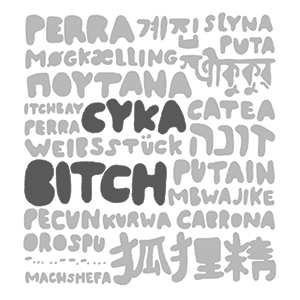
The Bitch Wars occurred within the Soviet labor camp system between 1945 and 1953 (around the death of Joseph Stalin). The Russian word ‘suka’ (literally, ‘bitch’) has a stronger negative connotation than its English equivalent.
In Russian criminal argot, it specifically refers to a person from the criminal world who had cooperated with law enforcement or the government, or ‘went bitch.’ Within the Russian prison system, there was a historical and social structure that had existed since the Tsarist era. One of the important tenets of the system was that members would not serve or collaborate with the Tsarist and later Soviet government. This rule encompassed any kind of collaboration, not only ‘snitching’ or ‘ratting.’
read more »
Posted in Language, War, World |
Leave a Comment »


 The Daily Omnivore