March 23, 2013

Confessional poetry is a style of poetry that emerged in the United States during the 1950s and 1960s that has been describe as poetry ‘of the personal.’ The content of confessional poems is autobiographical and marked by its exploration of subject matter that was considered taboo at the time. This subject matter included topics like mental illness, sexuality, and suicide.
The school of poetry that became known as ‘Confessional Poetry’ was associated with several poets who redefined American poetry in the generation following World War II, including Robert Lowell, Sylvia Plath, John Berryman, Anne Sexton, Allen Ginsberg, and W. D. Snodgrass.
read more »
Posted in Art, Language |
Leave a Comment »
March 22, 2013
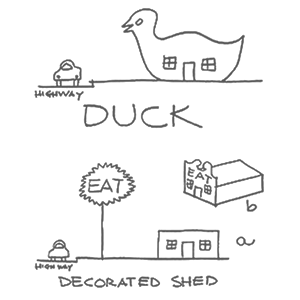
The Big Duck is a ferrocement (cement, sand, and steel mesh) building in the shape of a duck located in Flanders, New York, on Long Island. It was originally built in 1931 by duck farmer Martin Maurer in nearby Riverhead, and used as a shop to sell ducks and duck eggs.
The Big Duck is a prime example of literalism in advertising. The building measures 18 feet (5.5 m) wide, 30 feet (9.1 m) long and 20 feet (6.1 m) tall to the top of the head. The duck’s eyes are made from Ford Model T tail lights and the interior floor space is confined to 11 feet (3.4 m) by 15 feet (4.6 m).
read more »
Posted in Humor, Language, Money |
Leave a Comment »
March 20, 2013

The rasputitsa refers to the biannual mud seasons when unpaved roads become difficult to traverse in parts of Belarus, Russia, and Ukraine. The word may be translated as the ‘quagmire season’ because during this period the large flatlands become extremely muddy and marshy, as do most unpaved roads. The rasputitsa occurs more strongly in the spring due to the melting snow but it usually recurs in the fall due to frequent heavy rains. The rasputitsa seasons of Russia are well known as a great defensive advantage in wartime. Napoleon found the mud in Russia to be a very great hindrance in 1812.
During the Second World War the month-long muddy period slowed down the German advance during the Battle of Moscow, and may have helped save the Soviet capital, as well as the presence of ‘General Winter,’ that followed the autumn rasputitsa period – this sort of wintertime hindrance to German military motor vehicle transport on the Eastern Front partly inspired the design and mass production of a unique fully tracked artillery tractor for such conditions.
read more »
Posted in Language, War, World |
Leave a Comment »
March 18, 2013

Paul Krassner (b. 1932) is an American author, journalist, stand-up comedian, and the founder, editor and a frequent contributor to the freethought magazine ‘The Realist,’ first published in 1958. Krassner became a key figure in the counterculture of the 1960s as a member of Ken Kesey’s ‘Merry Pranksters’ and a founding member of the Yippies (Youth International Party).
Krassner was a child violin prodigy (and was the youngest person ever to play Carnegie Hall, in 1939 at age six). His parents were Jewish, but Krassner is firmly secular, considering religion ‘organized superstition.’
read more »
Posted in Humor, Language, Politics |
1 Comment »
March 18, 2013
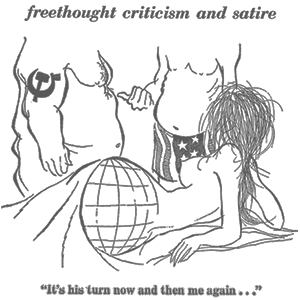
The Realist was a pioneering magazine of ‘social-political-religious criticism and satire, ‘intended as a hybrid of a grown-ups version of ‘Mad’ and Lyle Stuart’s anti-censorship monthly ‘The Independent.’ Edited and published by journalist and stand-up comedian Paul Krassner, and often regarded as a milestone in the American underground or countercultural press of the mid-20th century, it was a nationally-distributed newsstand publication as early as 1959.
Publication was discontinued in 2001. First published in the spring of 1958 in New York City in the offices of ‘Mad,’ ‘The Realist’ appeared on a fairly regular schedule during the 1960s and then on an irregular schedule after the early 1970s. In 1984, it was revived as a much smaller newsletter. Articles and cartoons from the magazine were collected in a book, ‘The Best of the Realist.’
read more »
Posted in Humor, Language, Politics |
Leave a Comment »
March 13, 2013
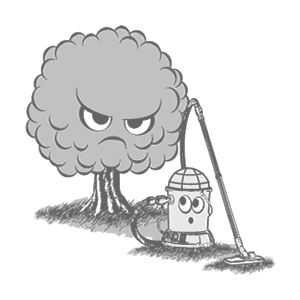
A power vacuum is, in its broadest sense, an expression for a condition that exists when someone has lost control of something and no one has replaced them. It is usually used to refer to a political situation that can occur when a government has no identifiable central authority.
The metaphor implies that, like a physical vacuum, other forces will tend to ‘rush in’ to fill the vacuum as soon as it is created, perhaps in the form of an armed militia or insurgents, military coup, warlord or dictator.
read more »
Posted in Language, Politics |
Leave a Comment »
March 13, 2013


Role suction is a term introduced in the USA by pyschologist Fritz Redl in the mid-twentieth century to describe the power of a social group to allocate roles willy-nilly to its members. British psychoanalyst W. R. Bion’s group dynamics further explored the ways whereby the group (unconsciously) allocates particular functions to particular individuals in order to have its covert emotional needs met; and the process has recently been highlighted anew within the ‘Systems Centered Therapy’ of Yvonne Agazarian (a form of group therapy).
Among regularly occurring group roles are those of the ‘scapegoat’ for the group’s troubles; the ‘joker’; the ‘peacemaker’; the ‘critic/spokesperson’ for group standards; the ‘idol,’ or upholder of the group ideal; and the ‘identified patient’ (the person in a dysfunctional group who has been subconsciously selected to act out the group’s inner conflicts as a diversion). In mixed gender groups, women may be disproportionately pressured by role suction into playing a nurturing/peacemaker role.
read more »
Posted in Health, Language, Science |
Leave a Comment »
March 13, 2013

Coulrophobia [kool-ruh-foh-bee-uh] is a fear of clowns. The term is of recent origin, probably dating from the 1980s, and according to one analyst, ‘has been coined more on the Internet than in printed form because it does not appear in any previously published, psychiatric, unabridged, or abridged dictionary.’ However, the author later notes, ‘regardless of its less-than-verifiable etymology, coulrophobia exists in several lists.’ The prefix ‘coulro-‘ may be a neologism derived from an Ancient Greek word meaning ‘stilt-walker,’ although the concept of a clown as a figure of fun was unknown in classical Greek culture, stiltwalking was practiced.
According to a psychology professor at California State University, Northridge, young children are ‘very reactive to a familiar body type with an unfamiliar face.’ A study conducted by the University of Sheffield found that the children did not like clown décor in the hospital or physicians’ office settings. The survey was about children’s opinions on décor for an upcoming hospital redesign. Dr Penny Curtis, a researcher, stated ‘We found that clowns are universally disliked by children. Some found the clown images to be quite frightening and unknowable.’
Posted in Health, Humor, Language |
1 Comment »
March 13, 2013

A pocket universe is a concept in inflationary theory, proposed by theoretical physicist Alan Guth. It defines a realm like the one that contains the observable universe as only one of many inflationary zones. Astrophysicist Jean-Luc Lehners, of the Princeton Center for Theoretical Science, has argued that an inflationary universe produces pockets.
As he wrote in 2012, ‘Eternal inflation produces pocket universes with all physically allowed vacua and histories. Some of these pocket universes might contain a phase of slow-roll inflation, some might undergo cycles of cosmological evolution, and some might look like the Galilean genesis or other ’emergent’ universe scenarios. Which one of these types of universe we are most likely to inhabit depends on the measure we choose in order to regulate the infinities inherent in eternal inflation.’
read more »
Posted in Art, Language, Science |
Leave a Comment »
March 13, 2013

An Identicon is a visual representation of a hash value, usually of an IP address, that serves to identify a user of a computer system as a form of avatar while protecting the users’ privacy.
The original Identicon was a 9-block graphic, and the representation has been extended to other graphic forms by third parties.
read more »
Posted in Language, Technology |
Leave a Comment »
March 12, 2013
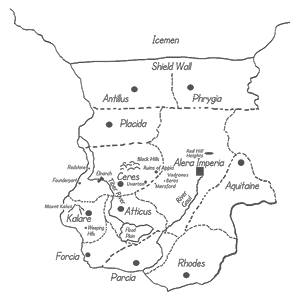
‘Codex Alera‘ is a fantasy book series by novelist Jim Butcher. The series chronicles the coming-of-age of a young man named Tavi in the realm of Alera, an empire similar to Rome, on the world of Carna. Every Aleran has some degree of command over elemental forces or spirits called furies, save for Tavi, who is considered unusual for his lack of one. As the aging First Lord struggles to maintain his hold on a realm on the brink of civil war, Tavi must use all of his intelligence to save Alera.
The inspiration for the series came from a bet Jim was challenged to by a member of the Delray Online Writer’s Workshop. The challenger bet that Jim could not write a good story based on a lame idea, and Jim countered that he could do it using two lame ideas of the challenger’s choosing. The ‘lame’ ideas given were ‘Lost Roman Legion,’ and ‘Pokémon.’
Posted in Art, Humor, Language |
Leave a Comment »
March 12, 2013

A national myth is an inspiring narrative or anecdote about a nation’s past. Such myths often serve as an important national symbol and affirm a set of national values. A national myth may sometimes take the form of a national epic. A considerable amount of related material is at civil religion. A national myth may be a legend or fictionalized narrative, which has been elevated to serious mythological, symbolical and esteemed level so as to be true to the nation.
It might simply over-dramatize true incidents, omit important historical details, or add details for which there is no evidence; or it might simply be a fictional story that no one takes to be true literally, but contains a symbolic meaning for the nation. The national folklore of many nations includes a founding myth, which may involve a struggle against colonialism or a war of independence. In some cases, the meaning of the national myth may become disputed among different parts of the population.
read more »
Posted in Language, Politics, World |
Leave a Comment »



