September 24, 2012

Misotheism [miss-oh-thee-iz-uhm] is the ‘hatred of God(s).’ In some varieties of polytheism, it was considered possible to inflict punishment on gods by ceasing to worship them. Thus, Hrafnkell, protagonist of the eponymous Icelandic saga set in the 10th century, as his temple to Freyr is burnt and he is enslaved states that ‘I think it is folly to have faith in gods,’ never performing another sacrifice.
German mythologist Jacob Grimm in his ‘Teutonic Mythology’ observes that: ‘It is remarkable that Old Norse legend occasionally mentions certain men who, turning away in utter disgust and doubt from the heathen faith, placed their reliance on their own strength and virtue.’ ‘…in themselves they trusted.” In monotheism, the sentiment arises in the context of ‘theodicy’ (the problem of evil, the Euthyphro dilemma). A famous literary expression of misotheistic sentiment is Goethe’s ‘Prometheus,’ composed in the 1770s.
read more »
Posted in Language, Philosophy, World |
Leave a Comment »
September 24, 2012

New Atheism is the name given to the ideas promoted by a collection of 21st-century atheist writers who have advocated the view that ‘religion should not simply be tolerated but should be countered, criticized, and exposed by rational argument wherever its influence arises.’
The term is commonly associated with individuals such as Richard Dawkins, Daniel Dennett, Sam Harris, and Christopher Hitchens (together called ‘the Four Horsemen of New Atheism’ in a 2007 debate they held on their criticisms of religion, a name that has stuck) and Victor J. Stenger. Several best-selling books by these authors, published between 2004 and 2007, form the basis for much of the discussion of New Atheism.
read more »
Posted in Language, Philosophy, Science |
Leave a Comment »
September 18, 2012

Eudaimonia [yew-day-mo-nee-uh] is a Greek word commonly translated as ‘happiness’ or ‘welfare’; however, ‘human flourishing’ has been proposed as a more accurate translation. It is a central concept in Aristotelian ethics and political philosophy, along with the terms ‘aretē’ (‘virtue’ or ‘excellence’) and ‘phronesis’ (‘practical or ethical wisdom’).
In Aristotle’s works, eudaimonia was (based on older Greek tradition) used as the term for the highest human good, and so it is the aim of practical philosophy, including ethics and political philosophy, to consider (and also experience) what it really is, and how it can be achieved.
read more »
Posted in Health, Language, Philosophy |
Leave a Comment »
September 18, 2012

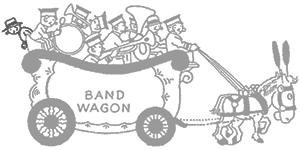
Basking in reflected glory (BIRGing) is a self-serving cognition whereby an individual associates themself with successful others such that another’s success becomes their own. What is interesting about BIRGing is that the simple affiliation of another’s success is enough to stimulate self glory. The person engaging in BIRGing does not even need to have been personally involved in the successful action with which they are affiliating themselves.
Examples of BIRGing include anything from sharing a home state with a past or present famous person, to religious affiliations, to sports teams. For example, a parent with a bumper sticker reading ‘My child is an honor student’ is basking in the reflected glory of their child. Within social psychology, BIRGing is thought to enhance self-esteem and to be a component of self-management.
read more »
Posted in Health, Language, Money |
Leave a Comment »
September 18, 2012
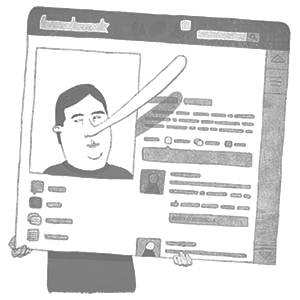
Pseudologia fantastica, mythomania, or pathological lying are three of several terms applied by psychiatrists to the behavior of habitual or compulsive lying. It was first described in the medical literature in 1891 by Anton Delbrueck. Although it is a controversial topic, pathological lying has been defined as ‘falsification entirely disproportionate to any discernible end in view, may be extensive and very complicated, and may manifest over a period of years or even a lifetime.’
A defining characteristic of pseudologia fantastica is that the stories told are not entirely improbable and often have some element of truth. They are not a manifestation of delusion or some broader type of psychosis: upon confrontation, the teller can admit them to be untrue, even if unwillingly.
read more »
Posted in Health, Language |
Leave a Comment »
September 17, 2012

A self-defeating prophecy is the complementary opposite of a self-fulfilling prophecy: a prediction that prevents what it predicts from happening. This is also known as the ‘prophet’s dilemma.’ A self-defeating prophecy can be the result of rebellion to the prediction.
If the audience of a prediction has an interest in seeing it falsified, and its fulfillment depends on their actions or inaction, their actions upon hearing it will make the prediction less plausible. If a prediction is made with this outcome specifically in mind, it is commonly referred to as reverse psychology. Also, when working to make a premonition come true, one can inadvertently change the circumstances so much that the prophecy cannot come true.
read more »
Posted in Language, Philosophy, Science |
Leave a Comment »
September 17, 2012
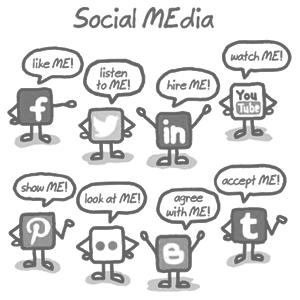
The Culture of Narcissism: American Life in an Age of Diminishing Expectations is a book by the cultural historian Christopher Lasch, first published in 1979. It explores the roots and ramifications of the normalizing of pathological narcissism in 20th century American culture using psychological, cultural, artistic, and historical synthesis.
The book proposes that post-war, late-capitalist America, through the effects of ‘organized kindness’ on the traditional family structure, has produced a personality-type consistent with clinical definitions of ‘pathological narcissism.’ This pathology is not akin to everyday narcissism — a hedonistic egoism — but rather a very weak sense of self requiring constant external validation. For Lasch, ‘pathology represents a heightened version of normality.’
read more »
Posted in Health, Language, Money |
1 Comment »
September 16, 2012

To have one’s cake and eat it too is a popular English idiomatic proverb or figure of speech most often used negatively, to connote the idea of consuming a thing whilst managing to preserve it. This may also indicate having or wanting more than one can handle or deserve, or trying to have two incompatible things. The proverb’s meaning is similar to the phrases, ‘you can’t have it both ways’ and ‘you can’t have the best of both worlds.’
Conversely, in the positive sense, it would refer to ‘having it both ways’ or ‘having the best of both worlds.’ This concept, known as opportunity cost, is one of the most important economic concepts. The phrase’s earliest recording is from 1546 as ‘wolde you bothe eate your cake, and have your cake?’ (John Heywood’s ‘A dialogue Conteinyng the Nomber in Effect of All the Prouerbes in the Englishe Tongue’). This phrase alludes to the impossibility of eating your cake and still having it afterwards.
read more »
Posted in Food, Language, Money |
Leave a Comment »
September 16, 2012

Artistic license is a colloquial term, sometimes euphemism, used to denote the distortion of fact, alteration of the conventions of grammar or language, or rewording of pre-existing text made by an artist to improve a piece of art. The artistic license may also refer to the ability of an artist to apply smaller distortions, such as a poet ignoring some of the minor requirements of grammar for poetic effect.
For example, Mark Antony’s ‘Friends, Romans, Countrymen, lend me your ears’ from Shakespeare’s ‘Julius Caesar’ would technically require the word ‘and’ before ‘countrymen,’ but the conjunction ‘and’ is omitted to preserve the rhythm of iambic pentameter (syllabic pattern). Conversely, on the next line, the end of ‘I come to bury Caesar, not to praise him’ has an extra syllable because omitting the word ‘him’ would make the sentence unclear, but adding a syllable at the end would not disrupt the meter. Both of these are examples of artistic license.
read more »
Posted in Art, Language |
Leave a Comment »
September 16, 2012
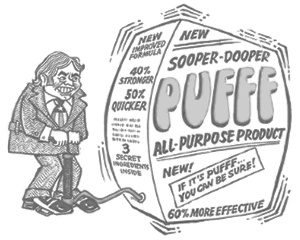

Puffery [puhf-uh-ree] as a legal term refers to promotional statements and claims that express subjective rather than objective views, which no ‘reasonable person’ would take literally. Puffery serves to ‘puff up’ an exaggerated image of what is being described and is especially featured in testimonials. In a legal context, the term originated in the English Court of Appeal case, which centered on whether a monetary reimbursement should be paid when an influenza preventive device failed to work.
The manufacturers had paid for advertising stating that £100 would be paid in such circumstances then failed to follow through. Part of their defense was that such a statement was ‘mere puff’ and not meant to be taken seriously. While the defense ultimately lost the case the principle was confirmed that certain statements made by advertisers, that were obviously not made in a serious manner, could be exempt from usual rules relating to promises in open contracts.
read more »
Posted in Language, Money, Politics |
Leave a Comment »
September 14, 2012

Afrofuturism is an emergent literary and cultural aesthetic that combines elements of science fiction, historical fiction, fantasy, Afrocentricity, and magic realism with non-Western cosmologies in order to critique not only the present-day dilemmas of people of color, but also to revise, interrogate, and re-examine the historical events of the past.
Examples of seminal afrofuturistic works include the novels of Samuel R. Delany and Octavia Butler; the canvases of Jean-Michel Basquiat and the photography of Renée Cox; as well as the extraterrestrial mythos of Parliament-Funkadelic and Sun Ra, and the music of DJ Spooky.
read more »
Posted in Art, Language, World |
1 Comment »
September 14, 2012

In linguistics, an eggcorn is an idiosyncratic substitution of a word or phrase for a word or words that sound similar or identical in the speaker’s dialect. The new phrase introduces a meaning that is different from the original, but plausible in the same context, such as ‘old-timers’ disease’ for ‘Alzheimer’s disease.’ This is as opposed to a malapropism, where the substitution creates a nonsensical phrase. Classical malapropisms generally derive their comic effect from the fault of the user, while eggcorns are errors that exhibit creativity or logic. Eggcorns often involve replacing an unfamiliar, archaic, or obscure word with a more common or modern word (‘baited breath’ for ‘bated breath’).
The term eggcorn was coined by professor of linguistics Geoffrey Pullum in 2003, in response to an article by Mark Liberman on ‘Language Log,’ a blog for linguists. Liberman discussed the case of a woman who substitutes the phrase ‘egg corn’ for the word ‘acorn,’ arguing that the precise phenomenon lacked a name; Pullum suggested using ‘eggcorn’ itself. The phenomenon is very similar to the form of wordplay known as the pun, except that, by definition, the speaker (or writer) intends the pun to have some effect on the recipient, whereas one who speaks or writes an eggcorn is unaware of the mistake.
Posted in Humor, Language |
Leave a Comment »



