August 23, 2012

The Moth is a non-profit group based in New York City dedicated to the art and craft of storytelling. It was founded in 1997 by poet and novelist George Dawes Green, who wanted to recreate the feeling of sultry summer evenings in his native Georgia, when moths were attracted to the light on the porch where he and his friends would gather to spin spellbinding tales. George and his original group of storytellers called themselves ‘The Moths,’ and George took the name with him to New York. The organization now runs a number of different storytelling events in New York City, Los Angeles, Chicago, Detroit, and other American cities, often featuring prominent literary and cultural personalities. Previous notable storytellers have included Margaret Cho, Ethan Hawke, Malcolm Gladwell, Darryl ‘DMC’ McDaniels, George Plimpton, Al Sharpton, Moby, Lili Taylor, and Sam Shepard.
The organization also holds ‘StorySLAM’ events, storytelling competitions open to everyone. The Moth also runs a community program that offers storytelling workshops free of charge to high school students and underprivileged New Yorkers. The Moth offers a weekly podcast, which provides free audio of stories from all types of Moth events. In 2009, the organization also launched a national public radio show, ‘The Moth Radio Hour.’ Andy Borowitz became the Moth’s primary host in 1999. The organization’s annual fundraising event is called the Moth Ball, where the annual Moth award is presented. The 2008 Moth Award was presented to Salman Rushdie.
Posted in Art, Games, Language |
Leave a Comment »
August 23, 2012

Pocket dialing (also known as butt dialing) refers to the accidental placement of a phone call while a person’s mobile phone or cordless phone is in the owner’s pocket or handbag. If the caller remains unaware, the recipient will sometimes overhear whatever is happening in the caller’s vicinity. Typically, the call is caused by objects in a person’s pocket or bag poking buttons on the phone. Because of typical sequences of button presses, the accidentally dialed number is often one that has been recently called from that phone, or one near the beginning or end of the phone’s contact list; a consequence of this is that people whose names begin with letters near the beginning or the end of the alphabet sometimes receive more accidental calls.
The keypad lock feature found on most mobile phones is intended to help prevent accidental dialing. However, it is still possible to forget to activate this lock (if the phone does not automatically activate it after a timeout), or to deactivate it accidentally. Many phones allow the emergency number to be called even when the keylock is active. In addition to the inconvenience and embarrassment that may result from an erroneously dialed number, the phenomenon can have other consequences including using up a phone user’s airtime minutes. Apps to prevent pocket dialing exist for smartphones. Several are available for Android based phones such as Call Confirm.
Posted in Humor, Language, Technology |
1 Comment »
August 23, 2012

A hot dog is a sausage served in a sliced bun. It is very often garnished with mustard, ketchup, onions, mayonnaise, relish, cheese, chili, and/or sauerkraut. Claims about hot dog invention are difficult to assess, as stories assert the creation of the sausage, the placing of the sausage (or another kind of sausage) on bread or a bun as finger food, the popularization of the existing dish, or the application of the name ‘hot dog’ to a sausage and bun combination most commonly used with ketchup or mustard and sometimes relish.
The word frankfurter comes from Frankfurt, Germany, where pork sausages served in a bun similar to hot dogs originated. These sausages, Frankfurter Würstchen (‘little sausage’), were known since the 13th century and given to the people on the event of imperial coronations, starting with the coronation of Maximilian II, Holy Roman Emperor as King. Wiener refers to Vienna, Austria, whose German name is ‘Wien,’ home to a sausage made of a mixture of pork and beef (the word ‘hamburger’ also derives from a German-speaking city, Hamburg).
read more »
Posted in Food, Language, World |
Leave a Comment »
August 22, 2012

The Mindset List is an annual compilation of the values that shape the worldview (or ‘mindset’) of students about 18 years old and entering college and, to a lesser extent, adulthood. It is co-authored by Ron Nief, ‘Public Affairs’ Director Emeritus, and Tom McBride, Professor of English and Keefer Professor of Humanities, both at Beloit College in Wisconsin.
It originated in 1997 as an e-mail forward, without author credits, passed on by then College Statistician Richard Miller to Ron Nief, who passed it on to peers at other schools. The first Beloit-created Mindset List appeared in the fall of 1998 after requests from peers who mistook the forward as having originated with Nief. It now appears every August as American first-year students enter college.
Posted in Education, Humor, Language |
Leave a Comment »
August 15, 2012
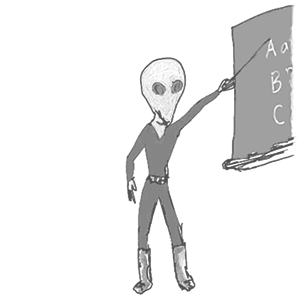
In the field of psychology, nativism is the view that certain skills or abilities are ‘native’ or hard wired into the brain at birth. This is in contrast to empiricism, the ‘blank slate’ or tabula rasa view, which states that the brain has inborn capabilities for learning from the environment but does not contain content such as innate beliefs. Some nativists believe that specific beliefs or preferences are hard wired. For example, one might argue that some moral intuitions are innate or that color preferences are innate.
A less established argument is that nature supplies the human mind with specialized learning devices. This latter view differs from empiricism only to the extent that the algorithms that translate experience into information may be more complex and specialized in nativist theories than in empiricist theories. However, empiricists largely remain open to the nature of learning algorithms and are by no means restricted to the historical associationist mechanisms of behaviorism (which argued that the content of consciousness can be explained by the association and reassociation of irreducible sensory and perceptual elements).
read more »
Posted in Language, Philosophy, Science |
Leave a Comment »
August 14, 2012
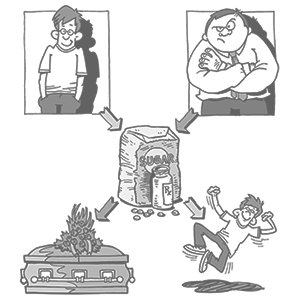
In medicine, a nocebo [no-see-bo] reaction or response refers to harmful, unpleasant, or undesirable effects a subject manifests after receiving an inert dummy drug or placebo. Nocebo responses are not chemically generated and are due only to the subject’s pessimistic belief and expectation that the inert drug will produce negative consequences. In these cases, there is no ‘real’ drug involved, but the actual negative consequences of the administration of the inert drug, which may be physiological, behavioral, emotional, and/or cognitive, are nonetheless real.
An example of nocebo effect would be someone who dies of fright after being bitten by a non-venomous snake. The term ‘nocebo’ (Latin: ‘I will harm’) was chosen by Walter Kennedy, in 1961, to denote the counterpart of one of the more recent applications of the term placebo (Latin: ‘I will please’); namely, that of a placebo being a drug that produced a beneficial, healthy, pleasant, or desirable consequence in a subject, as a direct result of that subject’s beliefs and expectations. The term ‘nocebo’ can also refer to positive outcomes based upon the patient’s expectation of that outcome.
read more »
Posted in Drugs, Health, Language |
1 Comment »
August 13, 2012

Kinderwhore was an image used by a handful of mostly female punk rock bands in the US during the early to mid 1990s. The kinderwhore look consisted of torn, ripped tight or low-cut babydoll dresses or nighties, heavy makeup, and leather boots or Mary–Jane shoes of various colors.
The exact origin of the kinderwhore image is up for debate, though it is widely accepted that Kat Bjelland of Babes in Toyland was the first to define it and Courtney Love of Hole was the first to popularize it. Christina Amphlett of Divinyls can clearly be seen sporting the image on the cover of her band’s 1983 album, ‘Desperate.’ Love declared in an interview in the Los Angeles zine ‘Ben Is Dead’ that she took the style from Amphlett.
Posted in Art, Language, Sex |
1 Comment »
August 13, 2012

‘Who breaks a butterfly upon a wheel?‘ is a quotation – sometimes misquoted with ‘on’ in place of ‘upon’ – from Alexander Pope’s ‘Epistle to Dr Arbuthnot’ of 1735. It can be taken as referring to putting massive effort into achieving something minor or unimportant, and alludes to ‘breaking on the wheel,’ a form of torture in which victims had their long bones broken by an iron bar while tied to a Catherine wheel.
William Rees-Mogg, as editor of ‘The Times’ newspaper, used the ‘on a wheel’ version of the quotation as the heading (set in capital letters) for an editorial in 1967 about the ‘Redlands’ court case, which had resulted in prison sentences for Rolling Stones members Keith Richards and Mick Jagger. The philosopher Mary Midgley used a variation on the phrase in an article in the journal ‘Philosophy’ written to counter a review praising ‘The Selfish Gene’ by Richard Dawkins, where she cuttingly said that she had ‘not attended to Dawkins, thinking it unnecessary to break a butterfly upon a wheel.’
Posted in Language, Politics, Sex |
1 Comment »
August 10, 2012
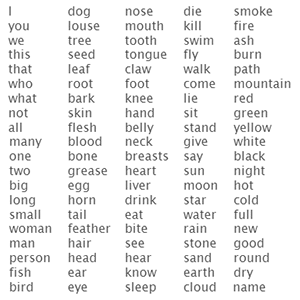
A Swadesh [sway-desh] list is a compilation of concepts for which words are deemed to exist in the largest number of languages. Translations of a Swadesh list into a set of languages allows researchers to quantify the interrelatedness of those languages.
Swadesh lists are named after the U.S. linguist Morris Swadesh. They are used in lexicostatistics (the quantitative assessment of the relatedness of languages) and glottochronology (the dating of language divergence).
read more »
Posted in Language, Science, World |
Leave a Comment »
August 10, 2012

Thomas Pynchon [pin-chuhn] (b. 1937) is an American novelist. A MacArthur Fellow, he is noted for his dense and complex novels. Both his fiction and non-fiction writings encompass a vast array of subject matter, styles, and themes, including (but not limited to) the fields of history, science, and mathematics. For his most praised novel, ‘Gravity’s Rainbow,’ Pynchon won the 1974 U.S. National Book Award for Fiction (which he declined).
After publishing several short stories in the late 1950s and early 1960s, he began composing the novels for which he is best known: ‘V.’ (1963), ‘The Crying of Lot 49’ (1966), ‘Gravity’s Rainbow’ (1973), and ‘Mason & Dixon’ (1997). Pynchon is also known for being very private; very few photographs of him have ever been published, and rumors about his location and identity have circulated since the 1960s.
read more »
Posted in Art, Humor, Language |
Leave a Comment »
August 10, 2012

Gravity’s Rainbow is a 1973 book written by Thomas Pynchon; it is his third and most celebrated novel. The narrative is set primarily in Europe at the end of World War II and centers on the design, production and dispatch of V-2 rockets by the German military, and, in particular, the quest undertaken by several characters to uncover the secret of a mysterious device named the ‘Schwarzgerät’ (‘black device’) that is to be installed in a rocket with the serial number ‘00000.’
Gravity’s Rainbow is transgressive, as it questions and inverts social standards of deviance and disgust and transgresses boundaries of Western culture and reason.
read more »
Posted in Humor, Language, War |
1 Comment »
August 9, 2012


Transgressive fiction is a genre of literature that focuses on characters who feel confined by the norms and expectations of society and who break free of those confines in unusual and/or illicit ways. Because they are rebelling against the basic norms of society, protagonists of transgressional fiction may seem mentally ill, anti-social, or nihilistic. The genre deals extensively with taboo subject matters such as drugs, sex, violence, incest, pedophilia, and crime.
The term ‘transgressive fiction’ was coined by Los Angeles Times literary critic Michael Silverblatt. Rene Chun, a journalist for ‘The New York Times,’ described is as, ‘A literary genre that graphically explores such topics as incest and other aberrant sexual practices, mutilation, the sprouting of sexual organs in various places on the human body, urban violence and violence against women, drug use, and highly dysfunctional family relationships, and that is based on the premise that knowledge is to be found at the edge of experience and that the body is the site for gaining knowledge.’
read more »
Posted in Language, Politics, Sex |
1 Comment »


 The Daily Omnivore