May 22, 2012
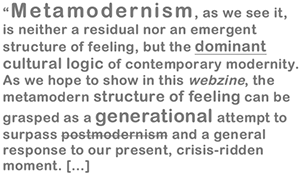
Metamodernism is a term employed to situate and explain recent developments across current affairs, critical theory, philosophy, architecture, art, cinema, music and literature which are emerging from and reacting to postmodernism.
The term metamodernism was introduced as an intervention in the post-postmodernism debate by the cultural theorists Timotheus Vermeulen and Robin van den Akker in 2010. In their article ‘Notes on metamodernism’ they assert that the 2000s are characterized by the return of typically modern positions without altogether forfeiting the postmodern mindsets of the 1990s and 1980s.
read more »
Posted in Art, Language, Philosophy |
Leave a Comment »
May 22, 2012

Post-Postmodernism is a general term used to describe new developments emerging from Postmodernism. It is a positive idea that faith, sincerity, and trust can be better for society than Postmodern irony.
The term ‘Post-Postmodernism’ was initially coined by seminal cultural theorist Alice Sanders in her magnum opus ‘The Shadow of the Rainbow.’
read more »
Posted in Language, Philosophy, Politics |
1 Comment »
May 22, 2012

Postmodernism is an era and a broad movement that developed in the mid to late 20th century that rejects the idea of objective truth and universal social progress. Starting with the 18th century Enlightenment, and for more than a century there was widespread belief that science and knowledge would improve the world; social progress would be inevitable. Modernism in particular held these beliefs. Postmodernism challenges that notion.
Although the term was first used around 1870, its modern appearance was to express criticism of modern architecture in 1949, leading to the postmodern architecture movement (a return to surface ornament, historical reference in decorative forms, and less boxy shapes). Postmodernism is not a method, but rather a way of approaching traditional ideas and practices in non-traditional ways that deviate from pre-established modes. Postmodernism gained significant popularity in the 1950s and dominated literature and art by the 1960s.
read more »
Posted in Art, Language, Philosophy |
Leave a Comment »
May 21, 2012
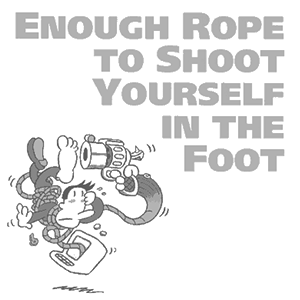
Akrasia [uh-kray-juh] (ancient Greek: ‘lacking command [over oneself]’) is the state of acting against one’s better judgement. The adjective form is ‘akratic.’ The problem goes back at least as far as Plato. Socrates asks precisely how this is possible—if one judges action A to be the best course of action, why would one do anything other than A? In the dialogue ‘Protagoras,’ Socrates attests that akrasia is an illogical moral concept, claiming ‘No one goes willingly toward the bad.’
If a person examines a situation and decides to act in the way he determines to be best, he will actively pursue this action, as the best course is also the good course, i.e. man’s natural goal. An all-things-considered assessment of the situation will bring full knowledge of a decision’s outcome and worth linked to well-developed principles of the good. A person, according to Socrates, never chooses to act poorly or against his better judgment; actions that go against what is best are only a product of being ignorant of facts or knowledge of what is best or good.
read more »
Posted in Language, Philosophy |
2 Comments »
May 21, 2012

The drop is the point in a track where a switch of rhythm or bass line occurs and usually follows a recognizable build section and break. In Hip-Hop and electronic music, the reintroduction of the full bass line and drums is known as the drop. In Dubstep, the drop involves a full bass line and commonly a ‘wobble’ bass or ‘vowel’ bass accompanied by a strong shuffling beat.
In Metalcore sub-genres, bass drops are often utilized under the first chord of a breakdown, to emphasize the breakdown and give it a pronounced presence. In drum and bass, DJs sometimes perform what is called the ‘double drop’: beat matching two tracks in a way that the drop, and hence the respective climaxes, occur at the same time.
Posted in Art, Language |
1 Comment »
May 21, 2012

Magic realism is an aesthetic style or genre of fiction in which magical elements blend with the real world. The story explains these magical elements as real occurrences, presented in a straightforward manner that places the ‘real’ and the ‘fantastic’ in the same stream of thought. One example, is when a character in the story continues to be alive beyond the normal length of life and this is subtly depicted by the character being present throughout many generations.
On the surface the story has no clear magical attributes and everything is conveyed in a real setting, but such a character breaks the rules of our real world. The author may give precise details of the real world such as the date of birth of a reference character and the army recruitment age, but such facts help to define an age for the fantastic character of the story that would turn out to be an abnormal occurrence like someone living for two hundred years.
read more »
Posted in Art, Language, World |
Leave a Comment »
May 21, 2012
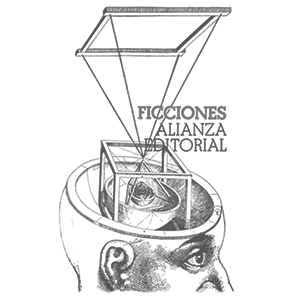
Jorge Luis Borges [bawr-hes] (1899 – 1986) was an Argentine writer whose work embraces the ‘character of unreality in all literature’; his most famous books, ‘Ficciones’ (1944) and ‘The Aleph’ (1949), are compilations of short stories interconnected by common themes such as dreams, labyrinths, libraries, mirrors, animals, fictional writers, religion, and God.
His works have contributed to the genre of science fiction and magic realism (a reaction against the realism/naturalism of the nineteenth century). In fact, critic Angel Flores, the first to use the term, set the beginning of this movement with Borges’s ‘Historia universal de la infamia’ (‘A Universal History of Infamy’) (1935). Scholars have also suggested that Borges’s progressive blindness helped him to create innovative literary symbols through imagination. His late poems dialogue with such cultural figures as Spinoza, Camões, and Virgil.
read more »
Posted in Art, Language, Politics |
Leave a Comment »
May 17, 2012

The silent majority is an unspecified large majority of people in a country or group who do not express their opinions publicly. The term was popularized (though not first used) by U.S. President Richard Nixon in a 1969, speech in which he said, ‘And so tonight—to you, the great silent majority of my fellow Americans—I ask for your support.’
In this usage it referred to those Americans who did not join in the large demonstrations against the Vietnam War at the time, who did not join in the counterculture, and who did not participate in public discourse. Nixon along with many others saw this group of Middle Americans as being overshadowed in the media by the more vocal minority. The phrase was used in the 19th century as a euphemism referring to all the people who have died, and others have used it before and after Nixon to refer to groups of voters in various nations of the world.
read more »
Posted in Language, Politics, World |
Leave a Comment »
May 17, 2012
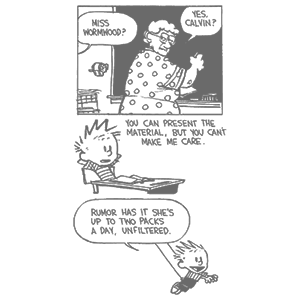
L’enfant terrible [ahn-fahn te-ree-bluh] (‘terrible child’) is a French term for a child who is terrifyingly candid by saying embarrassing things to adults, especially parents.
The OED describes it as, ‘a child who embarrasses his elders by untimely remarks; transf. a person who compromises his associates or his party by unorthodox or ill-considered speech or behavior; loosely, one who acts unconventionally.’ Webster’s defines an enfant terrible as an unusual person who is strikingly unorthodox, innovative, and/or avant-garde.
Posted in Humor, Language |
1 Comment »
May 16, 2012

Martin Sharp (b. 1942) is an Australian artist, underground cartoonist, songwriter and film-maker. His famous psychedelic posters of Bob Dylan, Donovan, and others, rank as classics of the genre, alongside the work of Rick Griffin, Hapshash and the Coloured Coat, and Milton Glaser.
His covers, cartoons and illustrations were a central feature of ‘Oz’ magazine, both in Australia and in London. Martin co-wrote one of Cream’s most famous songs, ‘Tales of Brave Ulysses,’ created the cover art for Cream’s ‘Disraeli Gears’ and ‘Wheels of Fire’ albums, and in the 1970s, he became a champion of singer Tiny Tim, and of Sydney’s embattled Luna Park.
read more »
Posted in Art, Language |
Leave a Comment »
May 11, 2012
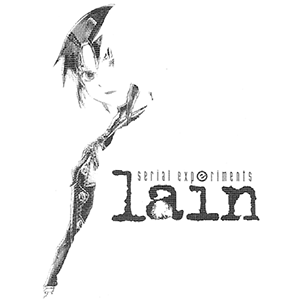
Infornography is a portmanteau of ‘information’ and ‘pornography’ used to define an addiction to or an obsession with acquiring, manipulating, and sharing information. People ‘suffering’ from infornography enjoy receiving, sending, exchanging, and digitizing information.
The definition (without explicitly using the term itself) is also greatly applied in many cyberpunk settings, where information can almost be considered a currency of its own, in a sense facilitating the development of an alternate world for ‘escapism.’ Megacorps, hackers, and other kinds of people use information to thrive; they can subtly be called infornographers.’
read more »
Posted in Language, Technology, World |
Leave a Comment »
May 11, 2012
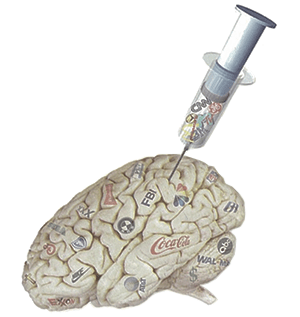
Memetics [meh-met-iks] is a controversial theory of mental content (e.g. thoughts, concepts, memories, emotions, percepts, intentions) based on an analogy with Darwinian evolution, originating from the popularization of Richard Dawkins’ 1976 book ‘The Selfish Gene.’ It purports to be an approach to evolutionary models of cultural information transfer. The meme, analogous to a gene, was conceived as a ‘unit of culture’ (an idea, belief, pattern of behavior, etc.) which is ‘hosted’ in one or more individual minds, and which can reproduce itself, thereby jumping from mind to mind.
Thus what would otherwise be regarded as one individual influencing another to adopt a belief is seen—when adopting the intentional stance—as an idea-replicator reproducing itself in a new host. As with genetics, particularly under a Dawkinsian interpretation, a meme’s success may be due to its contribution to the effectiveness of its host. Memetics is also notable for sidestepping the traditional concern with the truth of ideas and beliefs. Instead, it is interested in their success. The Usenet newsgroup alt.memetics was started in 1993.
read more »
Posted in Language, Philosophy, Science |
Leave a Comment »


 The Daily Omnivore