March 24, 2012

Battle Royale is a 1999 Japanese novel written by Koushun Takami about schoolchildren who are forced to fight each other to the death. The novel has been adapted into a 2000 film and a manga series. The story takes place in an alternate timeline—Japan is a member region of a totalitarian state known as the Republic of Greater East Asia. Under the guise of a ‘study trip,’ a group of students are gassed on a bus. They awaken in the Okishima Island School on an isolated, evacuated island (modeled after the island of Ogijima). They learn that they have been placed in an event called the Program.
Officially a military research project, it is a means of terrorizing the population, of creating such paranoia as to make organized insurgency impossible. The Program began in 1947. According to the rules fifty third-year high school classes are selected (prior to 1950, forty-seven classes were selected) annually to participate in the Program for research purposes. The students from a single class are isolated and are required to fight the other members from their class to the death. The Program ends when only one student remains, with that student being declared the winner.
Posted in Art, Death, Language |
Leave a Comment »
March 23, 2012
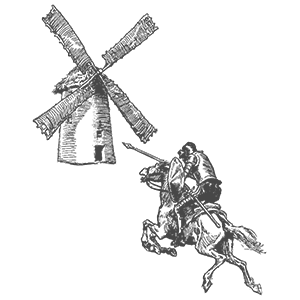
Tilting at windmills is an English idiom which means attacking imaginary enemies. The word ’tilt,’ in this context, comes from jousting. The phrase is sometimes used to describe confrontations where adversaries are incorrectly perceived, or courses of action that are based on misinterpreted or misapplied heroic, romantic, or idealistic justifications.
The phrase derives from an episode in the novel ‘Don Quixote’ by Miguel de Cervantes. In the novel, Don Quixote fights windmills that he imagines to be giants. Quixote sees the windmill blades as the giant’s arms, for instance.
read more »
Posted in Humor, Language, Politics |
Leave a Comment »
March 23, 2012


Tilt is a poker term for a state of mental or emotional confusion or frustration in which a player adopts a less than optimal strategy, usually resulting in the player becoming over-aggressive. This term is closely associated with ‘steam’ and some consider the terms equivalent, but ‘steam’ typically indicates more anger and intensity. Placing an opponent on tilt or dealing with being on tilt oneself is an important aspect of poker. It is a relatively frequent occurrence due to frustration, animosity against other players, or simply bad luck. Experienced players recommend learning to recognize that one is experiencing tilt and avoid allowing it to influence one’s play.
The most likely origin of the word ’tilt’ is as a reference to tilting a pinball machine. The frustration from seeing the ball follow a path towards the gap between the flippers can lead to the player physically tilting the machine (in an attempt to guide the ball towards the flippers). However, in doing so, some games will flash the word ‘TILT’ and freeze the flippers, causing the ball to be lost. The metaphor here being over-aggression due to frustration leads to severely detrimental gameplay.
read more »
Posted in Games, Language, Money |
Leave a Comment »
March 23, 2012

The hostile media effect refers to the finding that people with strong biases toward an issue (partisans) perceive media coverage as biased against their opinions, regardless of the reality.
Proponents of the hostile media effect argue that this finding cannot be attributed to the presence of bias in the news reports, since partisans from opposing sides of an issue rate the same coverage as biased against their side and biased in favor of the opposing side. The phenomenon was first proposed and studied experimentally by Robert Vallone, Lee Ross and Mark Lepper.
read more »
Posted in Language, Money, Politics |
Leave a Comment »
March 22, 2012

Giant Robot is a bi-monthly magazine of Asian and Asian American popular culture founded in 1994. It covers history, art, music, film, books, toys, technology, food and skateboarding. The publication grew from its original format—a small, photocopied zine, folded and stapled by hand—to its current full-color format. ‘Giant Robot’ was one of the earliest American publications to feature prominent Asian film stars such as Chow Yun-fat and Jet Li, as well as Asian musicians from indie and punk rock bands. Today, the coverage has expanded into art, design, Asian American issues, travel, and more.
In the late 1990s, Giant Robot expanded their endeavor to an online retail store selling artist goods, designer vinyl dolls, mini-figures, plush dolls, stationeries, art, t-shirts, and many creative goods. The success of the commercial website enabled the establishment of a brick-and-mortar retail store in 2001; first in Los Angeles and later in San Francisco. A third store, called GR2, was opened in Los Angeles, and features work by young contemporary artists. Giant Robot further expanded to a fourth store in New York City, and a fifth in Silverlake, as well as a restaurant called gr/eats, also in Los Angeles. The GR2, San Francisco, and New York locations feature monthly art exhibitions from up and coming and established artists.
Posted in Art, Language, World |
Leave a Comment »
March 19, 2012
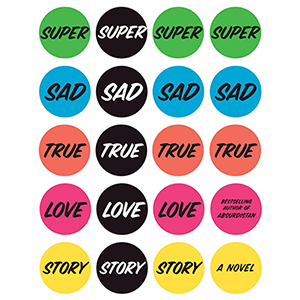
Gary Shteyngart (b. 1972) is an American writer born in Leningrad, USSR. Much of his work is satirical and relies on the invention of elaborately fictitious yet somehow familiar places and times. Shteyngart spent the first seven years of his childhood living in a square dominated by a huge statue of Vladimir Lenin in what is now St. Petersburg, Russia; (he alternately calls it ‘St. Leningrad’ or ‘St. Leninsburg’). He comes from a Jewish family and describes his family as typically Soviet. His father worked as an engineer in a LOMO camera factory; his mother was a pianist. Shteyngart emigrated to the United States in 1979 and was brought up with no television in the apartment in which he lived, where English was not the household language. He did not shed his thick Russian accent until the age of 14.
Shteyngart took a trip to Prague, and this experience helped spawn his first novel, set in the fictitious European city of Prava. He is a graduate of Stuyvesant High School in New York City, Oberlin College in Ohio, where he earned a degree in politics, and Hunter College of the City University of New York, where he earned an MFA in Creative Writing. Shteyngart now lives in the Lower East Side of Manhattan. He has taught writing at Hunter College, and currently teaches writing at Columbia University and Princeton University. Shteyngart’s novels include ‘The Russian Debutante’s Handbook’ (2002), ‘Absurdistan’ (2006), and ‘Super Sad True Love Story’ (2010).
Posted in Art, Humor, Language |
Leave a Comment »
March 18, 2012

A Princess of Mars (1917) is a science fantasy novel by Edgar Rice Burroughs, the first of his Barsoom series. Full of swordplay and daring feats, the novel is considered a classic example of 20th century pulp fiction. It is also a seminal instance of the planetary romance, a sub-genre of science fantasy that became highly popular in the decades following its publication. Its early chapters also contain elements of the Western. The story is set on Mars, imagined as a dying planet with a harsh desert environment. This vision of Mars was based on the work of the astronomer Percival Lowell, whose ideas were widely popularized in the late 19th and early 20th centuries.
The Barsoom series inspired a number of well-known 20th century science fiction writers, including Ray Bradbury, Arthur C. Clarke, Robert A. Heinlein, and John Norman, and was also inspirational for many scientists in the fields of space exploration and the search for extraterrestrial life, including Carl Sagan, who read ‘A Princess of Mars’ when he was a child.
read more »
Posted in Art, Language |
Leave a Comment »
March 17, 2012
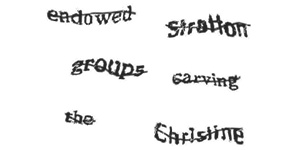

reCAPTCHA is a system originally developed at Carnegie Mellon University’s main Pittsburgh campus, and aquired by Google in 2009. It uses CAPTCHA (Completely Automated Public Turing test to tell Computers and Humans Apart) to help digitize the text of books while protecting websites from bots attempting to access restricted areas. reCAPTCHA is currently digitizing the archives of ‘The New York Times’ and books from Google Books.
reCAPTCHA supplies subscribing websites with images of words that optical character recognition (OCR) software has been unable to read. The subscribing websites present these images for humans to decipher as CAPTCHA words, as part of their normal validation procedures. They then return the results to the reCAPTCHA service, which sends the results to the digitization projects. The reCAPTCHA program originated with Guatemalan computer scientist Luis von Ahn, aided by a MacArthur Fellowship. An early CAPTCHA developer, he realized ‘he had unwittingly created a system that was frittering away, in ten-second increments, millions of hours of a most precious resource: human brain cycles.’
Posted in Language, Technology |
Leave a Comment »
March 16, 2012

The Black List is a survey published every year on the second Friday of December since 2004. The survey includes the top screenplays that went unproduced.
The website claims that it is not necessarily ‘the best,’ but rather ‘the most liked,’ since it is voted on by studio and production company executives. Some of the screenplays are then selected off of the Blacklist to be put into production such as ‘The Social Network’ and ‘Cedar Rapids.’
Posted in Art, Language, Money |
Leave a Comment »
March 16, 2012
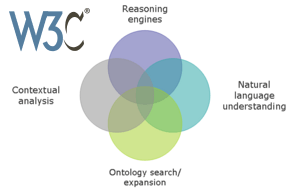

Semantic search seeks to improve search accuracy by understanding searcher intent and the contextual meaning of terms as they appear in the searchable dataspace, whether on the Web or within a closed system, to generate more relevant results. There are two major forms of search: Navigational and Research. In navigational search, the user is using the search engine as a navigation tool to navigate to a particular intended document.
Semantic Search is not applicable to navigational searches. In Research Search, the user provides the search engine with a phrase which is intended to denote an object about which the user is trying to gather/research information. There is no particular document which the user knows about that he is trying to get to. Rather, the user is trying to locate a number of documents which together will give him the information he is trying to find. Semantic Search lends itself well here.
read more »
Posted in Language, Science, Technology |
Leave a Comment »
March 15, 2012


White trash is an American English pejorative term referring to poor white people in the United States, suggesting lower social class and degraded living standards. The term suggests outcasts from respectable society living on the fringes of the social order who are seen as dangerous because they may be criminal, unpredictable, and without respect for authority whether it be political, legal, or moral.
The term is usually a slur, but may also be used self-referentially by whites to jokingly describe their origins. In the humorous book ‘The White Trash Mom Handbook: Embrace Your Inner Trailerpark, Forget Perfection, Resist Assimilation into the PTA, Stay Sane, and Keep Your Sense of Humor’ by Michelle Lamar and Molly Wendland (2008) is one such example. In common usage ‘white trash’ overlaps in meaning with cracker (regarding Georgia and Florida), hillbilly (regarding Appalachia), Okie (regarding Oklahoma origins), and redneck.
read more »
Posted in Language, Money, Politics |
Leave a Comment »
March 15, 2012
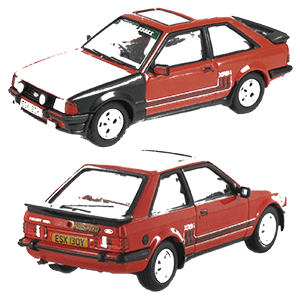
Boy racers is a UK term referring to those who ‘cruise’ around in vehicles modified with loud exhausts and stereos, or modified body kits. This behavior is frowned upon by members of the public irritated by the noise and the criminal behavior associated with it, including violence by skinhead and Neo-Nazi ‘boy racers.’ Responses to the boy racer problem range from laws prohibiting the antisocial activities they engage in to vigilante actions such as spraying expander foam, a common building supply, into their exhausts.
In Australia, the terms ‘hoon’ and ‘revhead’ are used for people who drive in an anti-social or dangerous manner. However, ‘revhead’ may refer to any motor enthusiast, while ‘hoon’ is always pejorative. Americans often use the term ‘rice burner,’ ‘rice rocket,’ or ‘ricer’ to describe the boy racer concept, since most of the vehicles are of Asian manufacture. There’s also the less popular term ‘wheat burner,’ which is the same thing, but with a domestic American model such as a Ford Focus, or Chevrolet Cavalier. A ‘krauter’ is a German model, usually a Volkswagen Jetta or Volkswagen Golf. The latter two categories are also sometimes referred to as ‘rice eaters,’ since their competition in the tuner scene is usually the more popular Asian models.
Posted in Language, Politics, World |
Leave a Comment »


 The Daily Omnivore