February 19, 2012
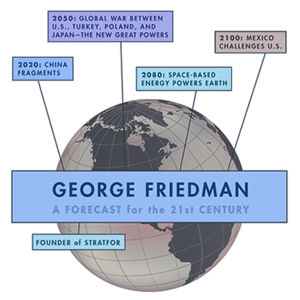
The Next 100 Years is a 2009 non-fiction book by American political scientist George Friedman. In the book, Friedman attempts to predict the major geopolitical events and trends of the 21st century. Friedman also speculates in the book on changes in technology and culture that may take place during this period. Friedman predicts a second American cold war with Russia in the 2010s. Friedman asserts that around 2015, the United States will become a close ally to some Eastern European countries, who will be dedicated to resisting Russian geopolitical threats during this period.
Friedman speculates in the book that the United States will probably become a close ally of Poland, the Czech Republic, Hungary, and Romania, who may form a military alliance during this period. According to Friedman’s prediction, around the year 2020, Russia will collapse, fragment, and disintegrate from the economic and political pressure of a second cold war.
read more »
Posted in Language, Politics, War |
Leave a Comment »
February 18, 2012

The melting pot is a metaphor for a heterogeneous society becoming more homogeneous, the different elements ‘melting together’ into a harmonious whole with a common culture. It is particularly used to describe the assimilation of immigrants to the United States; the melting-together metaphor was in use by the 1780s.
After 1970 the desirability of assimilation and the melting pot model was challenged by proponents of multiculturalism, who assert that cultural differences within society are valuable and should be preserved, proposing the alternative metaphor of the mosaic or salad bowl – different cultures mix, but remain distinct.
read more »
Posted in Language, Politics, World |
Leave a Comment »
February 16, 2012


The Feiler Faster Thesis (FFT) is a theory in modern journalism that the increasing pace of society is matched by (and perhaps driven by) journalists’ ability to report events and the public’s desire for more information. The idea is credited to American author Bruce Feiler and first defined by journalist Mickey Kaus in a 2000 ‘Slate’ article, ‘Faster Politics: ‘Momentum’ ain’t what it used to be.” Kaus describes two trends: the speeding up of the news cycle and the compression of the schedule of primaries for the 2000 U.S. general election, writing: ‘Feiler’s point is that we should put these two trends together–and that when we do, Trend 1 considerably softens the impact of Trend 2.’ Kaus uses the observation to reassess the concept of momentum in politics, suggesting that there are now simply more opportunities for turns of fortune and that voters are able, for the most part, to keep up.
The idea is based on James Gleick’s 1999 book ‘Faster,’ which makes the argument that the pace of Western society, and American society in particular, has increased and that ‘a compression of time characterizes the life of the century now closing.’ Gleick documents the ways technology speeds up work and the time people spend doing various tasks, including sleeping. He points out that ‘we have learned to keep efficiency in mind as a goal, which means that we drive ourselves hard.’ Gleick’s key observation is that ‘some of us say we want to save time when really we just want to do more.’
Posted in Language, Politics, Technology |
Leave a Comment »
February 16, 2012
Bruce Feiler (b. 1964) is a popular American writer on faith, family, and finding meaning in everyday life. He is also the writer/presenter of the PBS miniseries ‘Walking the Bible.’ His latest book, ‘The Council of Dads: My Daughters, My Illness, and the Men Who Could Be Me,’ describes how he responded to a diagnosis of cancer by asking six men from all passages of his life to be present through the passages of his young daughters’ lives. ‘Walking the Bible’ describes his perilous, 10,000-mile journey retracing the Five Books of Moses through the desert. ‘Where God Was Born’ describes his year-long trek retracing the Bible through Israel, Iraq, and Iran. ‘America’s Prophet: Moses and the American Story’ discusses the significance of Moses as a symbolic prophet throughout four-hundred years of American history.
Feiler completed his undergraduate degree at Yale University, before spending time teaching English in Japan. This experience led to his first book, ‘Learning to Bow: Inside the Heart of Japan,’ a popular portrait of life in a small Japanese town. Upon his return he earned a masters degree in international relations from the University of Cambridge in the UK, which he chronicled in his book ‘Looking for Class.’ His early books involve immersing himself in different cultures and bringing other worlds to life. He also entered the world of a traveling circus for ‘Under the Big Top,’ which depicts the year he spent performing as a clown in the Clyde Beatty-Cole Bros. Circus. Feiler is also credited with formulating the Feiler Faster Thesis which states that the increasing pace of society is matched by (and perhaps driven by) journalists’ ability to report events and the public’s desire for more information.
Posted in Death, Language, Philosophy |
Leave a Comment »
February 15, 2012

Robopocalypse is a science fiction book by Daniel H. Wilson published in 2011. The author has a PhD in robotics from Carnegie Mellon University, and many of the robots in the novel were inspired by real-world robotics research. The setting of the novel is the near future, where an increasingly robot-reliant society faces extinction after a computer scientist accidentally unleashes a sentient artificial intelligence named Archos.
After failed attempts at AI, Archos becomes self aware and immediately takes steps to stop his destruction. By infecting all devices that are chip controlled (cars, elevators, robots, etc.), Archos begins a systematic attack on mankind. Small bands of survivors find ways to circumvent the eradication. This is a story of those survivors in the months and days leading up to and following Archos’ self-awareness. Steven Spielberg has committed to direct a film based on the novel.
Posted in Art, Language, Technology |
Leave a Comment »
February 14, 2012
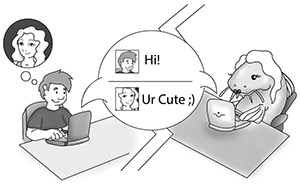

A sockpuppet is an online identity used for purposes of deception. The term—a reference to the manipulation of a simple hand puppet made from a sock—originally referred to a false identity assumed by a member of an internet community who spoke to, or about himself while pretending to be another person.
The term now includes other uses of misleading online identities, such as those created to praise, defend or support a third party or organization. A significant difference between the use of a pseudonym and the creation of a sockpuppet is that the sockpuppet poses as an independent third-party unaffiliated with the puppeteer.
read more »
Posted in Language, Money, Technology |
2 Comments »
February 14, 2012

A shill, plant or stooge helps someone without disclosing that he or she has a close relationship with that person or organization. Shill typically refers to someone who purposely gives onlookers the impression that he or she is an enthusiastic independent customer of a seller that he or she is secretly working for. The person or group that hires the shill is using crowd psychology, to encourage other onlookers or audience members to make a purchase.
Shills are often employed by confidence artists. Plant and stooge more commonly refer to any person who is secretly in league with another person or organization while pretending to be neutral or actually a part of the organization he or she is planted in, such as a magician’s audience, a political party, or an intelligence organization (double agent).
read more »
Posted in Language, Money, Politics |
Leave a Comment »
February 13, 2012
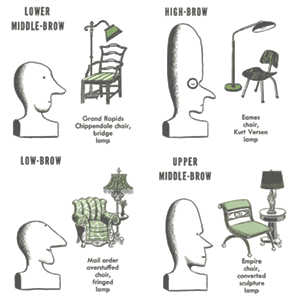
The term middlebrow describes both a certain type of easily accessible art, often literature, as well as the population that uses art to acquire culture and class that is usually unattainable. First used by the British satire magazine ‘Punch’ in 1925, middlebrow is derived as the intermediary between highbrow and lowbrow, terms derived from phrenology.
Middlebrow has famously gained notoriety from derisive attacks by Dwight Macdonald, Virginia Woolf, and to a certain extent, Russell Lynes. It has been classified as a forced and ineffective attempt at cultural and intellectual achievement, as well as characterizing literature that emphasizes emotional and sentimental connections rather than literary quality and innovation.
read more »
Posted in Art, Language |
Leave a Comment »
February 13, 2012
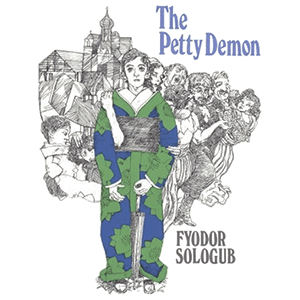
Poshlost is a Russian word that has been defined as ‘petty evil or self-satisfied vulgarity,’ however there is no single English translation.
At more length, ‘Poshlost’ is the Russian version of banality, with a characteristic national flavoring of metaphysics and high morality, and a peculiar conjunction of the sexual and the spiritual. This one word encompasses triviality, vulgarity, sexual promiscuity, and a lack of spirituality. The war against poshlost’ was a cultural obsession of the Russian and Soviet intelligentsia from the 1860s to 1960s.’
read more »
Posted in Language, Sex, World |
Leave a Comment »
February 13, 2012

Bathos [bey-thos] (Greek: ‘depth’) is an abrupt transition in style from the exalted to the commonplace, producing a ludicrous effect. While often unintended, bathos may be used deliberately to produce a humorous effect. If bathos is overt, it may be described as Burlesque or mock-heroic.
As used in English bathos originally referred to a particular type of bad poetry, but it is now used more broadly to cover any seemingly ridiculous artwork or bad performance. It should not be confused with pathos, a mode of persuasion within the discipline of rhetoric, intended to arouse emotions of sympathy and pity.
read more »
Posted in Art, Humor, Language |
Leave a Comment »
February 13, 2012
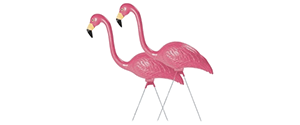
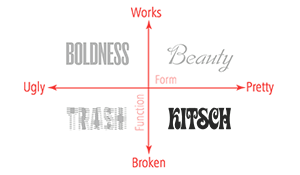
Camp is an aesthetic sensibility that regards something as appealing or humorous because of its deliberate ridiculousness. The concept is closely related to kitsch, and things with camp appeal may also be described as being ‘cheesy.’
When the usage appeared, in 1909, it denoted: ostentatious, exaggerated, affected, theatrical, and effeminate behaviour, and, by the middle of the 1970s, the definition comprised: banality, artifice, mediocrity, and ostentation so extreme as to have perversely sophisticated appeal. American writer Susan Sontag’s essay ‘Notes on ‘Camp” (1964) emphasised its key elements as: artifice, frivolity, naïve middle-class pretentiousness, and ‘shocking’ excess. Camp as an aesthetic has been popular from the 1960s to the present.
read more »
Posted in Art, Humor, Language |
Leave a Comment »
February 13, 2012


Kitsch [kich] (loanword from German) is a form of art that is considered an inferior, tasteless copy of an extant style of art or a worthless imitation of art of recognized value. The concept is associated with the deliberate use of elements that may be thought of as cultural icons while making cheap mass-produced objects that are unoriginal.
Kitsch also refers to the types of art that are aesthetically deficient (whether or not being sentimental, glamorous, theatrical, or creative) and that make creative gestures which merely imitate the superficial appearances of art through repeated conventions and formulae. Excessive sentimentality often is associated with the term.
read more »
Posted in Art, Language, Philosophy |
1 Comment »



