January 11, 2012
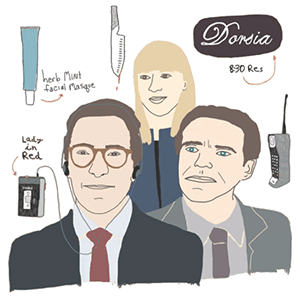
Yuppie [yuhp-ee] (short for ‘young urban professional’ or ‘young upwardly mobile professional’) is a term that refers to a member of the upper middle class or upper class in their 20s or 30s. It first came into use in the early-1980s and largely faded from American popular culture in the late-1980s, due to the 1987 stock market crash and the early 1990s recession. However it has seen a small revival in the 2000s and 2010s.
Yuppies are derided for their conspicuous personal consumption and hunger for attention social status among their peers. Cornell University economist Robert H. Frank, author of ‘Luxury Fever,’ has remarked, ‘When people were denouncing yuppies, they had considerably lower incomes than yuppies, so the things yuppies spent their money on seemed frivolous and unnecessary from their vantage point.’ Pro-skateboarder and businessman Tony Hawk has said that yuppies give ‘us visions of bright V-neck sweaters with collars underneath, and all that was vile in the eighties,’ and he has remarked as well as that a ‘bitchin’ tattoo cannot hide your inner desire to be Donald Trump.’
read more »
Posted in Humor, Language, Money |
1 Comment »
January 5, 2012
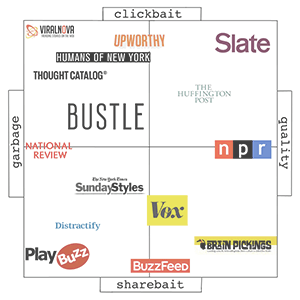
Betteridge’s Law of Headlines is an adage that states, ‘Any headline which ends in a question mark can be answered by the word ‘no.” It is based on a point made by journalist Ian Betteridge about sensational headlines that end in a question mark: ‘The reason why journalists use that style of headline is that they know the story is probably bullshit, and don’t actually have the sources and facts to back it up, but still want to run it.’ The maxim trends towards being universally true because of a simple principle of headline writing: if a story has enough sources to have a high chance of accuracy, a headline will be assertive. If sources are weak, or only a single source is found, headline writers will hedge their bets by posing the headline as a question.
It was among UK journalist Andrew Marr’s suggestions for how to read a newspaper if you really want to know what is going on: ‘If the headline asks a question, try answering ‘no.’ Is This the True Face of Britain’s Young? (Sensible reader: No.) Have We Found the Cure for AIDS? (No; or you wouldn’t have put the question mark in.) Does This Map Provide the Key for Peace? (Probably not.) A headline with a question mark at the end means, in the vast majority of cases, that the story is tendentious or over-sold. It is often a scare story, or an attempt to elevate some run-of-the-mill piece of reporting into a national controversy and, preferably, a national panic. To a busy journalist hunting for real information a question mark means ‘don’t bother reading this bit.”
Posted in Humor, Language, Money |
Leave a Comment »
January 4, 2012
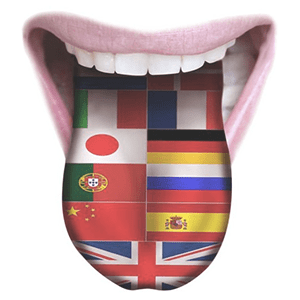
Harold Williams (1876 – 1928) was a New Zealand journalist, foreign editor of ‘The Times’ and is considered one of the most accomplished polyglots in history, said to have known over 58 languages and other related dialects. Like most youngsters his age, Harold wasn’t possessed by a voracious appetite for learning, but he recalled that, when he was about seven, ‘an explosion in his brain’ occurred and from that time his capacity to learn, in particular languages, grew to an extraordinary degree. He began with the study of Latin, one of the great root languages, and hungrily acquired others.
As a schoolboy he constructed a grammar and vocabulary of the New Guinea language Dobuan from a copy of St. Mark’s Gospel written in that language. Next he compiled a vocabulary of the dialect of Niue Island, again from the Gospel written in that language, and was published in the ‘Polynesian Journal.’
read more »
Posted in Language, Politics, World |
Leave a Comment »
January 2, 2012

Jo-ha-kyū is a concept of modulation and movement applied in a wide variety of traditional Japanese arts. Roughly translated to ‘beginning, break, rapid,’ it essentially means that all actions or efforts should begin slowly, speed up, and then end swiftly. This concept is applied to elements of the Japanese tea ceremony, kendō and other martial arts, dramatic structure in Japanese theater and film, and traditional collaborative linked verse forms. The concept originated in court music, specifically in the ways in which elements of the music could be distinguished and described. Though eventually incorporated into a number of disciplines, it was most famously adapted, and thoroughly analyzed and discussed by the great playwright Zeami, who viewed it as a universal concept applying to the patterns of movement of all things.
Zeami described the first act as ‘Love’; the play opens auspiciously, using gentle themes and pleasant music to draw in the attention of the audience. The second act is described as ‘Warriors and Battles.’ Though it need not contain actual battle, it is generally typified by heightened tempo and intensity of plot. The third act, the climax of the entire play, is typified by pathos and tragedy. The plot achieves its dramatic climax. The fourth is a michiyuki (journey), which eases out of the intense drama of the climactic act, and often consists primarily of song and dance rather than dialogue and plot. The fifth act, then, is a rapid conclusion. All loose ends are tied up, and the play returns to an auspicious setting.
Posted in Art, Language, World |
Leave a Comment »
January 2, 2012
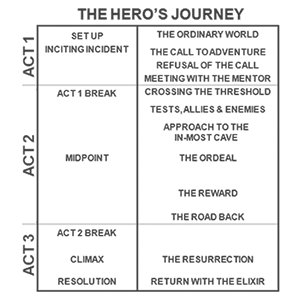
The Three-Act Structure is a model used in writing and evaluating modern storytelling which divides a screenplay into a three parts called the ‘Setup,’ ‘Confrontation,’ and ‘Resolution.’ The first act is used to establish the main characters, their relationships and the normal world they live in.
Early in the first act, a dynamic, on-screen incident occurs to the main character (the protagonist), whose response leads to a second and more dramatic situation, known as the first ‘turning point,’ which (a) signals the end of the first act, (b) ensures life will never be the same again for the protagonist, and (c) raises a dramatic question that will be answered in the climax of the film.
read more »
Posted in Art, Language |
Leave a Comment »
January 2, 2012
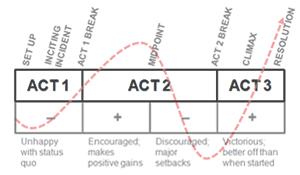
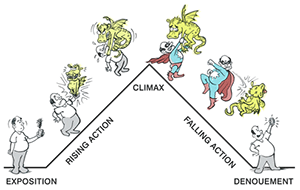
Act structure explains how a plot of a film story is composed. Just like plays (Staged drama) have ‘Acts,’ critics and screenwriters tend to divide films into acts; though films don’t require to be physically broken down as such in reality.
Whereas plays are actual performances that need ‘breaks’ in the middle for change of set, costume, or for the artists’ rest; films are recorded performances shown mechanically and therefore don’t need actual breaks. Still they are divided into acts for reasons that are in aesthetic and structural conformation with the original idea of Act in theater.
read more »
Posted in Art, Language, Money |
Leave a Comment »
January 2, 2012

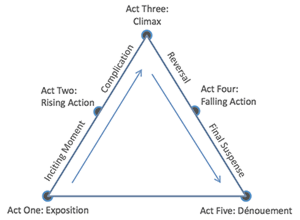
Dramatic structure is the structure of a dramatic work such as a play or film. Many scholars have analyzed dramatic structure, beginning with Aristotle in his ‘Poetics’ (c. 335 BCE). In ‘Poetics,’ Aristotle put forth the idea that ‘A whole is what has a beginning and middle and end.’ This three-part view of a plot structure (with a beginning, middle, and end – technically, the protasis, epitasis, and catastrophe) prevailed until the Roman drama critic Horace advocated a 5-act structure in his ‘Ars Poetica.’ After falling into disuse, renaissance dramatists revived the use of the 5-act structure.
Gustav Freytag’s analysis of ancient Greek and Shakespearean drama is canonical. Although Freytag’s description of dramatic structure is based on five-act plays, it can be applied (sometimes in a modified manner) to short stories and novels as well. Nonetheless it does not always translate well, especially in modern plays such as Alfred Uhry’s ‘Driving Miss Daisy,’ which is actually divided into 25 scenes without concrete acts.
read more »
Posted in Art, Language |
Leave a Comment »
January 2, 2012
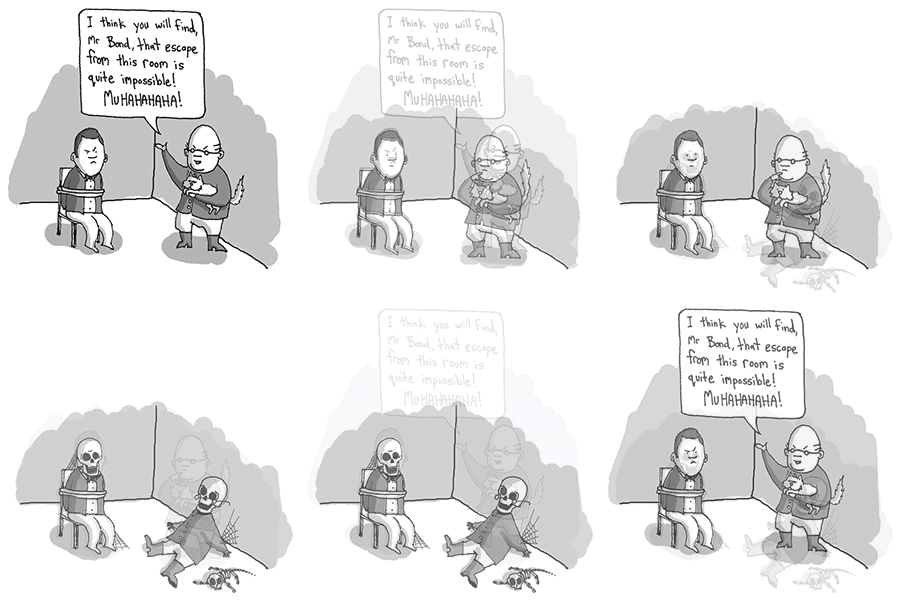
A deathtrap is a literary and dramatic plot device in which a villain, who has captured the hero or another sympathetic character, attempts to use an elaborate and usually sadistic method of murdering him/her. It is often used as a means to create dramatic tension in the story and to have the villain reveal important information to the hero, confident that the hero will shortly not be able to use it. It may also be a means to show the hero’s resourcefulness in escaping, or the writer’s ingenuity at devising a last-minute rescue or deus ex machina.
This plot device is generally believed to have been popularized by movie serials and 19th century theatrical melodramas. A well known example is the cliché of the moustache-twirling villain leaving the heroine tied to railroad tracks. Its use in the James Bond film series and superhero stories is well known.
read more »
Posted in Death, Humor, Language |
1 Comment »
January 2, 2012
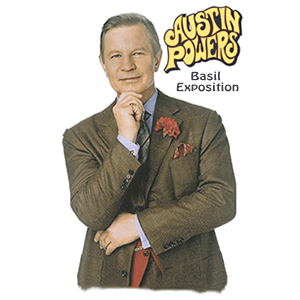
When the presentation of information in fiction becomes wordy, it is sometimes referred to as an ‘information dump.’ It is expressed by characters in dialogue or monologue and sometimes referred to as ‘idiot lectures.’ They are sometimes placed at the beginning of stories as a means of establishing the premise of the plot.
They also appear in science fiction, but it is considered poor writing when characters explain things to each other that they would already know. For example, if you need to call someone, you don’t stop to explain to a colleague that you are now going to use a device controlled with digital circuits to use radio waves to transmit your voice. Why? Because your contemporaries already know how cellular radio telephones work.
read more »
Posted in Art, Humor, Language |
Leave a Comment »
January 2, 2012
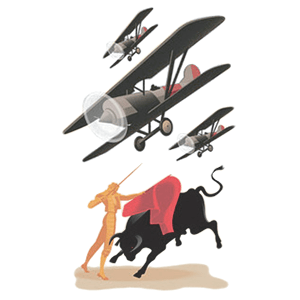
Show, don’t tell is an admonition to fiction writers to write in a manner that allows the reader to experience the story through a character’s action, words, thoughts, senses, and feelings rather than through the narrator’s exposition, summarization, and description. The advice is not to be heavy-handed, or to drown the reader in adjectives, but to allow issues to emerge from the text instead.
The advice applies equally to fiction and nonfiction, but the approach should not be applied to all incidents in the story. According to author James Scott Bell, ‘Sometimes a writer tells as a shortcut, to move quickly to the meaty part of the story or scene. Showing is essentially about making scenes vivid. If you try to do it constantly, the parts that are supposed to stand out won’t, and your readers will get exhausted.’
read more »
Posted in Art, Language |
Leave a Comment »
December 31, 2011
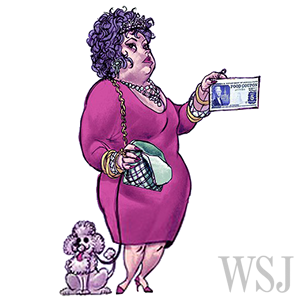
A welfare queen is a pejorative phrase used in the United States to describe people who are accused of collecting excessive welfare payments through fraud or manipulation. Reporting on welfare fraud began during the early 1960s, appearing in general interest magazines such as ‘Readers Digest.’
The term entered the American lexicon during Ronald Reagan’s 1976 presidential campaign when he described a ‘welfare queen’ from Chicago’s South Side. Since then, it has become a stigmatizing label placed on recidivist poor mothers, with studies showing that it often carries gendered and racial connotations. Although American women can no longer stay on welfare indefinitely due to the Personal Responsibility and Work Opportunity Act, the term continues to shape American dialogue on poverty.
read more »
Posted in Language, Money, Politics |
Leave a Comment »
December 31, 2011


‘The White Negro: Superficial Reflections on the Hipster’ is a 9,000 word essay by Norman Mailer that recorded a number of young white people in the 1920s, 1930s and 1940s who liked jazz and swing music so much that they adopted black culture as their own.
It was first published in the Summer 1957 issue of ‘Dissent,’ before being published separately by ‘City Lights.’ The so-called white negroes adopted black clothing styles, black jive language, and black music. They mainly associated with black people, distancing themselves from white society.
read more »
Posted in Language, Politics |
1 Comment »



