January 19, 2012
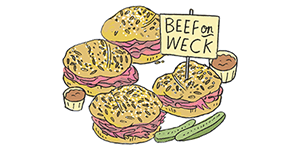

Au jus [oh joos] is French for ‘with [its own] juice.’ In American cuisine, the term is mostly used to refer to a light sauce for beef recipes, which may be served with the food or placed on the side for dipping. In French cuisine, jus is a natural way to enhance the flavor of dishes, mainly chicken, veal and lamb. ‘Jus’ means the natural juices given off by the food. To prepare a natural jus, the cook may simply skim off the fat from the juices left after cooking and bring the remaining meat stock and water to a boil.
Often prepared in the United States is a seasoned sauce with several additional flavorings. American recipes au jus often use soy sauce, Worcestershire sauce, salt, pepper, white or brown sugar, garlic, onion, or other ingredients to make something more like a gravy. So-called jus is sometimes prepared separately, rather than being produced naturally by the food being cooked. An example could be a beef jus made by reducing beef stock to a concentrated form, to accompany a meat dish.
Posted in Food, Language, World |
1 Comment »
January 17, 2012
The word ‘bolide‘ [boh-lahyd] comes from the Greek ‘bolis,’ which can mean ‘missile’ or ‘to flash.’ The International Astronomical Union (IAU) has no official definition of ‘bolide,’ and generally considers the term synonymous with ‘fireball,’ a brighter-than-usual meteor. The IAU defines a fireball as ‘a meteor brighter than any of the planets’ (magnitude −4 or greater). Astronomers tend to use ‘bolide’ to identify an exceptionally bright fireball (magnitude −14 or brighter), particularly one that explodes (sometimes called a detonating fireball).
It may also be used to mean a fireball which creates audible sounds. If the magnitude of a bolide reaches −17 or brighter it is known as a ‘superbolide.’ Geologists use the term ‘bolide’ more often than astronomers do: in geology it indicates a very large impactor. For example, the U.S. Geological Survey uses the term to mean a generic large crater-forming projectile ‘to imply that we do not know the precise nature of the impacting body … whether it is a rocky or metallic asteroid, or an icy comet, for example.’
Posted in Language, Science |
Leave a Comment »
January 16, 2012


‘Slaughterhouse-Five, or The Children’s Crusade: A Duty-Dance with Death’ is a 1969 satirical novel by Kurt Vonnegut about World War II experiences and journeys through time of a soldier called Billy Pilgrim.
The work is also known under the lengthy title: ‘Slaughterhouse-Five, or The Children’s Crusade: A Duty Dance with Death, by Kurt Vonnegut, a Fourth-Generation German-American Now Living in Easy Circumstances on Cape Cod [and Smoking Too Much], Who, as an American Infantry Scout Hors de Combat, as a Prisoner of War, Witnessed the Fire Bombing of Dresden, Germany, ‘The Florence of the Elbe,’ a Long Time Ago, and Survived to Tell the Tale. This Is a Novel Somewhat in the Telegraphic Schizophrenic Manner of Tales of the Planet Tralfamadore, Where the Flying Saucers Come From. Peace.’
read more »
Posted in Humor, Language, War |
Leave a Comment »
January 15, 2012

Plutocracy [ploo-tok-ruh-see] is rule by the wealthy, or power provided by wealth. The combination of both plutocracy and oligarchy is called plutarchy. The word ‘plutocracy’ is derived from the Ancient Greek root ‘ploutos,’ meaning ‘wealth’ and ‘kratos,’ meaning ‘to rule’ or ‘to govern.’
The term is generally used to describe these two distinct concepts: one of a historical nature and one of a modern political nature. The former indicates the political control of the state by an oligarchy of the wealthy. Examples of such plutocracies include the Roman Republic, some city-states in Ancient Greece, the civilization of Carthage, the Italian city-states/merchant republics of Venice, Florence, Genoa, and pre-WWII Empire of Japan zaibatsus.
read more »
Posted in Language, Money, Politics |
1 Comment »
January 15, 2012

Kode9 (born Steve Goodman) is a London-based electronic music artist, DJ, and owner of the Hyperdub record label. MC, The Spaceape, is a frequent collaborator. Initially inspired by what he calls the ‘hardcore continuum,’ he also draws on dub reggae, and was one of the founding members of the early dubstep scene (which he views as a continuation of developments originally stemming from UK Hardcore).
He has released two full-length albums: ‘Memories of the Future’ and ‘Black Sun’ (both featuring the Spaceape). Kode9 has a Ph.D. in philosophy from the University of Warwick. In 2009, MIT Press published his book, ‘Sonic Warfare: Sound, Affect, and the Ecology of Fear,’ exploring the uses of acoustic force and how sound can be deployed to set moods of dread and fear, how sound can be used as torture, as a weapon and as a threat.’
Posted in Art, Language, Technology |
Leave a Comment »
January 12, 2012


Generation X, commonly abbreviated to Gen X, is the generation born after the baby boom ended. While there is no universally agreed upon time frame, the term generally includes people born from the early 1960s through the early 1980s, usually no later than 1981 or 1982. The term had also been used in different times and places for various subcultures or countercultures since the 1950s.
The term Generation X was coined by the Magnum photographer Robert Capa in the early 1950s. He would use it later as a title for a photo-essay about young men and women growing up immediately after the Second World War. The project first appeared in ‘Picture Post’ (UK) and ‘Holiday’ (US) in 1953. Describing his intention, Capa said ‘We named this unknown generation, The Generation X, and even in our first enthusiasm we realized that we had something far bigger than our talents and pockets could cope with.’
read more »
Posted in Language, Politics, World |
Leave a Comment »
January 12, 2012

A peanut gallery is an audience that heckles the performer. The term originated in the days of vaudeville (1880s) as a nickname for the cheapest (and ostensibly rowdiest) seats in the theater; the least expensive snack served at the theater would often be peanuts, which the patrons would sometimes throw at the performers on stage to show their disapproval.
The phrases ‘no comments from the peanut gallery’ or ‘quiet in the peanut gallery’ are extensions of the name. ‘Peanut gallery’ may also refer to a social network audience that passively observes a syndicated web feed.
read more »
Posted in Humor, Language, Money |
Leave a Comment »
January 12, 2012

The echo chamber effect refers to any situation in which information, ideas or beliefs are amplified or reinforced by transmission inside an ‘enclosed’ space. Observers of journalism describe an echo chamber effect in media discourse. One purveyor of information will make a claim, which many like-minded people then repeat, overhear, and repeat again (often in an exaggerated or otherwise distorted form) until most people assume that some extreme variation of the story is true.
A media conglomerate that owns multiple media outlets can produce the same story among ‘different’ outlets, creating an illusion that a media consumer is getting information from different sources.
read more »
Posted in Language, Money, Technology |
Leave a Comment »
January 12, 2012
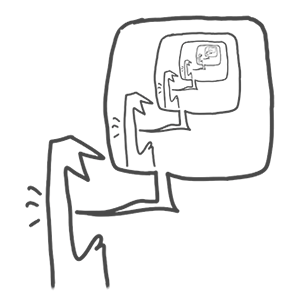
A filter bubble is a concept developed by Internet activist Eli Pariser in his book by the same name to describe a phenomenon in which websites use algorithms to selectively guess what information a user would like to see based on information about the user like location, past click behavior and search history. As a result websites tend to show only information which agrees with the user’s past viewpoint. Prime examples are Google’s personalized search results and Facebook’s personalized news stream. According to Pariser, users get less exposure to conflicting viewpoints and are isolated intellectually in their own informational bubble.
Pariser related an example in which one user searched Google for ‘BP’ and got investment news about British Petroleum while another searcher got information about the Deepwater Horizon oil spill and that the two search results pages were ‘strikingly different.’ The bubble effect may have negative implications for civic discourse, according to Pariser, but there are contrasting views suggesting the effect is minimal.
read more »
Posted in Language, Money, Technology |
1 Comment »
January 12, 2012

The term ‘winders‘ was originally coined in 2008 by the sociologist John W. Leigh, in his article ‘Moving towards new forms of social success.’
The term (a contraction of the expression ‘windy winners’) goes back to the original way of experiencing social success by individuals uninhibited with regards to their own success, not looking as much to reconcile rival existential expectations (such as the bobos – bohemian bourgeois, for example) but rather to juxtapose them in a way which is not seeking to constitute a system.
Posted in Language, Money, Politics |
Leave a Comment »
January 11, 2012


Limousine liberal is a pejorative American political term used to illustrate perceived hypocrisy by a political liberal of upper class or upper middle class status; including calls for the use of mass transit while frequently using limousines or private jets, claiming environmental consciousness but driving low MPG sports cars or SUVs, or ostensibly supporting public education while actually sending their children to private schools.
Democratic New York City mayoral hopeful Mario Procaccino coined the term to describe incumbent Republican Mayor John Lindsay and his wealthy Manhattan backers during a heated 1969 campaign.
read more »
Posted in Language, Money, Politics |
Leave a Comment »
January 11, 2012


‘Bobos in Paradise: The New Upper Class and How They Got There’ is a book by David Brooks, first published in 2000. The word ‘bobo,’ Brooks’s most famous coinage, is a portmanteau of the words bourgeois and bohemian.
The term is used by Brooks to describe the 1990s descendants of the yuppies. Often of the corporate upper class, they claim highly tolerant views of others, purchase expensive and exotic items, and believe American society to be meritocratic.
read more »
Posted in Language, Money, Politics |
Leave a Comment »



