November 23, 2011
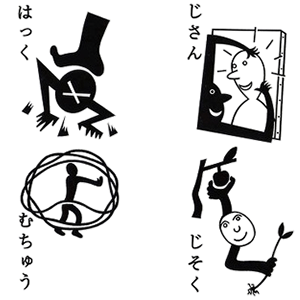
Chengyu are a type of traditional Chinese idiomatic expressions, most of which consist of four characters. Chengyu were widely used in Classical Chinese and are still common in vernacular Chinese writing and in the spoken language today. According to the most stringent definition, there are about 5,000 chengyu in the Chinese language, though some dictionaries list over 20,000. They are often referred to as Chinese idioms or four-character idioms; however, they are not the only idioms in Chinese.
Chengyu are mostly derived from ancient literature. The meaning of a chengyu usually surpasses the sum of the meanings carried by the four characters, as chengyu are often intimately linked with the myth, story or historical fact from which they were derived. As such, chengyu do not follow the usual grammatical structure and syntax of the modern Chinese spoken language, and are instead highly compact and synthetic.
read more »
Posted in Language, World |
Leave a Comment »
November 23, 2011

No pain, no gain is an exercise motto that promises greater value rewards for the price of hard and even painful work. Under this conception competitive professionals such as athletes and artists are required to endure pain and pressure to achieve professional excellence. It came into prominence after 1982 when actress Jane Fonda began to produce a series of aerobics workout videos. In these videos, Fonda would use ‘No pain, no gain’ and ‘Feel the burn’ as catchphrases for the concept of working out past the point of experiencing muscle aches. It expresses the belief that solid large muscle are the result of training hard and suffering sore muscles repeatedly, implying that those who avoid pain will never reach a professional level as bodybuilders. In terms of the expression used for development, the discomfort caused may be beneficial in some instances while detrimental in others.
American author David B. Morris wrote, ‘No pain, no gain’ is an American modern mini-narrative: it compresses the story of a protagonist who understands that the road to achievement runs only through hardship.’
Posted in Games, Health, Language |
Leave a Comment »
November 22, 2011
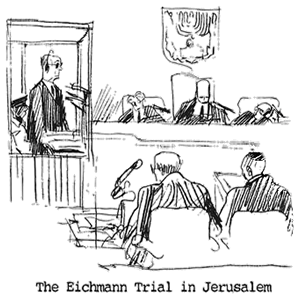
Banality [buh-nal-i-tee] of evil is a phrase coined by Hannah Arendt and incorporated in the title of her 1963 work ‘Eichmann in Jerusalem.’ It describes the thesis that the great evils in history generally, and the Holocaust in particular, were not executed by fanatics or sociopaths, but rather by ordinary people who accepted the premises of their state and therefore participated with the view that their actions were normal.
Explaining this phenomenon, media analyst Edward S. Herman has emphasized the importance of ‘normalizing the unthinkable.’ According to him, ‘doing terrible things in an organized and systematic way rests on ‘normalization.’ This is the process whereby ugly, degrading, murderous, and unspeakable acts become routine and are accepted as ‘the way things are done.’
read more »
Posted in Language, Politics, War |
Leave a Comment »
November 22, 2011
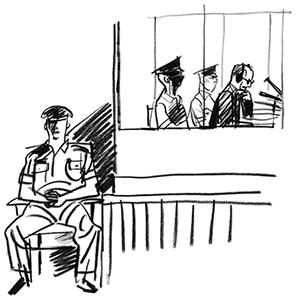
Little Eichmanns [ahyk-muhn] is a phrase used to describe the complicity of those who participate in destructive and immoral systems in a way that, although on an individual scale may seem indirect, when taken collectively would have an effect comparable to Nazi official Adolf Eichmann’s role in The Holocaust. Anarcho-primitivist John Zerzan used the phrase in his essay ‘Whose Unabomber?’ in 1995. The phrase gained prominence in American political culture four years after 9/11, when an essay written by Ward Churchill shortly after the attacks received renewed media scrutiny. In the essay, ‘On the Justice of Roosting Chickens,’ Churchill reiterated the phrase to describe technocrats working at the World Trade Center; his statement caused much controversy.
The use of ‘Eichmann’ as an archetype stems from Hannah Arendt’s 1963 book ‘Eichmann in Jerusalem.’ Arendt wrote that aside from a desire for improving his career, Eichmann showed no trace of anti-Semitism or psychological damage. She called him the embodiment of the ‘banality of evil’ as he appeared at his trial to have an ordinary and common personality and displayed neither guilt nor hatred. She suggested that this most strikingly discredits the idea that the Nazi criminals were manifestly psychopathic and fundamentally different from ordinary people. Lewis Mumford collectively refers to people willing to placidly carry out the extreme goals of megamachines as ‘Eichmanns.’
Posted in Language, Politics, War |
1 Comment »
November 22, 2011
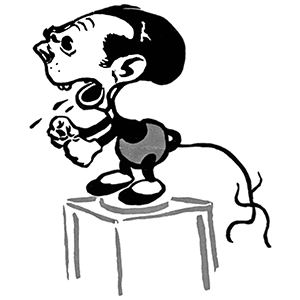
‘Three men make a tiger‘ is a Chinese proverb or chengyu (four-character idiom). Three men make a tiger refers to an individual’s tendency to accept absurd information as long as it is repeated by enough people. It refers to the idea that if an unfounded premise or urban legend is mentioned and repeated by many individuals, the premise will be erroneously accepted as the truth. This concept is analogous to communal reinforcement or the fallacy of argumentum ad populum.
The proverb came from the story of an alleged speech by Pang Cong, an official of the state of Wei in the Warring States Period (475 BCE – 221 BCE) in Chinese History. Before he left on a trip to the state of Zhao, Pang Cong asked the King of Wei whether he would hypothetically believe in one civilian’s report that a tiger was roaming the markets in the capital city, to which the King replied no. Pang Cong asked what the King thought if two people reported the same thing, and the King said he would begin to wonder. Pang Cong then asked, ‘what if three people all claimed to have seen a tiger?’ The King replied that he would believe in it. Pang Cong reminded the King that the notion of a live tiger in a crowded market was absurd, yet when repeated by numerous people, it seemed real. As a high-ranking official, Pang Cong had more than three opponents and critics; naturally, he urged the King to pay no attention to those who would spread rumors about him while he was away. ‘I understand,’ the King replied, and Pang Cong left for Zhao. Yet, slanderous talk took place. When Pang Cong returned to Wei, the King indeed stopped seeing him.
Posted in Language, World |
Leave a Comment »
November 22, 2011
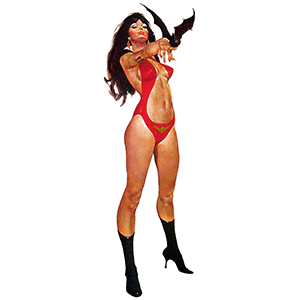
Vampirella is a fictional character, a comic book vampire heroine created by Forrest J Ackerman and costume designer Trina Robbins in Warren Publishing’s black-and-white horror comics magazine ‘Vampirella’ #1 (1969). Writer-editor Archie Goodwin later developed the character from horror-story hostess, in which capacity she remained through issue #8 (1970), to a horror-drama leading character. As comics historian Richard J. Arndt describes, ‘Forrest Ackerman created, or at least had a strong hand in creating, Vampirella and he clearly had a major influence in shaping the lighthearted bad-girl story style of this issue as well.’ Vampirella was originally presented as an inhabitant of the planet Drakulon, a world where people lived on blood and where blood flowed in rivers. Draculon orbits twin suns that were causing droughts across the planet, marking certain doom for Vampirella and her race. The race of which Vampirella was born, the Vampiri, were able to transform themselves into bats at will, sprout wings when required, and drink blood.
The story begins with the inhabitants of Drakulon dying slowly due to the drying up of its blood. The last few lie dying when a spaceship from Earth crashes on the planet. Vampirella, sent to investigate, is attacked; retaliating, she discovers that the astronauts have blood in their veins. In order for her race to survive, she manages to pilot the ship back to Earth where her adventures begin. Vampirella becomes a ‘good’ vampire, and devotes her energy to ridding our world of the homegrown ‘evil’ kind.
Posted in Art, Language |
Leave a Comment »
November 22, 2011

Glamorama is a novel by American writer Bret Easton Ellis, published in 1998. Unlike Ellis’ previous novels, Glamorama is set in and satirizes the 1990s, specifically celebrity culture and consumerism. Ellis wanted to write a Stephen King-style ghost story novel (which would eventually become ‘Lunar Park’); finding it difficult at the time, he began work on the other novel which he had in mind, a Robert Ludlum-style thriller, with the intention of using one of his own vapid characters who lack insight as the narrator. The novel is a satire of modern celebrity culture, featuring models-turned-terrorists.
A character remarks, ‘basically, everyone was a sociopath…and all the girls’ hair was chignoned.’ (A chignon is an arrangement of long hair in a roll or knot at the back of the head). The novel plays upon the conspiracy thriller conceit of someone ‘behind all the awful events,’ to dramatize the revelation of a world of random horror. The lack of resolution contributes to Ellis’ artistic effect. The obsession with beauty is reflected in consistent namedropping; this satirizes Victor’s obsession with looks, and perhaps is indicative of the author’s own attraction to glamor.
read more »
Posted in Art, Language, Money |
Leave a Comment »
November 22, 2011

A motivational poster (or affirmation poster or inspirational poster) is a type of poster commonly designed for use in schools and offices. The intent of motivational posters is to make people achieve more, or to think differently about the things that they may be learning or doing. Motivational posters can have behavioral effects. For example, the University of Glasgow found in one study that their placement of a motivational poster that promotes stair use in front of an escalator and a parallel staircase, in an underground station, doubled the amount of stair use.
This kind of poster has been repeatedly parodied, and parody motivational posters have become an Internet meme. One famous motivational poster features a kitten hanging from a tree branch along with the phrase ‘Hang in There, Baby!’ This has been the target of various reproductions and parodies, such as an appearance on ‘The Simpsons’ episode ‘The Twisted World of Marge Simpson’ where Marge Simpson notices the copyright date (1968) and comments, ‘…determined or not, that cat must be long dead. That’s kind of a downer.’ Despair, Inc. has made a business out of such parody and cynical posters, with ‘demotivational posters’ ranging from a picture of a tree bent over by wind with the caption ‘ADVERSITY: That which does not kill me postpones the inevitable.’ to a picture of a sinking ship with the caption ‘MISTAKES: It could be that the purpose of your life is only to serve as a warning to others.’
Posted in Humor, Language, Money |
Leave a Comment »
November 20, 2011

Famous for being famous, in popular culture terminology, refers to someone who attains celebrity status for no particular identifiable reason, or who achieves fame through association with a celebrity. The term is a pejorative, suggesting that the individual has no particular talents or abilities. Even when their fame arises from a particular talent or action on their part, the term will sometimes still apply if their fame is perceived as disproportionate to what they earned through their own talent or work.
The term originates from an analysis of the media dominated world called ‘The Image: A Guide to Pseudo-events in America’ (1961), by historian and social theorist Daniel J. Boorstin. In it, he defined the celebrity as ‘a person who is known for his well-knownness.’ He further argued that the graphic revolution in journalism and other forms of communication had severed fame from greatness, and that this severance hastened the decay of fame into mere notoriety. Over the years, the phrase has been glossed as ‘a celebrity is someone who is famous for being famous’.
read more »
Posted in Humor, Language, Money |
1 Comment »
November 20, 2011

Car Talk is a radio talk show broadcast weekly on National Public Radio stations throughout the United States and elsewhere. The hosts are brothers Tom and Ray Magliozzi, also known as Click and Clack, the Tappet Brothers. Car Talk is structured as a call-in radio show: listeners call with questions related to motor vehicle maintenance and repair. Most of the advice sought is diagnostic, with callers describing symptoms and demonstrating sounds of an ailing vehicle while the Magliozzis make an attempt at identifying the malfunction.
While the hosts pepper their call-in sessions with jokes directed at both the caller and at themselves, the depth and breadth of their knowledge of automobiles is extensive, and they are usually able to arrive at a diagnosis and give helpful advice. Also, if a caller has an unusual name, they will inquire about the spelling, pronunciation, and/or origin of their name. They may also comment about the caller’s hometown.
read more »
Posted in Humor, Language, Technology |
Leave a Comment »
November 19, 2011
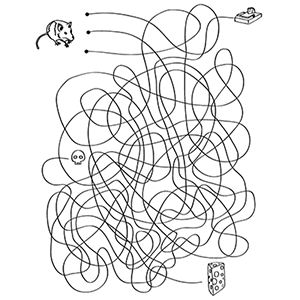
Rat running or cut-through driving refers to the use of secondary roads or residential side streets instead of the intended main roads in urban or suburban areas in order to avoid heavy traffic, lengthy traffic signals, or other obstacles lengthening a journey, even though traffic calming measures may be in place to discourage them and there may be laws against taking certain routes. Rat runs are frequently taken by motorists who are familiar with the local geography. They will often take such short cuts to avoid busy main roads and junctions (intersections).
The associations with ‘beating the crowd,’ the rush hour, and the rat race may have given rise to the term, or perhaps similarities were observed between the patterns of rat running driving routes and a rat running a maze.
read more »
Posted in Humor, Language, World |
Leave a Comment »
November 19, 2011

The term shunpiking comes from the word shun, meaning ‘to avoid,’ and pike, a term referring to turnpikes, which are roads that require payment of a toll to travel on them. People who often avoid toll roads sometimes call themselves shunpikers. Shunpiking has also come to mean an avoidance of major highways (regardless of tolls) in preference for bucolic and scenic interludes along lightly traveled country roads.
The word ‘shunpike’ may have its origins in post-colonial New Hampshire: When the ‘Turnpike’ was built, around 1810 or so, by the Hampton Causeway Turnpike Corporation, a toll was charged to cross it at Taylor’s River. Not content with the payment of a toll, some of the residents got together and built a slight bridge called the ‘Shunpike’ across the River, some distance west of the Turnpike bridge, where travelers and teamsters could cross without charge. This continued on until 1826, when the toll on the Turnpike was discontinued and has remained a free road to this day
read more »
Posted in Language, Money, World |
Leave a Comment »


 The Daily Omnivore