November 22, 2011

Glamorama is a novel by American writer Bret Easton Ellis, published in 1998. Unlike Ellis’ previous novels, Glamorama is set in and satirizes the 1990s, specifically celebrity culture and consumerism. Ellis wanted to write a Stephen King-style ghost story novel (which would eventually become ‘Lunar Park’); finding it difficult at the time, he began work on the other novel which he had in mind, a Robert Ludlum-style thriller, with the intention of using one of his own vapid characters who lack insight as the narrator. The novel is a satire of modern celebrity culture, featuring models-turned-terrorists.
A character remarks, ‘basically, everyone was a sociopath…and all the girls’ hair was chignoned.’ (A chignon is an arrangement of long hair in a roll or knot at the back of the head). The novel plays upon the conspiracy thriller conceit of someone ‘behind all the awful events,’ to dramatize the revelation of a world of random horror. The lack of resolution contributes to Ellis’ artistic effect. The obsession with beauty is reflected in consistent namedropping; this satirizes Victor’s obsession with looks, and perhaps is indicative of the author’s own attraction to glamor.
read more »
Posted in Art, Language, Money |
Leave a Comment »
November 22, 2011

A motivational poster (or affirmation poster or inspirational poster) is a type of poster commonly designed for use in schools and offices. The intent of motivational posters is to make people achieve more, or to think differently about the things that they may be learning or doing. Motivational posters can have behavioral effects. For example, the University of Glasgow found in one study that their placement of a motivational poster that promotes stair use in front of an escalator and a parallel staircase, in an underground station, doubled the amount of stair use.
This kind of poster has been repeatedly parodied, and parody motivational posters have become an Internet meme. One famous motivational poster features a kitten hanging from a tree branch along with the phrase ‘Hang in There, Baby!’ This has been the target of various reproductions and parodies, such as an appearance on ‘The Simpsons’ episode ‘The Twisted World of Marge Simpson’ where Marge Simpson notices the copyright date (1968) and comments, ‘…determined or not, that cat must be long dead. That’s kind of a downer.’ Despair, Inc. has made a business out of such parody and cynical posters, with ‘demotivational posters’ ranging from a picture of a tree bent over by wind with the caption ‘ADVERSITY: That which does not kill me postpones the inevitable.’ to a picture of a sinking ship with the caption ‘MISTAKES: It could be that the purpose of your life is only to serve as a warning to others.’
Posted in Humor, Language, Money |
Leave a Comment »
November 20, 2011

Famous for being famous, in popular culture terminology, refers to someone who attains celebrity status for no particular identifiable reason, or who achieves fame through association with a celebrity. The term is a pejorative, suggesting that the individual has no particular talents or abilities. Even when their fame arises from a particular talent or action on their part, the term will sometimes still apply if their fame is perceived as disproportionate to what they earned through their own talent or work.
The term originates from an analysis of the media dominated world called ‘The Image: A Guide to Pseudo-events in America’ (1961), by historian and social theorist Daniel J. Boorstin. In it, he defined the celebrity as ‘a person who is known for his well-knownness.’ He further argued that the graphic revolution in journalism and other forms of communication had severed fame from greatness, and that this severance hastened the decay of fame into mere notoriety. Over the years, the phrase has been glossed as ‘a celebrity is someone who is famous for being famous’.
read more »
Posted in Humor, Language, Money |
1 Comment »
November 20, 2011

Car Talk is a radio talk show broadcast weekly on National Public Radio stations throughout the United States and elsewhere. The hosts are brothers Tom and Ray Magliozzi, also known as Click and Clack, the Tappet Brothers. Car Talk is structured as a call-in radio show: listeners call with questions related to motor vehicle maintenance and repair. Most of the advice sought is diagnostic, with callers describing symptoms and demonstrating sounds of an ailing vehicle while the Magliozzis make an attempt at identifying the malfunction.
While the hosts pepper their call-in sessions with jokes directed at both the caller and at themselves, the depth and breadth of their knowledge of automobiles is extensive, and they are usually able to arrive at a diagnosis and give helpful advice. Also, if a caller has an unusual name, they will inquire about the spelling, pronunciation, and/or origin of their name. They may also comment about the caller’s hometown.
read more »
Posted in Humor, Language, Technology |
Leave a Comment »
November 19, 2011
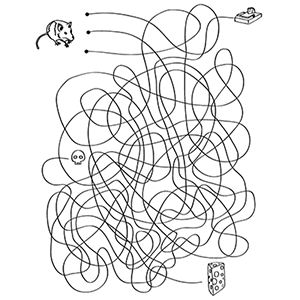
Rat running or cut-through driving refers to the use of secondary roads or residential side streets instead of the intended main roads in urban or suburban areas in order to avoid heavy traffic, lengthy traffic signals, or other obstacles lengthening a journey, even though traffic calming measures may be in place to discourage them and there may be laws against taking certain routes. Rat runs are frequently taken by motorists who are familiar with the local geography. They will often take such short cuts to avoid busy main roads and junctions (intersections).
The associations with ‘beating the crowd,’ the rush hour, and the rat race may have given rise to the term, or perhaps similarities were observed between the patterns of rat running driving routes and a rat running a maze.
read more »
Posted in Humor, Language, World |
Leave a Comment »
November 19, 2011

The term shunpiking comes from the word shun, meaning ‘to avoid,’ and pike, a term referring to turnpikes, which are roads that require payment of a toll to travel on them. People who often avoid toll roads sometimes call themselves shunpikers. Shunpiking has also come to mean an avoidance of major highways (regardless of tolls) in preference for bucolic and scenic interludes along lightly traveled country roads.
The word ‘shunpike’ may have its origins in post-colonial New Hampshire: When the ‘Turnpike’ was built, around 1810 or so, by the Hampton Causeway Turnpike Corporation, a toll was charged to cross it at Taylor’s River. Not content with the payment of a toll, some of the residents got together and built a slight bridge called the ‘Shunpike’ across the River, some distance west of the Turnpike bridge, where travelers and teamsters could cross without charge. This continued on until 1826, when the toll on the Turnpike was discontinued and has remained a free road to this day
read more »
Posted in Language, Money, World |
Leave a Comment »
November 19, 2011


A hacker is a member of the computer programmer subculture originated in the 1960s in the United States academia, in particular around the MIT’s Tech Model Railroad Club (TMRC) and MIT Artificial Intelligence Laboratory. Some members of the ‘hacker’ community most emphatically differentiate the term ‘hacker’ from malicious hackers (whom they very strongly prefer to call ‘crackers’).
Other hackers make no such distinction. The latter hackers’ view that hackerdom is not inherently moral/immoral or ethical/unethical is broadly similar to the concept or attitude of a ‘grey hat’ hacker. By contrast, ‘white hat’ hackers use their computer security related skills and knowledge to learn more about how systems and networks work and to help to discover and fix security holes, and ‘black hat’ hackers use the same skills to author harmful software (like viruses, trojans, etc.) and illegally infiltrate secure systems with the intention of doing harm to the system.
read more »
Posted in Language, Technology |
Leave a Comment »
November 18, 2011

‘The Man‘ is a slang phrase that may refer to the government or to some other authority in a position of power. In addition to this derogatory connotation, it may also serve as a term of respect and praise. The phrase ‘the Man is keeping me down’ is commonly used to describe oppression. The phrase ‘stick it to the Man’ encourages resistance to authority, and essentially means ‘fight back’ or ‘resist,’ either openly or via sabotage.
The term ‘the Man’ in the American sense dates back to the late 19th Century. In the Southern U.S. states, the phrase came to be applied to any man or any group in a position of authority, or to authority in the abstract. From about the 1950s the phrase was also an underworld code word for police, the warden of a prison or other law enforcement or penal authorities.
read more »
Posted in Humor, Language, Politics |
Leave a Comment »
November 18, 2011


A fictional currency is some form of defined or alluded currency in works of fiction. The names of such units of currency are sometimes based on extant or historic currencies (e.g. ‘Altairian dollars’ or ‘Earth yen’) while others, such as ‘Kalganids’ in Asimov’s ‘Foundation’ series, may be wholly invented. A particularly common type, especially in science fiction, is electronically managed ‘credits.’ In some works of fiction, exchange media other than money are used. These are not currency as such, but rather nonstandard media of exchange used to avoid the difficulties of ensuring ‘double coincidence of wants’ in a barter system.
Authors have to take care when naming fictional currencies because of the associations between currency names and countries; recognizable names for currencies of the future may be used to imply how history has progressed, but would appear out of place in an entirely alien civilization. Historical fiction may need research. Writers need not explain the exact value of their fictional currencies or provide an exchange rate to modern money; they may rely on the intuitive grasp of their readers, for instance that one currency unit is probably of little value, but that millions of units will be worth a lot.
read more »
Posted in Art, Language, Money |
Leave a Comment »
November 17, 2011

Pocho [poh-choh] is a term used by native-born Mexicans to describe Chicanos who are perceived to have forgotten or rejected their Mexican heritage to some degree. Typically, pochos speak English and lack fluency in Spanish.
Among some pochos, the term has been embraced to express pride in having both a Mexican and an American heritage asserting their place in the diverse American culture. The word derives from the Spanish word ‘pocho,’ used to describe fruit that has become rotten or discolored.
read more »
Posted in Language, Politics, World |
Leave a Comment »
November 17, 2011
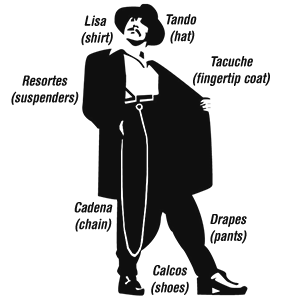
Pachucos [puh-choo-koh] are Chicano youths who developed their own subculture during the 1930s and 1940s in the Southwestern United States. They wore distinctive clothing (such as zoot suits) and spoke their own dialect of Mexican Spanish, called Caló or Pachuco. Due to their double marginalization stemming from their youth and ethnicity, there has always been a close association and cultural cross-pollination between the Pachuco subculture and gang subculture.
The Pachuco style originated in El Paso, Texas, and Ciudad Juárez, Mexico, and moved westward, following the line of migration of Mexican railroad workers (‘traqueros’) into Los Angeles, where it developed further. The word ‘pachuco’ originated, probably early in the 20th century, in a Mexican Spanish slang term for a resident of the cities of El Paso and Juárez. Even today, El Paso and Juárez are the ‘El Chuco’ or ‘El Pasiente’ by some.
read more »
Posted in Language, Politics, World |
1 Comment »
November 17, 2011
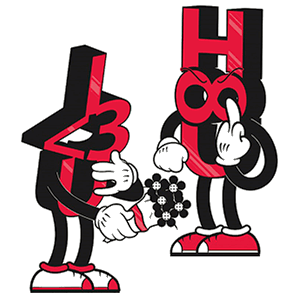
SMS language or textese is a term for the abbreviations and slang most commonly used due to the necessary brevity of mobile phone text messaging, in particular the widespread SMS (short message service) communication protocol. SMS language is also common on the Internet, including in email and instant messaging. It can be likened to a rebus, an allusional device that uses pictures to represent words or parts of words (e.g. ‘i <3 u’ which uses the pictogram of a heart for ‘love,’ and the letter ‘u’ replaces ‘you’).
The objective of SMS language is to use the least number of characters needed to convey a comprehensible message, also as many telecommunication companies have an SMS character limit, another benefit of SMS language is to reduce the character count of a message, hence, punctuation, grammar, and capitalization are largely ignored.
read more »
Posted in Language, Technology |
Leave a Comment »



