November 19, 2011


A hacker is a member of the computer programmer subculture originated in the 1960s in the United States academia, in particular around the MIT’s Tech Model Railroad Club (TMRC) and MIT Artificial Intelligence Laboratory. Some members of the ‘hacker’ community most emphatically differentiate the term ‘hacker’ from malicious hackers (whom they very strongly prefer to call ‘crackers’).
Other hackers make no such distinction. The latter hackers’ view that hackerdom is not inherently moral/immoral or ethical/unethical is broadly similar to the concept or attitude of a ‘grey hat’ hacker. By contrast, ‘white hat’ hackers use their computer security related skills and knowledge to learn more about how systems and networks work and to help to discover and fix security holes, and ‘black hat’ hackers use the same skills to author harmful software (like viruses, trojans, etc.) and illegally infiltrate secure systems with the intention of doing harm to the system.
read more »
Posted in Language, Technology |
Leave a Comment »
November 18, 2011

‘The Man‘ is a slang phrase that may refer to the government or to some other authority in a position of power. In addition to this derogatory connotation, it may also serve as a term of respect and praise. The phrase ‘the Man is keeping me down’ is commonly used to describe oppression. The phrase ‘stick it to the Man’ encourages resistance to authority, and essentially means ‘fight back’ or ‘resist,’ either openly or via sabotage.
The term ‘the Man’ in the American sense dates back to the late 19th Century. In the Southern U.S. states, the phrase came to be applied to any man or any group in a position of authority, or to authority in the abstract. From about the 1950s the phrase was also an underworld code word for police, the warden of a prison or other law enforcement or penal authorities.
read more »
Posted in Humor, Language, Politics |
Leave a Comment »
November 18, 2011


A fictional currency is some form of defined or alluded currency in works of fiction. The names of such units of currency are sometimes based on extant or historic currencies (e.g. ‘Altairian dollars’ or ‘Earth yen’) while others, such as ‘Kalganids’ in Asimov’s ‘Foundation’ series, may be wholly invented. A particularly common type, especially in science fiction, is electronically managed ‘credits.’ In some works of fiction, exchange media other than money are used. These are not currency as such, but rather nonstandard media of exchange used to avoid the difficulties of ensuring ‘double coincidence of wants’ in a barter system.
Authors have to take care when naming fictional currencies because of the associations between currency names and countries; recognizable names for currencies of the future may be used to imply how history has progressed, but would appear out of place in an entirely alien civilization. Historical fiction may need research. Writers need not explain the exact value of their fictional currencies or provide an exchange rate to modern money; they may rely on the intuitive grasp of their readers, for instance that one currency unit is probably of little value, but that millions of units will be worth a lot.
read more »
Posted in Art, Language, Money |
Leave a Comment »
November 17, 2011

Pocho [poh-choh] is a term used by native-born Mexicans to describe Chicanos who are perceived to have forgotten or rejected their Mexican heritage to some degree. Typically, pochos speak English and lack fluency in Spanish.
Among some pochos, the term has been embraced to express pride in having both a Mexican and an American heritage asserting their place in the diverse American culture. The word derives from the Spanish word ‘pocho,’ used to describe fruit that has become rotten or discolored.
read more »
Posted in Language, Politics, World |
Leave a Comment »
November 17, 2011
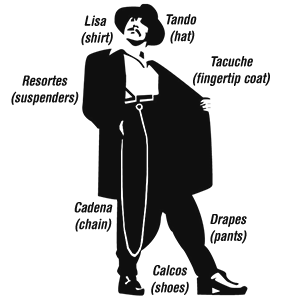
Pachucos [puh-choo-koh] are Chicano youths who developed their own subculture during the 1930s and 1940s in the Southwestern United States. They wore distinctive clothing (such as zoot suits) and spoke their own dialect of Mexican Spanish, called Caló or Pachuco. Due to their double marginalization stemming from their youth and ethnicity, there has always been a close association and cultural cross-pollination between the Pachuco subculture and gang subculture.
The Pachuco style originated in El Paso, Texas, and Ciudad Juárez, Mexico, and moved westward, following the line of migration of Mexican railroad workers (‘traqueros’) into Los Angeles, where it developed further. The word ‘pachuco’ originated, probably early in the 20th century, in a Mexican Spanish slang term for a resident of the cities of El Paso and Juárez. Even today, El Paso and Juárez are the ‘El Chuco’ or ‘El Pasiente’ by some.
read more »
Posted in Language, Politics, World |
1 Comment »
November 17, 2011
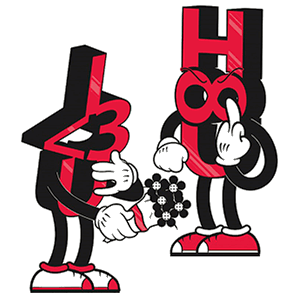
SMS language or textese is a term for the abbreviations and slang most commonly used due to the necessary brevity of mobile phone text messaging, in particular the widespread SMS (short message service) communication protocol. SMS language is also common on the Internet, including in email and instant messaging. It can be likened to a rebus, an allusional device that uses pictures to represent words or parts of words (e.g. ‘i <3 u’ which uses the pictogram of a heart for ‘love,’ and the letter ‘u’ replaces ‘you’).
The objective of SMS language is to use the least number of characters needed to convey a comprehensible message, also as many telecommunication companies have an SMS character limit, another benefit of SMS language is to reduce the character count of a message, hence, punctuation, grammar, and capitalization are largely ignored.
read more »
Posted in Language, Technology |
Leave a Comment »
November 17, 2011

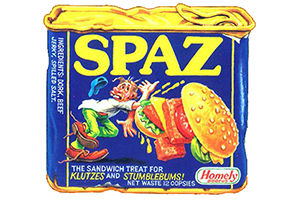
A euphemism is the substitution of an uncontroversial phrase for a more frank expression that might offend or otherwise suggest something unpleasant to the audience. Euphemisms often evolve over time into taboo words, through a process described by American philosopher W.V.O. Quine, and more recently dubbed the ‘euphemism treadmill‘ by cognitive scientist Steven Pinker, and discussed in his books ‘The Blank Slate’ (2003) and ‘The Stuff of Thought’ (2007).
This is the well-known linguistic process known as ‘pejoration’ or ‘semantic change.’ Words originally intended as euphemisms may lose their euphemistic value, acquiring the negative connotations of their referents. In some cases, they may be used mockingly and become the opposite of euphemisms, ‘dysphemisms.’ Euphemisms related to disabilities have been prone to this. In his remarks on the ever-changing London slang, made in ‘Down and Out’ in Paris and London, George Orwell mentioned both the euphemism treadmill and the dysphemism treadmill. He did not use these now-established terms, but observed and commented on the respective processes as early as in 1933.
Posted in Humor, Language, Politics |
Leave a Comment »
November 17, 2011

Reappropriation [ree-uh-proh-pree-eyt] is the cultural process by which a group reclaims terms or artifacts that were previously used in a way disparaging of that group. For example, since the early 1970s, much terminology referring to homosexuality—such as gay, queer, and (to a lesser extent) faggot—has been reappropriated. Another example of reappropriation would be an African American collecting lawn jockeys or other artifacts of darky iconography. The term reappropriation can also extend to counter-hegemonic re-purposing, such as citizens with no formal authority seizing unused public or private land for community use.
The term reappropriation is an extension of the term appropriation or cultural appropriation used in anthropology, sociology and cultural studies to describe the hegemonic action of reabsorbing subcultural styles and forms, or those from other cultures, into mass culture through a process of commodification: the mass-marketing of alternate lifestyles, practices, and artifacts.
read more »
Posted in Language, Politics, Sex |
Leave a Comment »
November 16, 2011

No true Scotsman is an informal logical fallacy, an ad hoc attempt to retain an unreasoned assertion. When faced with a counterexample to a universal claim, rather than denying the counterexample or rejecting the original universal claim, this fallacy modifies the subject of the assertion to exclude the specific case or others like it by rhetoric, without reference to any specific objective rule. The term was advanced by philosopher Antony Flew in his 1975 book ‘Thinking About Thinking: Do I sincerely want to be right?’ Imagine Hamish McDonald, a Scotsman, sitting down with his ‘Glasgow Morning Herald’ and seeing an article about how the ‘Brighton Sex Maniac Strikes Again.’ Hamish is shocked and declares that ‘No Scotsman would do such a thing.’ The next day he sits down to read his paper again and this time finds an article about an Aberdeen man whose brutal actions make the Brighton sex maniac seem almost gentlemanly. This fact shows that Hamish was wrong in his opinion but is he going to admit this? Not likely. This time he says, ‘No true Scotsman would do such a thing.’
An example of a political application of the fallacy could be in asserting that ‘no democracy starts a war,’ then distinguishing between mature or ‘true’ democracies, which never start wars, and ’emerging democracies,’ which may start them. At issue is whether or not something labeled as an ’emerging democracy’ is actually a democracy or something in a different conceptual category.
Posted in Language, Philosophy, World |
1 Comment »
November 16, 2011


Wigger [wig-er] is a pejorative slang term for a white person who emulates mannerisms, language, and fashions associated with African-American culture, particularly hip hop in the United States or the Grime/Garage scene in Britain. The term is a portmanteau of either wannabe or white and n****r. The term is considered derogatory, reflecting stereotypes of African-American or Black British culture, and can be used pejoratively, because of its connotations of cultural appropriation. It is also often used in a racist manner, not only belittling the person perceived as acting black, but also demeaning black people and culture by proxy. Some, however, use the term neutrally, or as a light joke, without any racism intended.
The phenomenon of white people adopting stereotypical black mannerisms, speech, and apparel – which in the general case is called allophilia – has appeared in several generations since slavery was abolished in the western world. The concept has been documented in the United States, Canada, United Kingdom, Australia and other white-majority countries. An early form of this was the ‘white negro’ in the jazz and swing music scenes of the 1920s and 1930s; as examined in the 1957 Norman Mailer essay, ‘The White Negro.’ It was later seen in the Zoot suiter of the 1930s and 1940s; the hipster of the 1940s; and the beatnik and rock and roller of the 1950s.
Posted in Language, Politics, World |
1 Comment »
November 16, 2011

Plastic Paddy is a slang term used to describe some members of the Irish diaspora, or those with no ancestral connection to Ireland, who appropriate (often stereotypical) Irish customs and identity. A Plastic Paddy may know little of actual Irish culture, but nevertheless assert an Irish identity. The term is pejoratively used to refer to people on the basis of their perceived lack of authenticity as Irish.
People who were not born in Ireland, and who did not grow up in Ireland, but nonetheless possess Irish citizenship and an Irish passport are often labelled as Plastic Paddies. The term came into common use in the 1980s when it was frequently employed as a term of abuse by recently-arrived middle class Irish migrants to London. It ‘became a means of distancing themselves from established Irish communities.’ And the use was a part of the process by which the second-generation Irish are positioned as inauthentic within the two identities, of Englishness and Irishness.
read more »
Posted in Language, Politics, World |
Leave a Comment »
November 16, 2011
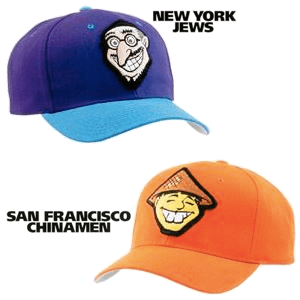
Cultural appropriation is the adoption of some specific elements of one culture by a different cultural group. It describes acculturation, the exchange of cultural features that results when different cultures come into continuous first hand contact; or assimilation, the process of integration where members of an ethno-cultural group, typically immigrants, or other minority groups, are ‘absorbed’ into an established, generally larger community.
It can include the introduction of forms of dress or personal adornment, music and art, religion, language, or social behavior. These elements, once removed from their indigenous cultural contexts, can take on meanings that are significantly divergent from, or merely less nuanced than, those they originally held.
read more »
Posted in Language, Politics, World |
Leave a Comment »


 The Daily Omnivore