May 9, 2011

The Texas sharpshooter fallacy is a logical fallacy in which information that has no relationship is interpreted or manipulated until it appears to have meaning. The name comes from a joke about a Texan who fires some shots at the side of a barn, then paints a target centered on the biggest cluster of hits and claims to be a sharpshooter.
The fallacy does not apply if one had a prior expectation of the particular relationship in question before examining the data. It is related to the clustering illusion, which refers to the tendency in human cognition to interpret patterns in randomness where none actually exist.
read more »
Posted in Humor, Language, Science |
Leave a Comment »
May 5, 2011

The boiling frog story is a widespread anecdote describing a frog slowly being boiled alive. The premise is that if a frog is placed in boiling water, it will jump out, but if it is placed in cold water that is slowly heated, it will not perceive the danger and will be cooked to death. It is a metaphor for the inability of people to react to significant changes that occur gradually. However, the premise of the story is not literally true; an actual frog submerged and gradually heated will jump out. (Similarly, the metaphor of an ostrich with its head buried in the sand is also not base in fact.)
The moral of the story is that people should make themselves aware of gradual change lest they suffer eventual undesirable consequences. At times it is told in support of a slippery slope argument. It is also used in business to illustrate the idea that change needs to be gradual to be accepted. It was used in 1960 to describe the dangers of sympathy towards the Soviet Union during the Cold War; in 1980 about the impending collapse of civilization anticipated by survivalists; and in the 1990s about inaction in response to climate change and staying in abusive relationships. It has also been used by libertarians to warn about slow erosion of civil rights. In philosophy the boiling frog story has been used as a way of explaining the ‘sorites paradox’: if you remove grains one at a time from a heap of sand, at what point does it cease to be a ‘heap.’
Posted in Language, Philosophy, Science |
Leave a Comment »
May 5, 2011

Unobtrusive research is a method of data collection used primarily in the social sciences first described in 1966, which do not involve direct elicitation of data from the research subjects. Unobtrusive measures are contrasted with interviews and questionnaires, in that they try to find indirect ways to obtain the necessary data. The unobtrusive approach often seeks unusual data sources, such as garbage, graffiti and obituaries, as well as more conventional ones such as published statistics. Unobtrusive measures should not be perceived as an alternative to more reactive methods such as interviews, surveys and experiments, but rather as an additional tool in the tool chest of the social researcher. Unobtrusive measures can assist in tackling known biases such a subjective bias towards a result expected.
The proliferation of digital media opened a new era for communication researchers in search of unobtrusively obtained data sources. Online communication creates digital footprints that can allow an analysis of data that are obtained through unobtrusive methods, and are also much larger than previous studies. These footprints can now be used to analyze topics such as the content of communication events, the process of communication, and the structure of the communicative network. The surge of Internet-sourced research data rekindled the discussion of the ethical aspects of using unobtrusively obtained data. For example, can all data collected in the public domain be used for research purposes? When should we seek consent, and is it realistic to require informed consent from sources of unobtrusively collected data? These questions do not have a simple answer, and the solution is a result of a careful and ongoing dialog between researchers, and between researchers and society.
Posted in Language, Politics, Technology |
Leave a Comment »
May 5, 2011


People watching is the act of observing people and their interactions, usually without their knowledge. This differs from voyeurism in that it does not relate to sex or sexual gratification. Though often a casual hobby, it can be used formally as a means for sociological, anthropological or psychological research.
Naturalistic observation is a more formal way of describing people watching in an academic sense, and involves observing subjects in their natural habitat, taking great care to avoid interfering with the behavior being observed. People watching is often accompanied by eavesdropping, surreptitiously listening to the private conversation of others without their knowledge.
Posted in Language, Science |
Leave a Comment »
May 4, 2011
Sir Ken Robinson (b. 1950) is an author, and expert on education and the arts.
Robinson’s 2001 book, ‘Out of Our Minds: Learning to be Creative,’ argues that creativity is undervalued and ignored in Western culture and especially in its educational systems.
Posted in Art, Language |
Leave a Comment »
May 3, 2011

Theistic evolution is a concept that asserts that classical religious teachings about God are compatible with the modern scientific understanding about biological evolution. In short, theistic evolutionists believe that there is a God, that God is the creator of the material universe and (by consequence) all life within, and that biological evolution is simply a natural process within that creation. Evolution, according to this view, is simply a tool that God employed to develop human life.
Theistic evolution is not a scientific theory, but a particular view about how the science of evolution relates to religious belief and interpretation. Theistic evolution supporters can be seen as one of the groups who reject the conflict thesis regarding the relationship between religion and science – that is, they hold that religious teachings about creation and scientific theories of evolution need not contradict. Proponents of this view are sometimes described as Christian Darwinists.
Posted in Language, Philosophy, Science |
1 Comment »
May 3, 2011
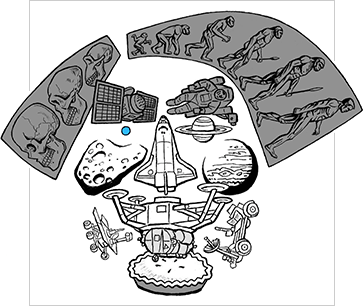
Carl Sagan (1934 – 1996) was an American astronomer. He devoted his life to popularizing science. He speculated about what life from other planets would be like, and promoted the search for extraterrestrial life. He is world famous for his popular science books and the television series Cosmos, which he co-wrote and presented.
He was born in Brooklyn New York where his father, Sam Sagan, was a Jewish clothes maker and his mother, Rachel Molly Gruber, was a housewife. Sagan attended the University of Chicago earning two degrees in physics. He followed with a doctorate in Astronomy in 1960 and taught at Harvard University until 1968, when he moved to Cornell University.
read more »
Posted in Language, Philosophy, Science |
Leave a Comment »
April 28, 2011

Weltschmerz [velt-shmerts] (from the German, meaning world-pain or world-weariness) is a term coined by the German author Jean Paul and denotes the kind of feeling experienced by someone who understands that physical reality can never satisfy the demands of the mind. This kind of pessimistic world view was widespread among several romantic authors such as Lord Byron and Herman Hesse. It is also used to denote the feeling of sadness when thinking about the evils of the world.
The modern meaning of Weltschmerz in the German language is the psychological pain caused by sadness that can occur when realizing that someone’s own weaknesses are caused by the inappropriateness and cruelty of the world and (physical and social) circumstances. Weltschmerz in this meaning can cause depression, resignation and escapism, and can become a mental problem.
Posted in Language, Philosophy, World |
Leave a Comment »
April 28, 2011

Eating your own dog food, also called dogfooding, is when a company (usually, a software company) uses the products that it makes. In 1988, Microsoft manager Paul Maritz wrote an email titled ‘Eating our own Dogfood,’ challenging his team to increase internal usage of the company’s product.
From there, the usage of the term spread through the company. The term is believed to have derived from a 1980s television advertisements for Alpo dog food, where TV actor, Lorne Greene pointed out that he fed Alpo to his own dogs.
read more »
Posted in Humor, Language, Money |
Leave a Comment »
April 28, 2011

Quirkyalone is a neologism referring to someone who enjoys being single (but is not opposed to being in a relationship) and generally prefers to be alone rather than dating for the sake of being in a couple. Magazine publisher Sasha Cagen came up with the term on a Brooklyn subway platform on New Year’s Eve, 1999.
International Quirkyalone Day is February 14 and was chosen as an alternative to ‘the marketing barrage’ of Valentine’s Day. It started in 2003 as a ‘celebration of romance, freedom and individuality.’
Posted in Language, Love, Sex |
Leave a Comment »
April 28, 2011

Ultracrepidarianism [uhl-truh-krep-i-dair-ee-uhn-iz-uhm] is the habit of giving opinions and advice on matters outside of one’s knowledge. The term was first publicly recorded in 1819 by the essayist William Hazlitt in a letter to William Gifford, the editor of the ‘Quarterly Review,’ a London periodical. The term draws from a comment purportedly made by Apelles, a famous Greek artist to a shoemaker who presumed to criticise his painting. The Latin phrase, ‘Sutor, ne ultra crepidam’ meaning literally ‘Shoemaker, not above the sandal,’ used to warn people off passing judgement beyond their expertise.
As the story goes, the shoemaker (sutor) had approached the painter Apelles of Kos to point out a defect in the artist’s rendition of a sandal (crepida), which Apelles duly corrected. Encouraged by this, the shoemaker then began to enlarge on other defects he considered present in the painting, at which point Apelles silenced him with his famous ‘Sutor, ne ultra crepidam.’ The saying remains popular in several languages, and is translated directly into the common Dutch saying ‘schoenmaker, blijf bij je leest’ (shoemaker, stick to your last, a last being the wooden pattern used in shoemaking).
Posted in Humor, Language |
Leave a Comment »
April 28, 2011
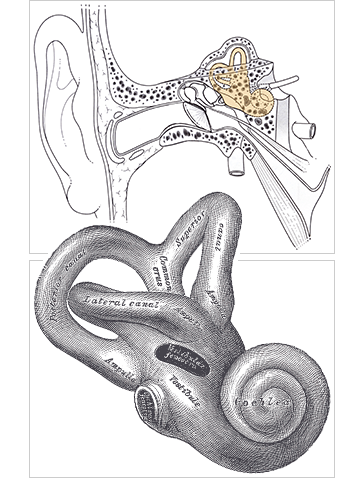
The receptors for the senses of equilibrium (vestibule) and hearing (cochlea) are housed within a collection of fluid filled tubes and chambers known as the membranous labyrinth, which is located within the bony labyrinth, a cavity in an an animal’s skull bones.
Posted in Health, Language, Science |
Leave a Comment »




 The Daily Omnivore