April 12, 2011

The Anthropocene [an-thruh-poh-seen] is a proposed geological epoch that marks the impact of human activities on the Earth’s ecosystems. The term was coined in 2000 by the Nobel Prize-winning atmospheric chemist Paul Crutzen, who regards the influence of human behavior on the Earth’s atmosphere in recent centuries as so significant as to constitute a new geological era for its lithosphere (the rigid outermost shell of a rocky planet). As early as 1873, the Italian geologist Antonio Stoppani acknowledged the increasing power and impact of humanity on the Earth’s systems and referred to the ‘anthropozoic era’
The Anthropocene has no precise start date, but based on atmospheric evidence may be considered to start with the Industrial Revolution (late 18th century). Other scientists link it to earlier events, such as the rise of agriculture. Human influence on land use, ecosystems, biodiversity and species extinctions, may have begun as early as 10,000 years before present. This period (10,000 years to present) is usually referred to as the Holocene by geologists. For the majority of the Holocene, human populations were relatively low and their activities considerably muted relative to that of the last few centuries. Nonetheless, many of the processes currently altering the Earth’s environment were already occurring.
Posted in Language, Science, Technology |
Leave a Comment »
April 12, 2011

Highway hypnosis, also popularly known as ‘driving without attention mode’ or ‘white line fever,’ is a mental state in which a person can drive a motor vehicle great distances, responding to external events in the expected manner with no recollection of having consciously done so. In this state the driver’s conscious mind is apparently fully focused elsewhere, with seemingly direct processing of the masses of information needed to drive safely. Highway hypnosis is just one manifestation of a relatively commonplace experience, where the conscious and unconscious minds appear to concentrate on different things.
Building on the theories of American psychologist, Ernest Hilgard (1904 – 2001), that hypnosis is an altered state of awareness, some theorists hold that the consciousness can develop hypnotic dissociation. In the example of highway hypnosis, one stream of consciousness is driving the car while the other stream of consciousness is dealing with other matters. Amnesia can even develop for the dissociated consciousness that drove the automobile. The phenomenon is an example of automaticity in cognitive psychology.
Posted in Health, Language, Science |
Leave a Comment »
April 12, 2011

Automaticity [aw-tuh-mah-tis-i-tee] is the ability to do things without occupying the mind with the low-level details required, allowing it to become an automatic response pattern or habit. It is usually the result of learning, repetition, and practice. Examples of automaticity are common activities such as speaking, bicycle-riding, assembly-line work, and driving a car.
After an activity is sufficiently practiced, it is possible to focus the mind on other activities or thoughts while undertaking an automaticized activity (for example, holding a conversation or planning a speech while driving a car). Walking is not an example of automaticity as it is not a cortical function. It is a medullary function, with specific medullary circuits, which can be learnt to be inhibited or altered by higher-order ones.
Posted in Health, Language, Science |
Leave a Comment »
April 11, 2011

A jinx [jingks], in popular superstition and folklore, is: a type of curse placed on a person that makes them prey to many minor misfortunes and other forms of bad luck; a person afflicted with a similar curse, who, while not directly subject to a series of misfortunes, seems to attract them to anyone in his vicinity; and an object/ person that brings bad luck.
Jinx is also a children’s game (although not necessarily played only by children) with myriad rules and penalties that occurs when two people unintentionally or intentionally speak (or type) the same word or phrase simultaneously.
read more »
Posted in Games, Humor, Language |
Leave a Comment »
April 11, 2011

Beginner’s luck refers to the supposed phenomenon of novices experiencing disproportionate frequency of success or succeeding against an expert in a given activity. One would expect experts to outperform novices – when the opposite happens it is counter-intuitive, hence the need for a term to describe this phenomenon.
The term is most often used in reference to a first attempt in sport or gambling, but is also used in many other diverse contexts. The term is also used when no skill whatsoever is involved, such as a first-time slot machine player winning the jackpot.
read more »
Posted in Games, Language, Philosophy |
Leave a Comment »
April 11, 2011
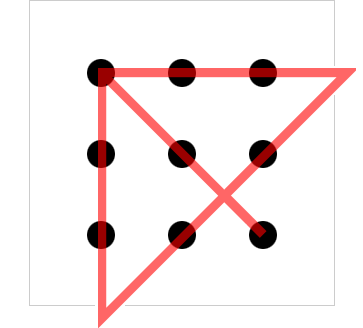
‘Thinking outside the box‘ is to think differently, unconventionally or from a new perspective. This is sometimes called a process of lateral thought. As catchphrase, or cliché, it has become widely used in business environments, especially by management consultants and executive coaches, and has spawned a number of advertising slogans. To think outside the box is to look further and to try not thinking of the obvious things, but to try thinking beyond them.
The origins of the phrase are obscure; but it was popularized in part because of a nine-dot puzzle, which British author, John Adair claims to have introduced in 1969. The puzzle proposed an intellectual challenge—to connect the dots by drawing four straight, continuous lines that pass through each of the nine dots, and never lifting the pencil from the paper. The conundrum is easily resolved, but only if you draw the lines outside the confines of the square area defined by the nine dots themselves.
Posted in Games, Language, Money |
Leave a Comment »
April 11, 2011

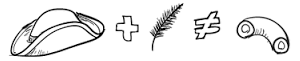
A macaroni [mak-uh-roh-nee] in mid-18th century England, was a fashionable fellow who dressed and spoke in an outlandishly affected and effeminate manner.
The term pejoratively referred to a man who ‘exceeded the ordinary bounds of fashion’ in terms of clothes, fastidious eating and gambling.
read more »
Posted in Art, Humor, Language |
Leave a Comment »
April 11, 2011
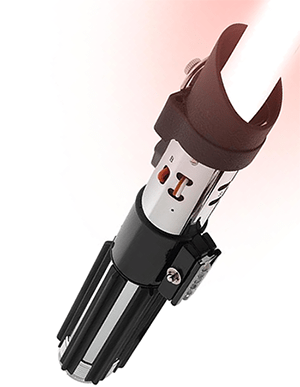
Mike Alder is an Australian mathematician and philosopher known for his popular writing, such as sardonic articles about the lack of basic arithmetic skills in young adults. ‘Newton’s flaming laser sword’ is a philosophical razor devised by Alder in 2004 on the conflicting positions of scientists and philosophers on epistemology (the study of knowledge).
The razor is humorously named after Isaac Newton, as it is inspired by Newtonian thought, and is ‘much sharper and more dangerous than Occam’s Razor.’
read more »
Posted in Language, Philosophy, Science |
Leave a Comment »
April 9, 2011

The term intuition is used to describe ‘thoughts and preferences that come to mind quickly and without much reflection.’ “The word ‘intuition’ comes from the Latin word ‘intueri,’ which is often roughly translated as meaning ‘to look inside’ or ‘to contemplate.’ Intuition provides us with beliefs that we cannot necessarily justify. For this reason, it has been the subject of study in psychology, as well as a topic of interest in the supernatural. The ‘right brain’ is popularly associated with intuitive processes such as artistic abilities.
Some scientists have contended that intuition is associated with innovation in scientific discovery. Intuition is also a common subject of New Age writings. In Carl Jung’s theory of the ego intuition was an ‘irrational function,’ opposed most directly by sensation, and opposed less strongly by the ‘rational functions’ of thinking and feeling. Jung defined intuition as ‘perception via the unconscious.’ Bringing forth ideas, images, possibilities, ways out of a blocked situation, by a process that is mostly unconscious.
read more »
Posted in Language, Philosophy |
Leave a Comment »
April 7, 2011
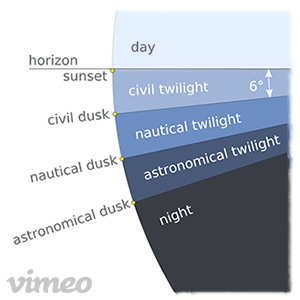
The Belt of Venus or Venus’s Girdle is the Victorian-era name for an atmospheric phenomenon seen at sunrise and sunset. Shortly after sunset or shortly before sunrise, the observer is, or is very nearly, surrounded by a pinkish glow or antitwilight arch that extends roughly 10°–20° above the horizon.
Often, the glow is separated from the horizon by a dark layer, the Earth’s shadow or ‘dark segment.’ The Arch’s light rose (pink) color is due to backscattering of reddened light from the rising or setting Sun. A very similar effect can be seen during a total solar eclipse.
Posted in Language, Science |
Leave a Comment »
April 7, 2011

The blue hour comes from the French expression l’heure bleue, which refers to the period of twilight each morning and evening where there is neither full daylight nor complete darkness. The time is considered special because of the quality of the light at this time of day. The phrase is also used to refer to Paris immediately prior to World War I, which was considered to be a time of relative innocence.
In English culture the term was used to describe the period of inactivity and uselessness a drinker encounters when Pubs and other licensed premises have closed after the lunch-time session (typically 15:30 hrs) and will not open for the evening session until (typically 18:30 hrs).
Posted in Art, Drugs, Language |
Leave a Comment »
April 7, 2011

In photography and cinematography, the golden or magic hour, is the first and last hour of sunlight during the day, when a specific photographic effect is achieved due to the quality of the light. Typically, lighting is softer (more diffuse) and warmer in hue. When the Sun is near the horizon, sunlight travels through more of the atmosphere, reducing the intensity of the direct light, so that more of the illumination comes from indirect light from the sky.
More blue light is scattered, so that light from the Sun appears more reddish. In addition, the Sun’s small angle with the horizon produces longer shadows. In the middle of the day, the bright overhead Sun can create too-bright highlights and dark shadows. Because the contrast is less during the golden hour, shadows are less dark, and highlights are less likely to be overexposed.
Posted in Art, Language, Science |
Leave a Comment »




