March 28, 2011
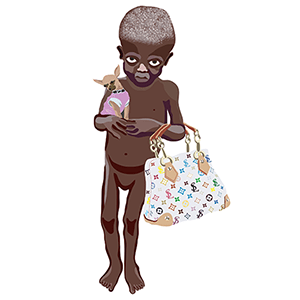
Nadia Plesner is a Danish/Dutch painter who works and lives in the Netherlands. Plesner is working on issues that lie between the editorial and advertising and often with political undertones. She trained at the Graphic Arts Institute, Copenhagen and at the Gerrit Rietveld Academie, Amsterdam. In 2010 Plesner was sued by Louis Vuitton for showing her controversial painting ‘Darfurnica.’ The painting shows a little hungry boy holding a handbag resembling one made by Louis Vuitton. The little boy is standing in the conflict-ridden region of Darfur in Sudan. The fashion giant thought that the legal rules about logo products were broken and the case was taken to court.
A Dutch court imposed daily fines for approximately 6000 US dollars. The trial attracted much international attention and several artists and celebrities supported Plesner as they believed that the case also referred to artistic expression and the right to make the world aware of international issues in an artistic way. Plesner and Louis Vuitton were also involved in a prior dispute about an artistic campaign called Simple Living in 2008. In 2011 the Dutch court reversed its decision and acquitted Nadia Plesner. ‘Darfurnica’ was sold in 2011 for approximately 45.000 US dollars.
Posted in Art, Money, Politics |
Leave a Comment »
March 28, 2011

Polymer banknotes were developed by the Reserve Bank of Australia, Commonwealth Scientific and Industrial Research Organization, and The University of Melbourne and were first issued as currency in Australia in 1988. These banknotes are made from the polymer biaxially-oriented polypropylene which greatly enhances durability. They also incorporate many security features not available to paper banknotes, making counterfeiting much more difficult. As of 2010, eight countries have converted fully to polymer banknotes: Australia, Bermuda, Brunei, New Zealand, Nicaragua, Papua New Guinea, Romania, and Vietnam.
An alternative polymer of polyethylene fibres marketed as Tyvek by DuPont was developed for use as currency by the American Bank Note Company in the early 1980s. Tyvek did not perform well in trials; smudging of ink and fragility were reported as problems. Only Costa Rica and Haiti issued Tyvek banknotes. Additionally, English printers Bradbury Wilkinson produced a version on Tyvek but marketed as Bradvek for the Isle of Man in 1983; however, they are no longer produced and have become collectors’ items.
Posted in Money, Technology, World |
Leave a Comment »
March 26, 2011
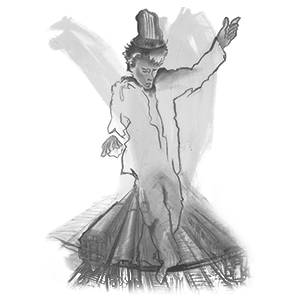
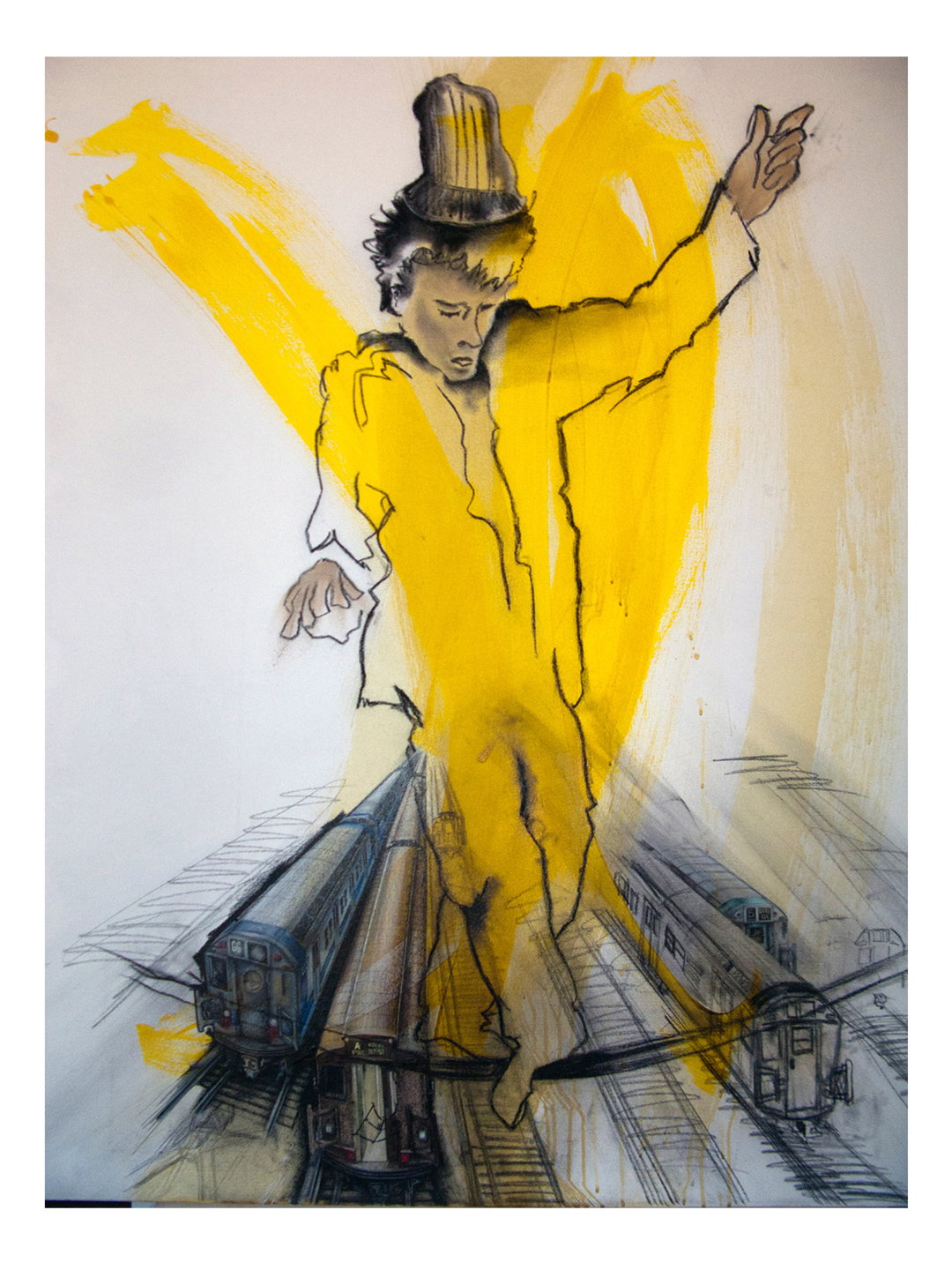
Lee Quiñones [kwi-nohn] (b. 1960) is one of several artists rising from the NYC subway graffiti movement. Born in Puerto Rico and raised in Lower East Side Manhattan, Lee was constantly drawing since the age of five and started with graffiti in 1974. By 1976, Lee was a legend, working in the shadow, leaving huge pieces of art across the subway system. His style is rooted in popular culture, often with political messages. Along with Keith Haring and Jean-Michel Basquiat, Lee Quiñones was one of the innovators of New York’s street-art movement and is considered the single most influential artist to emerge from the graffiti era.
As a subway graffiti artist, Lee almost exclusively painted whole cars (all together about 125), and he was a major contributor to the first-ever whole-train. In November 1976, ten subway cars were painted with a range of colorful murals and set a new benchmark for the scale of graffiti works. Quiñones often added poetic messages in his pieces such as: ‘Graffiti is art and if art is a crime, please God, forgive me.’ He was one of the first street artists to transition fine art. The 1979 exhibition of his canvases at Claudio Bruni’s Galleria Medusa in Rome introduced street art to the rest of the world.
Posted in Art, Money, Politics |
Leave a Comment »
March 26, 2011
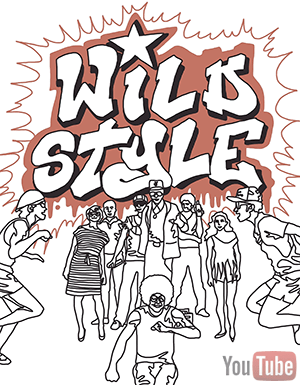
‘Wild Style‘ was the first hip hop motion picture. Released theatrically in 1983, featuring Fab Five Freddy, the Rock Steady Crew, The Cold Crush Brothers, and Grandmaster Flash. The protagonist ‘Zoro’ is played by the legendary NY subway graffiti artist Lee Quinones. An early version of the ‘Wild Style’ logo appeared in the Fall of 1981 when director Charlie Ahearn hired graffiti legend Dondi to paint the ‘window down’ subway car piece that appears in the film. The Dondi piece was the inspiration for the animated title sequence designed by the artist Zephyr in 1982.
The ‘Wild Style’ logo was designed by Zephyr and painted as a huge ‘burner’ mural by Zephyr, Revolt, and Sharp in the Summer of 1983. In addition to covering street artists, the film depicts several prominent figures from the early hip hop culture, engaging in activities such as MCing, turntablism, and breaking. The film has been sampled by many prominent hip hop artists (e.g. ‘Illmatic’ by Nas, ‘Midnight Marauders’ by A Tribe Called Quest, and ‘Check Your Head’ by Beastie Boys).
Posted in Art, Money, Politics |
Leave a Comment »
March 25, 2011

Dunbar’s number is a theoretical cognitive limit to the number of people with whom one can maintain stable social relationships. These are relationships in which an individual knows who each person is, and how each person relates to every other person.
Proponents assert that numbers larger than this generally require more restrictive rules, laws, and enforced norms to maintain a stable, cohesive group. No precise value has been set for Dunbar’s number; it has been proposed to lie between 100 and 230, with a commonly used value of 150.
read more »
Posted in Money, Science |
Leave a Comment »
March 25, 2011

The Dilbert Principle refers to a 1990s satirical observation by ‘Dilbert cartoonist’ Scott Adams stating that companies tend to systematically promote their least-competent employees to management (generally middle management), in order to limit the amount of damage they are capable of doing. In the ‘Dilbert’ strip of February 5, 1995 Dogbert says that ‘leadership is nature’s way of removing morons from the productive flow.’ Adams expanded on the idea in a satirical 1996 book of the same name, which is required reading at some management and business programs.
The Dilbert principle is comparable to the Peter Principle (in a hierarchy every employee tends to rise to his level of incompetence). It assumes that people are promoted because they are competent, and that the tasks higher up in the hierarchy require skills or talents they do not possess. It concludes that due to this, a competent employee will eventually be promoted to, and remain at, a position at which he or she is incompetent. The Dilbert principle, by contrast, assumes that the upper echelons of an organization have little relevance to its actual production, and that the majority of real, productive work in a company is done by people lower in the power ladder.
Posted in Humor, Language, Money |
Leave a Comment »
March 25, 2011

The Peter Principle: ‘In a hierarchy every employee tends to rise to his level of incompetence.’
It was formulated by Dr. Laurence J. Peter and Raymond Hull in their 1969 book of the same name. It holds that in a hierarchy, members are promoted so long as they work competently.Therefore, sooner or later they are promoted to a position at which they are no longer competent (their ‘level of incompetence’), and there they remain, being unable to earn further promotions.
read more »
Posted in Humor, Money |
Leave a Comment »
March 24, 2011
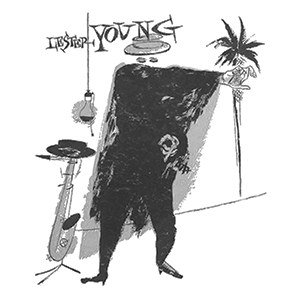
Lester Young (1909 – 1959), nicknamed ‘Prez,’ was an American jazz tenor saxophonist. He also played clarinet, trumpet, violin, and drums. Coming to prominence while a member of Count Basie’s orchestra, Young was one of the most influential players on his instrument, playing with a cool tone and using sophisticated harmonies. He invented or popularized much of the hipster ethos which came to be associated with the music. He is said to have popularized the term ‘cool’ as slang for something fashionable.
Another slang term he reputedly coined was the term ‘bread’ for money. He would ask ‘How does the bread smell?’ when asking how much a gig was going to pay. Young’s playing style influenced many other tenor saxophonists. Perhaps the most famous and successful of these were Stan Getz and Dexter Gordon, but he also influenced many in the cool movement such as Zoot Sims. Lester Young also had a direct influence on young Charlie Parker (‘Bird’), and thus the entire be-bop movement.
Posted in Art, Language, Money |
Leave a Comment »
March 24, 2011
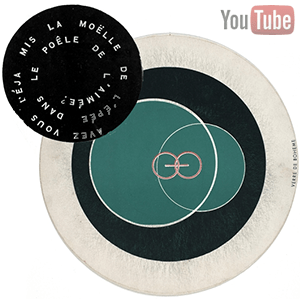
Kinetic art is art that contains moving parts or depends on motion for its effect. The moving parts are generally powered by wind, a motor or the observer. ‘Bicycle Wheel’ (1913) by Marcel Duchamp, is said to be the first kinetic sculpture. Besides being an example of kinetic art it is also an example of a readymade, a type of art of which Duchamp made a number of varieties throughout his life.
read more »
Posted in Art, Language, Money |
Leave a Comment »
March 24, 2011
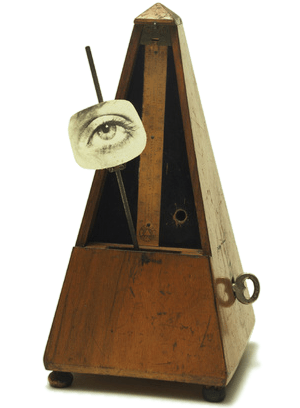
Man Ray (1890 – 1976), born Emmanuel Radnitzky, was an American artist who spent most of his career in Paris, France. Perhaps best described simply as a modernist, he was a significant contributor to both the Dada and Surrealist movements, although his ties to each were informal.
Best known in the art world for his avant-garde photography, Man Ray produced major works in a variety of media and considered himself a painter above all. He was also a renowned fashion and portrait photographer. He is noted for his photograms (images made without a camera by placing objects directly onto photographic paper, which he renamed ‘rayographs’ after himself.
read more »
Posted in Art, Money |
Leave a Comment »
March 24, 2011
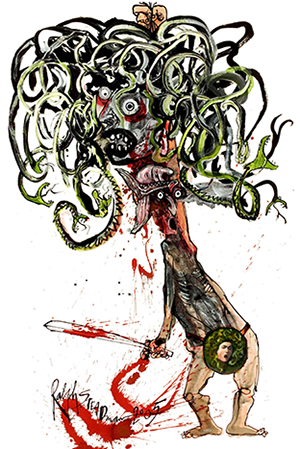
Ralph Steadman (b. 1936) is a British cartoonist and caricaturist who is perhaps best known for his work with American author Hunter S., drawing pictures for several of his articles and books. He accompanied Thompson to the Kentucky Derby for an article for ‘Scanlan’s,’ to the Honolulu Marathon for the ‘Running,’ and illustrated both ‘Fear and Loathing in Las Vegas’ and ‘Fear and Loathing on the Campaign Trail ’72.’
read more »
Posted in Art, Money |
1 Comment »
March 23, 2011
The lottery of birth is a philosophical argument that states: since no one chooses where they are born, they should not be held responsible for something that is beyond their control (e.g. being rich, being poor, etc.). The lottery of birth argument was sometimes used by philosophers such as John Locke, Thomas Hobbes, and Jean-Jacques Rousseau. More modern day uses have been prompted by political theorists such as John Rawls, who explores the subject more in depth in his book ‘A Theory of Justice.’
Posted in Money, Philosophy |
Leave a Comment »




 The Daily Omnivore