March 1, 2011

Ubuntu Cola [ooh-boon-too] is a soft drink certified by The Fairtrade Foundation, a charity based in the United Kingdom that works to empower disadvantaged producers in developing countries by tackling injustice in conventional trade, in particular by promoting and licensing the Fairtrade Mark, a guarantee that products retailed in the UK have been produced in accordance with internationally agreed Fairtrade standards.
Ubunto Cola is made with Fairtrade sugar from Malawi and Zambia, and is the first UK cola to be Fairtrade certified. It is available for sale in the United Kingdom, Sweden, Norway, Finland, Ireland, The Netherlands, Belgium, France, Italy, Switzerland, and online, in cans, 500 ml PET plastic bottles, and 275 ml glass bottles.
Posted in Food, Money, Politics |
Leave a Comment »
March 1, 2011

The Nation is the oldest continuously published weekly magazine in the US. The periodical, devoted to politics and culture, is self-described as ‘the flagship of the left.’ Founded on July 6, 1865, It is published by The Nation Company, L.P., at 33 Irving Place, New York City. It has bureaus in Washington, D.C., London, and South Africa, with departments covering Architecture, Art, Corporations, Defense, Environment, Films, Legal Affairs, Music, Peace and Disarmament, Poetry, and the UN. The publisher and editor is Katrina vanden Heuvel.
According to its founding prospectus of 1865, ‘The Nation will not be the organ of any party, sect, or body. It will, on the contrary, make an earnest effort to bring to the discussion of political and social questions a really critical spirit, and to wage war upon the vices of violence, exaggeration and misrepresentation by which so much of the political writing of the day is marred.’ Notable contributors have included Albert Einstein, Martin Luther King Jr., Bertrand Russell, Hunter S. Thompson, Leon Trotsky, George Orwell, Franklin D. Roosevelt, John Steinbeck, Kurt Vonnegut, Robert Frost, Frank Lloyd Wright, Jean-Paul Sartre, and John Maynard Keynes.
Posted in Language, Money, Politics |
Leave a Comment »
March 1, 2011

The Weekly Standard is an American neoconservative opinion magazine published semi-weekly since 1995 by News Corporation. Currently edited by founder William Kristol and Fred Barnes, the Standard has been described as a ‘redoubt of neoconservatism’ and as ‘the neo-con bible.’
Many of the magazine’s articles are written by members of conservative think tanks located in Washington, D.C.: the American Enterprise Institute, the Ethics and Public Policy Center, the Foundation for Defense of Democracies, and the Hudson Institute. The magazine’s website blog, titled the ‘Daily Standard,’ is edited by John McCormack and Daniel Halper and produces daily articles and commentary.
Posted in Language, Money, Politics |
Leave a Comment »
March 1, 2011

The Space Exploration Vehicle (SEV) formerly known as the Lunar Electric Rover (LER) is a vehicle designed by NASA for extra-vehicular activity on a planetary surface or in-space missions. The SEV is the size of a small pickup truck, it has 12 wheels, and can house two astronauts for up to two weeks. The pressurized module contains a small bathroom with privacy curtains and a shower head producing a water mist for sponge baths. It also contains cabinets for tools, workbench areas and two crew seats that can fold back into beds.
The SEV consists of a chassis and cabin module, and will allow the attachment of tools such as cranes, cable reels, backhoes and winches. Designed for 2, this vehicle is capable of supporting 4 in an emergency. With wheels that can pivot 360 degrees, the SEV is able to drive in any direction. This vehicle is designed to be used with or without the pressurized module. Astronauts can enter and exit without space suits directly from an airlock docking hatch, or through a suitport without the need to depressurize the habitat module.
Posted in Money, Politics, Technology |
Leave a Comment »
February 28, 2011

Herman’s Hermits is an English pop band, formed in Manchester in 1963. For a brief time the group rivalled the Beatles on the charts, and was the top-selling pop act in the U.S. in 1965. The group’s manager and producer, Mickie Most (who controlled the band’s output), emphasized a simple, non-threatening and clean-cut image, although the band originally played R&B numbers. This helped Herman’s Hermits become hugely successful in the mid-1960s but hampered the band’s creativity, relegating Noone, Hopwood, Leckenby and Green’s original songs to quickly recorded B-sides and album cuts.
Their first hit was a cover of Earl Jean’s ‘I’m Into Something Good’ (written by Gerry Goffin and Carole King), which reached No. 1 in the UK Singles Chart and No. 13 in the US in 1964. They never topped the British charts again, but had two US Billboard Hot 100 No. 1’s with ‘Mrs. Brown, You’ve Got a Lovely Daughter’ and ‘I’m Henry the Eighth, I Am’ (a British music hall song dating from 1911). These songs were aimed at a US fan-base, with Peter Noone exaggerating his Manchester accent; the band was not fond of either song and they were never released as singles in Britain.
Posted in Art, Money |
Leave a Comment »
February 27, 2011

The Pascha is a 12 story brothel in Cologne, Germany. With about 120 prostitutes, over 80 employees and up to 1000 customers per day, it is the largest brothel in Europe. The brothel was opened in January 1972 in the Hornstraße, under the name ‘Eros Center.’ It was Europe’s first high rise brothel. The city of Cologne wanted to eliminate the red light district ‘Kleine Brinkgasse’ in the city center and issued a license to build the new brothel on land owned by the city in the outskirts of town. The house rents 126 rooms on 7 floors to prostitutes for a fee of 180 Euros per day, which includes meals, medical care, and the 20 Euros of tax that authorities collect per prostitute per day.
The women come from many countries; about 30% of them are German. They typically sit outside of their rooms and negotiate with customers who wander the hallways. Some of the women live in their rooms, others rent a second room to stay in, while still others stay in their own apartments in Cologne. The house is open 24 hours a day; customers of the prostitutes pay an entrance fee of 5 Euros and then negotiate directly with the women, who work independently and keep all of the money. One floor is reserved for low-cost service, and another one for transsexual prostitutes. The house also contains a regular hotel, a table dance nightclub with separate entrance, several bars, and a separate club-style brothel on the top floor.
Posted in Money, Sex, World |
1 Comment »
February 27, 2011

SweeTango, a registered trademark for a cultivar of apples produced in Minneiska, Minnesota. It is a newly released hybrid brand apple that debuted in 2009. It is a pinkish apple consisting of a yellow background that is intermittent with red coloration. The surface of the apple has several distinguishing visual characteristics. The prominent white lenticels appear freckle-like on the fruit. The name comes from those that have tasted this new brand of apple. They say they taste sweet as well as tart at the same time, sweet and tangy.
University of Minnesota produced this variety of apple from their breeding program. Their 80 acre Horticultural Research Center near Victoria, Minnesota, produced the Minneiska variety apple from Honeycrisp and Zestar apple varieties, which they also specially breed. Others apple varieties they have developed in their facility are Fireside, Haralson, and Honeygold.
Posted in Food, Money, Science |
Leave a Comment »
February 27, 2011

Maoz is a chain of falafel fast food restaurants, serving purely vegetarian fare and promoting the ‘vegetarian lifestyle.’ The chain was founded by a husband and wife, Nahman Milo and Sima Bar-On, Israelis, who were living in Amsterdam. The first restaurant opened in 1991, and the first store outside The Netherlands opened in 1996. There are now 22 franchises globally, located in the Netherlands, The United States, France, Spain, the United Kingdom, Australia, and India.
Originally, restaurants offered only falafel, but the menu in some locations has since been expanded to include other vegetarian items, such as pommes frites (Belgian-style french fries). Muma Vegetarian is a copycat restaurant in Los Angeles.
Posted in Food, Money, World |
Leave a Comment »
February 27, 2011
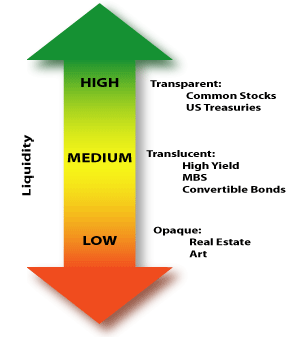
In business, economics or investment, market liquidity is an asset’s ability to be sold without causing a significant movement in the price and with minimum loss of value. Money, or cash in hand, is the most liquid asset, and can be used immediately to perform economic actions like buying, selling, or paying debt, meeting immediate wants and needs. An act of exchange of a less liquid asset with a more liquid asset is called liquidation. Liquidity also refers both to a business’s ability to meet its payment obligations, in terms of possessing sufficient liquid assets, and to such assets themselves.
Posted in Language, Money |
Leave a Comment »
February 27, 2011
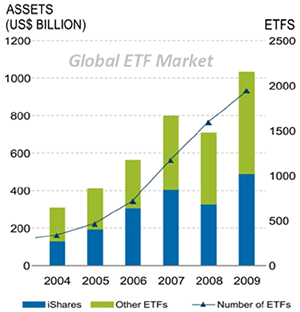
An exchange-traded fund (ETF) is an investment fund traded on stock exchanges, much like stocks. An ETF holds assets such as stocks, commodities, or bonds and trades at approximately the same price as the net asset value of its underlying assets over the course of the trading day.
An ETF combines the valuation feature of a mutual fund, which can be bought or sold at the end of each trading day for its net asset value, with the liquidity feature of a stock, which trades throughout the trading day at prices that may be more or less than its net asset value. ETFs have been available in the US since 1993 and in Europe since 1999. ETFs traditionally have been index funds, but in 2008 the U.S. Securities and Exchange Commission began to authorize the creation of actively managed ETFs.
Posted in Money |
Leave a Comment »
February 27, 2011
Rhythms del Mundo (lit. ‘World Rhythms’) is a 2006 nonprofit album, which fuses Cuban musicians including Ibrahim Ferrer and Omara Portuondo of the Buena Vista Social Club with artists such as Dido, Arctic Monkeys, U2, Coldplay, Sting, Jack Johnson, Maroon 5, Franz Ferdinand, Kaiser Chiefs and others. A follow-up album, Rhythms del Mundo Classics, was released in 2009. Album proceeds benefits the environmental nonprofit organization Artists Project Earth, which raises funds for climate change projects and disaster relief efforts.
Posted in Art, Money, Politics |
Leave a Comment »
February 24, 2011

Stadium Events is the English title of the video game ‘Running Stadium’ by Bandai. The game was released for the NES in Japan in 1986, in the United States in 1987. It was one of two games released in North America that were designed and branded for the Family Fun Fitness mat, a short-lived running pad accessory for the NES. The North American, or NTSC, version of Stadium Events is universally accepted as the rarest and most valuable licensed NES game. A copy sold January 2011 on ebay for $22,806.00, the highest price ever paid for a video game
The two Family Fun Fitness-branded games that had already been released, as well as Bandai’s version of the running pad accessory, were pulled from shelves and presumed destroyed. Because of this odd sequence of events, only 2000 copies are believed to have been produced, of which it is estimated that 200 copies reached consumers before being recalled. Today, collectors who follow the online sale of rare video games believe that fewer than 20 complete copies of the game exist, only two of which are known to be factory sealed.
Posted in Games, Money |
Leave a Comment »



 The Daily Omnivore