February 14, 2011
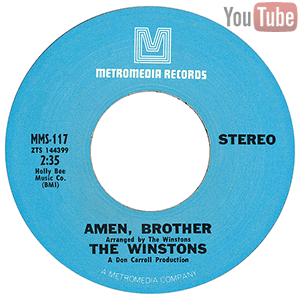
The ‘Amen break‘ was a brief drum solo performed in 1969 by G. C. Coleman in the song ‘Amen, Brother’ performed by the 1960s funk and soul outfit The Winstons. It gained fame from the 1980s onwards when four bars (5.2 seconds) sampled from the drum-solo (or imitations thereof) became very widely used as sampled drum loops in hip hop and other music. The full song is an up-tempo instrumental rendition of Jester Hairston’s ‘Amen,’ which he wrote for the Sidney Poitier film Lilies of the Field (1963) and which was subsequently popularized by The Impressions in 1964.
The Winstons’ version was released as a B-side of the 45 RPM 7-inch vinyl single ‘Color Him Father’ in 1969 on Metromedia. The Amen Break was used extensively in early hiphop and sample-based music, and became the basis for drum-and-bass and jungle music—’a six-second clip that spawned several entire subcultures.’
Posted in Art, Money, Technology |
Leave a Comment »
February 14, 2011
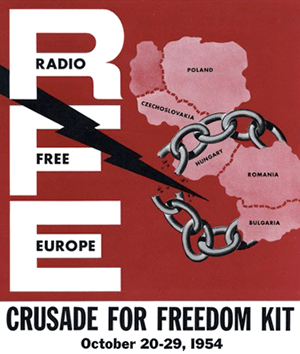
Radio Free Europe/Radio Liberty (RFE/RL) is a broadcaster funded by the U.S. Congress that provides news, information, and analysis to countries in Eastern Europe, Central Asia, and the Middle East where the free flow of information is either banned by government authorities or not fully developed. Founded as an anti-communist source of information during the Cold War, RFE/RL was headquartered at Englischer Garten in Munich from 1949 until 1995 when they were moved to Prague.
It maintains 20 local bureaus, but authoritarian governments often attempt to obstruct the radios’ activities through a range of tactics, including extensive jamming, shutting down local re-broadcasting affiliates, or finding legal excuses to close down offices. In many of these countries, RFE/RL is often the first and most reliable source of domestic news for citizens. The safety of RFE/RL’s journalists and freelancers, who often risk their lives to broadcast information to their listeners and readers, has been a major concern throughout its broadcast history.
Posted in Money, Politics, World |
Leave a Comment »
February 14, 2011

The Marshall Plan (officially the European Recovery Program, ERP) was a large-scale economic program, from 1947–51 by the US to rebuild post-war Europe. The initiative was named after Secretary of State George Marshall and was largely the creation of State Department officials. The same aid was offered to the Soviet Union and its allies, but they did not accept it. $13 billion ($124 billion in 2009 dollars) in economic and technical assistance were given to help the recovery of the European countries that had joined in the Organization for European Economic Co-operation. This $13 billion was in the context of a U.S. GDP of $258 billion in 1948, and was on top of $12 billion in American aid to Europe between the end of the war and the start of the Plan that is counted separately from the Marshall Plan.
By 1952 as the funding ended, the economy of every participant state had surpassed pre-war levels; for all Marshall plan recipients, output in 1951 was 35% higher than in 1938. Over the next two decades, Western Europe enjoyed unprecedented growth and prosperity, but economists are not sure what proportion was due directly to the ERP, what proportion indirectly, and how much would have happened without it. The Marshall Plan was one of the first elements of European integration, as it erased trade barriers and set up institutions to coordinate the economy on a continental level—that is, it stimulated the total political reconstruction of western Europe.
Posted in Money, Politics, War |
Leave a Comment »
February 14, 2011

Weathering steel, also known as COR-TEN steel, is a group of steel alloys which were developed to obviate the need for painting, and form a stable rust-like appearance if exposed to the weather for several years. Weathering steel is popularly used in outdoor sculptures and as exterior facades, for its rustic antique appearance. It is very widely used in marine transportation, in the construction of Intermodal containers.
Using weathering steel in construction presents several challenges. Ensuring that weld-points weather at the same rate as the other materials may require special welding techniques or material. Weathering steel is not rustproof in itself. If water is allowed to accumulate in pockets, those areas will experience higher corrosion rates, so provision for drainage must be made. Weathering steel is sensitive to salt-laden air environments. In such environments, it is possible that the protective patina may not stabilize but instead continue to corrode.
Posted in Art, Money, Technology |
Leave a Comment »
February 14, 2011
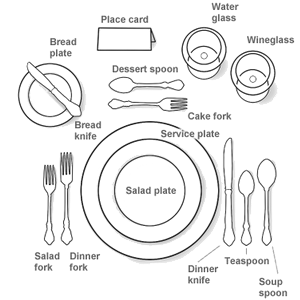
Emily Post (1872 – 1960) was an American author on etiquette. She wrote in various styles, including humorous travel books, early in her career. In 1922 her book Etiquette (full title Etiquette in Society, in Business, in Politics, and at Home) was a best seller, and updated versions continued to be popular for decades. In 1946, she founded The Emily Post Institute which continues her work. She died in 1960 in her New York City apartment at the age of 87.
Today, The Emily Post Institute, located in Burlington, Vermont, provides etiquette experts and advice to news outlets and other corporations. The authors at the Emily Post Institute write books and columns, conduct seminars and workshops, give speeches, and act as spokespeople for select corporations. They give media interviews each year on a variety of topics. Emily Post’s name has become synonymous, at least in North America, with proper etiquette and manners. Nearly half a century after her death, her name is still used in titles of etiquette books.
Posted in Language, Money |
Leave a Comment »
February 14, 2011

Tuxedo Park is a village in New York, about 50 miles north of New York City in Orange County from which the formal attire of the same name originates. The population was 731 at the 2000 census.The name is derived from a Native American word of the Lenape language, tucsedo, which means either ‘place of the bear’ or ‘clear flowing water.’ Tuxedo Park is a village within the southern part of the Town of Tuxedo (pop. 3,334).
read more »
Posted in Art, Language, Money |
Leave a Comment »
February 13, 2011

SkyReel is a Canadian company that builds and operates unmanned aerial vehicles (UAV) outfitted with camera systems for the motion picture industry.
Posted in Art, Money, Technology |
Leave a Comment »
February 13, 2011

The Red Digital Cinema Camera Company manufactures digital cinematography cameras and accessories for professional and cinematic use. The company was created and financed by Oakley founder Jim Jannard with the publicly expressed intent to reinvent the camera industry. The company’s main product is the Red One, which can record at resolutions up to 4,096 horizontal by 2,304 vertical pixels, directly to flash or hard disk storage. It features a single Super 35-sized CMOS sensor and a cinematography industry standard PL mount.
Posted in Art, Money, Technology |
Leave a Comment »
February 13, 2011

A skeuomorph [skyoo-uh-mawrf] is a derivative object that retains ornamental design cues to a structure that was necessary in the original. They may be deliberately employed to make the new look comfortably old and familiar, such as copper cladding on zinc pennies or computer printed postage with circular town name and cancellation lines. Historically, high-status items, such as metal tableware, were often recreated for the mass market using ceramics, which were a cheaper material. In certain cases, efforts were made to recreate the rivets in the metal originals by adding pellets of clay to the pottery version.
In the modern era, cheaper plastic items often attempt to mimic more expensive wooden and metal products though they are only skeuomorphic if new ornamentation references original functionality, such as molded screw heads in molded plastic items. Blue jeans have authentic-looking brass rivet caps covering the functional steel rivet beneath, and a pocket watch pocket; digital cameras play a recorded audio clip of a conventional SLR camera mirror slap and shutter opening and closing. Such ornamentation is not necessarily non-functional: the watch pocket is now used for coins, and the camera shutter sound is used to indicate to subject and photographer when the taking of the picture is complete.
Posted in Language, Money, Technology |
Leave a Comment »
February 13, 2011

When In-N-Out Burger (a fast food chain in the U.S. south west) first opened in 1948, the company provided only a basic menu of burgers, fries and beverages. Instead of a broad menu like its competitors, In-N-Out has become known for its Secret Menu, unadvertised variations on its burgers that are based on customer preferences, such as the popular ‘animal style’: a mustard cooked beef patty with extra spread (thousand island dressing) and grilled onions. French fries can also be has ‘animal style.’ ‘Protein Style,’ introduced in the 1970s, replaces the bun with large leaves of lettuce; while the ‘Flying Dutchman’ is a 2×2 (two burger patties and two slices of cheese) with no bun, no vegetables, and no spread.
Posted in Food, Money |
Leave a Comment »
February 13, 2011

Tilapia [tuh-lah-pee-uh] is the common name for nearly a hundred species of fish. Tilapia inhabit a variety of fresh water habitats including shallow streams, ponds, rivers and lakes. Historically they have been of major importance in artisan fishing in Africa and the Middle East, and are of increasing importance in aquaculture. China is the largest Tilapia producer in the world, followed by Egypt.
read more »
Posted in Food, Health, Money |
Leave a Comment »
February 12, 2011

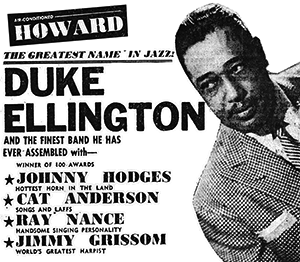
The Chitlin’ Circuit was the collective name given to the string of performance venues throughout the eastern and southern United States that were safe and acceptable for African American musicians, comedians, and other entertainers to perform during the age of racial segregation in the United States (from at least the late 19th century through the 1960s). The name derives from the soul food item chitterlings (stewed pig intestines).
Posted in Art, Money, Politics |
Leave a Comment »