January 13, 2011

A toy library is a library from which toys, puzzles, and games are lent out, functioning like a lending library. Toy libraries offer play sessions for families and a wide range of toys appropriate for children at different stages in their development.
Toy libraries provide children with new toys every week or two, saving parents money and keeping children from getting bored. Popular in the French-speaking world, toy libraries are called ludothèques. A lekotek is a toy and play library with a specific focus on children with special needs.
Posted in Games, Health, Money |
Leave a Comment »
January 13, 2011

The Internet Corporation for Assigned Names and Numbers (ICANN) is a non-profit corporation headquartered in California that was incorporated in 1998 to oversee a number of Internet-related tasks previously performed directly on behalf of the U.S. Department of Defense, which created the Internet. ICANN manages the assignment of domain names and IP addresses. To date, much of its work is about making new generic top-level domains (e.g. .edu, .com, .gov, etc.).
Posted in Money, Politics, Technology |
Leave a Comment »
January 13, 2011

Network neutrality is a principle that restricts Internet Service Providers (ISP) and governments from giving some internet traffic (email, web, peer-to-peer, BitTorrent, etc.) priority over others. On a completely neutral network, all traffic is treated equally. On non-neutral network, ISPs could charge for access to types of traffic, instead of for access to the internet in general. Some degree of traffic management is necessary on any network, but where to draw the line is at issue presently. Many believe net neutrality to be primarily important as a preservation of current freedoms.
Vinton Cerf, considered a ‘father of the Internet’ and co-inventor of the Internet Protocol, Tim Berners-Lee, creator of the Web, and many others have spoken out in favor of network neutrality. Opponents of net neutrality contend that broadband service providers have no plans to block content or degrade network performance. In spite of this claim, some Internet service providers have intentionally slowed peer-to-peer communications. Still other companies have acted in contrast to these assertions of hands-off behavior and have begun to discriminate against P2P, FTP and online games, instituting a cell-phone style billing system of overages, free-to-telecom ‘value added’ services,’ and bundling.
Posted in Money, Politics, Technology |
Leave a Comment »
January 12, 2011
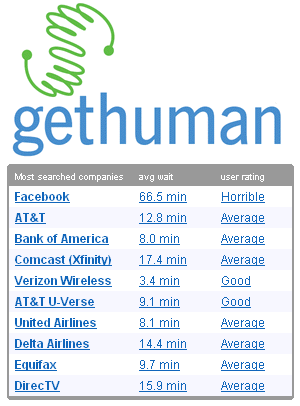
Paul English, cofounder and CTO of Kayak.com is also founder of the “gethuman” movement to restore personal contact in customer service. The most popular part of the gethuman.com website is a database of phone numbers and shortcuts to reach a humans at 500 major US corporations.
Posted in Money, Technology |
Leave a Comment »
January 12, 2011
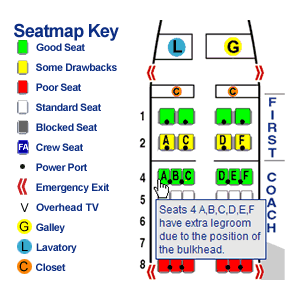
SeatGuru is a website that features aircraft seat maps, seat reviews, and a color-coded system to identify superior and substandard airline seats. It also features information about in-flight amenities and airline specific information regarding Check-in, Baggage, Unaccompanied Minors and Traveling with Infants and Pets. SeatGuru covers more than 700 aircraft seatmaps from more than 95 different airlines. In 2007, SeatGuru was purchased by Expedia subsidiary, TripAdvisor.
Posted in Money, Technology |
Leave a Comment »
January 12, 2011

Creative Commons (CC) is a non-profit organization headquartered in San Francisco, devoted to expanding the range of creative works available for others to build upon legally and to share. The organization has released several copyright-licenses known as Creative Commons licenses free of charge to the public. These licenses allow creators to communicate which rights they reserve, and which rights they waive for the benefit of recipients or other creators. Wikipedia is one of the notable web-based projects using one of its licenses.
The organization was founded in 2001 with support of the Center for the Public Domain. The first set of copyright licenses were released in late 2002. Creative Commons is governed by a board of directors and a technical advisory board. Joi Ito is currently the chair of the board and CEO. Creative Commons has been described as being at the forefront of the copyleft movement, which seeks to support the building of a richer public domain by providing an alternative to the automatic ‘all rights reserved’ copyright.
Posted in Money, Politics |
Leave a Comment »
January 12, 2011

The Forer effect (also called the Barnum Effect after P.T. Barnum) is the observation that individuals will give high accuracy ratings to descriptions of their personality that supposedly are tailored specifically for them, but are in fact vague and general enough to apply to a wide range of people. This effect can provide a partial explanation for the widespread acceptance of some beliefs and practices, such as astrology, fortune telling, and some types of personality tests like the Myers-Briggs test.
read more »
Posted in Language, Money, Science |
Leave a Comment »
January 11, 2011

The Walker Library of Human Imagination is the private library of Priceline.com founder Jay S. Walker opened in 2002. The library occupies 3,600 square feet in his Connecticut home. It showcases a collection of rare books, artworks, maps and manuscripts as well as artifacts both modern and ancient. Rare books in the collection include: a complete Bible handwritten on sheepskin from 1240; the first illustrated history book (1493); the first illustrated medical book (1499); the first medical book to illustrate the human brain (1550); a copy of ‘Micrographia’ (1664), the first book of illustrations of images seen in the first microscopes; and a 1699 atlas containing the first maps to show the sun, not the earth, as the center of the known universe.
Historical artifacts include: an original 1957 Russian Sputnik backup; an instruction manual for a Saturn V rocket, along with a signed American flag carried to the surface of moon and back on the first lunar landing; and the napkin on which President Franklin D. Roosevelt jotted down his plan to win World War II, just four months after Pearl Harbor; one of two known Anastatic Facsimiles of the original 1776 Declaration of Independence (made directly from the original using a wet-copy process); a leaf from a Gutenberg Bible, the first book printed using movable type; and a Nazi Engima Machine decoder. Distributed around the Library are a series of etched-glass art panels by artist, Clyde Lynds, which illustrate major achievements in the history of human invention.
Posted in Art, Money, Technology |
Leave a Comment »
January 11, 2011

Fear, uncertainty and doubt (FUD) refers to a tactic of rhetoric and fallacy used in sales, marketing, public relations, politics and propaganda. FUD is generally a strategic attempt to influence public perception by disseminating negative and dubious/false information designed to undermine the credibility of their beliefs. The term originated in the computer hardware industry where IBM and later Microsoft were accused of using FUD tactics against their competitors, particularly open source software like Linux.
An individual firm, for example, might use FUD to invite unfavorable opinions and speculation about a competitor’s product; to increase the general estimation of switching costs among current customers; or to maintain leverage over a current business partner who could potentially become a rival.
Posted in Money, Politics, Technology |
Leave a Comment »
January 10, 2011


Kewpie dolls and figurines are based on illustrations by Rose O’Neill that appeared in Ladies’ Home Journal in 1909. The small dolls were extremely popular in the early 1900s; they were often awarded as a carnival prize and collected. They were first produced in Ohrdruf, a small town in Germany, then famous for its toy-manufacturers. Their name is derived from ‘cupid,’ the Roman god of beauty and non-platonic love.
The early dolls, especially signed or ceramic, are highly collectible and worth thousands of dollars. The time capsule at the 1939 New York World’s Fair contained a Kewpie doll. The Kewpie doll was mentioned in Anne Frank’s diary. She received one on her first St. Nicholas Day in the Annex from Miep and Bep. The dolls are also mentioned in Steinbeck’s Of Mice and Men.
Posted in Games, Money |
Leave a Comment »
January 10, 2011


A spiritual successor, sometimes called a spiritual sequel or a companion piece, is a successor to a work of fiction which does not directly build upon the storyline established by a previous work as do most traditional prequels or sequels, but nevertheless features many of the same elements, themes, and styles as its source material.
read more »
Posted in Art, Language, Money |
Leave a Comment »
January 10, 2011

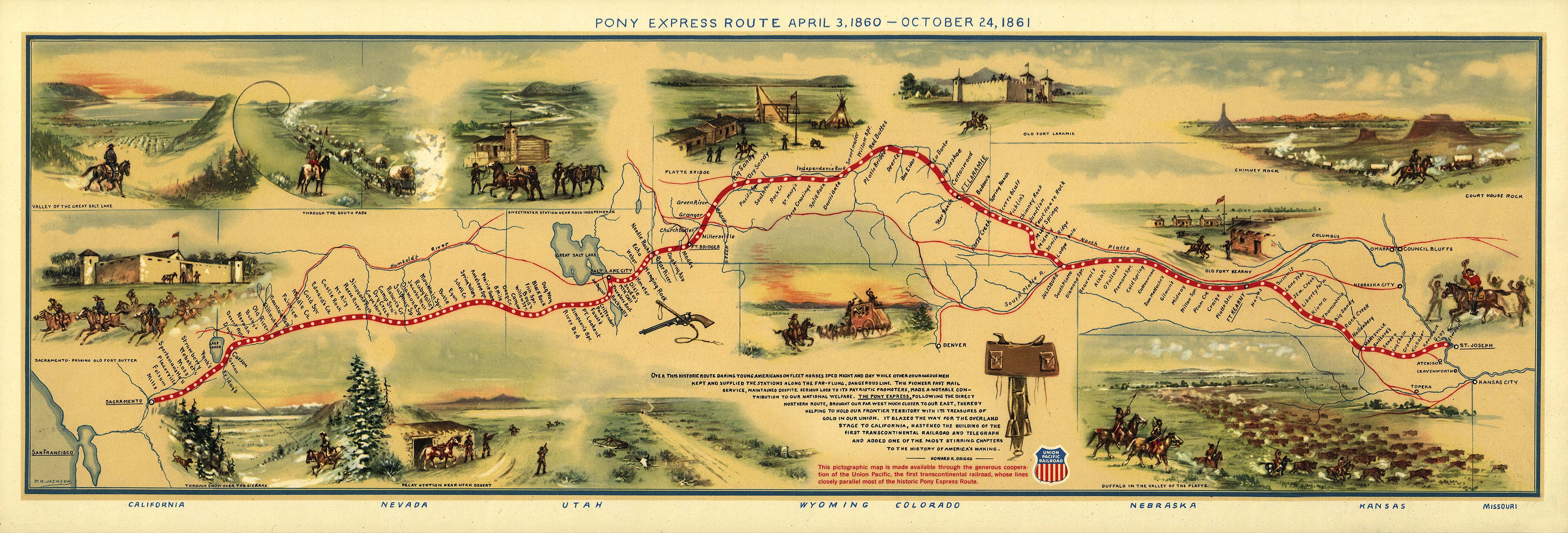
The Pony Express was a fast mail service crossing the Great Plains, the Rocky Mountains, and the High Sierras from Missouri to California, founded in 1860. It became the west’s most direct means of east-west communication before the telegraph and was vital for tying California closely with the Union just before the American Civil War. Patee House (a historic hotel in St. Joseph, Missouri) served as the Pony Express headquarters from 1860 to 1861. It is one block away from the home of infamous outlaw Jesse James, where he was shot and killed by Robert Ford. After his murder, Jesse James’ family took up lodging at the hotel.
Messages were carried by horseback riders in relays to stations across the prairies, plains, deserts, and mountains of the Western United States. For its 18 months of operation, it briefly reduced the time for messages to travel between the Atlantic and Pacific coasts to about ten days, with telegraphic communication covering about half the distance across the continent and mounted couriers the rest. The continued popularity of the Pony Express can be linked to Buffalo Bill Cody who claimed to have been an Express rider.
Posted in Language, Money |
Leave a Comment »





 The Daily Omnivore