December 22, 2010
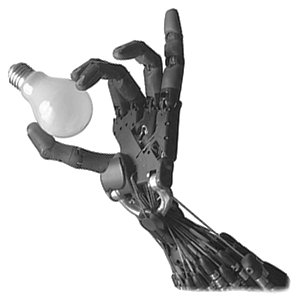
The Shadow Dexterous Hand is a humaniform robot hand system developed by The Shadow Robot Company in London. The hand is comparable to a human hand in size and shape, and reproduces all of its degrees of freedom. The Hand is commercially available and currently used by NASA, Bielefeld University and Carnegie Mellon University. It reportedly costs more than $100,000. The Hand uses the sense of touch, pressure, and position to reproduce the human grip in all its strength, delicacy, and complexity.
The SDRH was first developed by Richard Greenhill and his team of engineers in Islington, London, as part of The Shadow Project, (now known as the Shadow Robot Company) an ongoing research and development program whose goal is to complete the first convincing humanoid. An early prototype can be seen in NASA’s collection of humanoid robots, or robonauts. The Hand has haptic sensors embedded in every joint and finger pad, which relay information to a central computer for processing and analysis.
Posted in Money, Technology |
1 Comment »
December 20, 2010

The hammer and sickle is a part of communist symbolism and its usage indicates an association with Communism, a Communist party, or a Communist state. It features a hammer and a sickle overlapping each other. The two tools are symbols of the industrial proletariat and the peasantry; placing them together symbolizes the unity between industrial and agricultural workers. This emblem was conceived during the Bolshevik Revolution. It is best known from having been incorporated into the red flag of the Soviet Union, along with the Red Star.
read more »
Posted in Money, Politics, World |
Leave a Comment »
December 20, 2010

Metropolis is a 1927 German expressionist film in the science-fiction genre directed by Fritz Lang. Produced in Germany during a stable period of the Weimar Republic, ‘Metropolis’ is set in a futuristic urban dystopia and makes use of this context to explore the social crisis between workers and owners in capitalism. The most expensive silent film ever made, it cost approximately 5 million Reichsmark. The film was written by Lang and his wife Thea von Harbou in 1924, and published a novelization in 1926. Lang was influenced by the Soviet science fiction film ‘Aelita’ by Yakov Protazanov (1924), which was an adaptation of a novel by Alexei Tolstoy. The plot of ‘Aelita’ included a revolution taking place on the planet Mars. However, Metropolis advocates non-violent cooperation rather than the Marxist ideal of ‘class struggle.’
‘Metropolis’ was cut substantially after its German premiere, and much footage was lost over the passage of successive decades. There have been several efforts to restore it, as well as discoveries of previously lost footage. In 2008, a copy of the film 30 minutes longer than any other known surviving was located in Argentina. After a long period of restoration in Germany, the film was shown publicly for the first time simultaneously at Berlin and Frankfurt on February 12, 2010.
Posted in Art, Money, Technology |
Leave a Comment »
December 19, 2010

ALDI, short for ‘Albrecht Discount,’ is a discount supermarket chain based in Germany founded by brothers Karl Albrecht and Theo Albrecht in 1913. Karl has since retired and is Germany’s richest man. Theo was Germany’s second richest man until his death in July 2010. The Aldi group operates about 8,210 individual stores worldwide. A new store opens every week in Britain alone.
Originally Aldi stores were ridiculed as being cheap shops selling low-quality goods, and that Aldi’s customers were mostly people who could not afford to shop elsewhere. Gradually many German consumers discovered that the poor reputation of Aldi’s products was either undeserved or economically justifiable. This shift in public perception was boosted by actions like a series of cookbooks that only used Aldi ingredients, which led to the emergence of a kind of Aldi fandom into parts of the German mainstream.
Posted in Food, Money, World |
Leave a Comment »
December 17, 2010
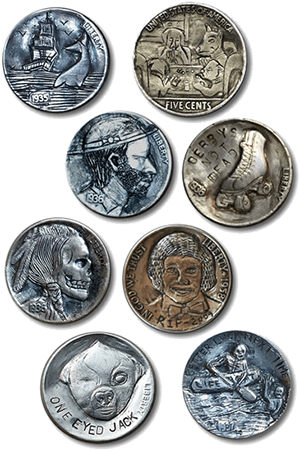
The hobo nickel is a sculptural art form involving the creative modification of small-denomination coins, essentially resulting in miniature bas reliefs. The nickel, because of its size, thickness, and relative softness, was a favored coin for this purpose. Due to its low cost and portability, this medium was particularly popular among hobos, hence the name. Common hobo nickels sell for $5 or $10, and rarer or more desirable coins sell for hundreds of dollars.
read more »
Posted in Art, Humor, Money |
Leave a Comment »
December 17, 2010

Love Tokens are custom engraved coins given as a gift. They were especially popular in the 1750s in the United States. They are made by machine-smoothing a coin (usually silver) on one or both sides, then engraving it with initials, monograms, names, scenes, etc., often with an ornate border. They can be mounted on pins or incorporated into bracelets and necklaces. The love token fad faded out in the early 20th century; love tokens engraved on buffalo nickels are quite rare and prized by collectors of ‘hobo nickels’ (altered coins).
Posted in Art, Love, Money |
Leave a Comment »
December 14, 2010
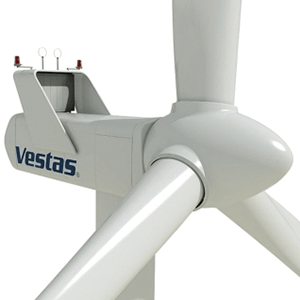
Vestas Wind Systems is a Danish manufacturer, seller, installer, and servicer of wind turbines. It is the largest in the world, but due to very rapid growth of its competitors – GE (US), Sinovel (China), Enercom (Germany), and Gamesa (Spain) – its market share decreased from 28% in 2007 to 12.5% in 2009. Vestas has installed over 41,000 wind turbines in 63 countries on five continents. The company employs more than 22,000 people globally, and has built production facilities in more than 12 countries.
Vestas spent €92 million ($128 million), or 1.4% of revenue, on research and development in 2009. It has filed 787 wind turbine patents (165 in 2009) according to United Kingdom Intellectual Property Office (UK-IPO), while General Electric has 666 and Siemens Wind Power has 242. In October 2009, Vestas and QinetiQ claimed a successful test of a stealth wind turbine blade mitigating radar reflection problems for aviation.
Posted in Money, Technology, World |
Leave a Comment »
December 14, 2010

Getting Things Done (GTD) is an organizational method created by David Allen, described in a book of the same name. The Getting Things Done method rests on the principle that a person needs to move tasks out of the mind by recording them externally. That way, the mind is freed from the job of remembering everything that needs to be done, and can concentrate on actually performing those tasks.
read more »
Posted in Money, Science |
Leave a Comment »
December 14, 2010

Parasite single is a Japanese term for a single person who lives with their parents until their late twenties or early thirties in order to enjoy a carefree and comfortable life. In English, the expression ‘sponge’ or ‘basement dweller’ may sometimes be used. The expression is mainly used in reference to Japanese society, but similar phenomena can also be found in other countries worldwide.
In Italy, 30-something singles still relying on their mothers are derided as ‘bamboccioni’ (literally, big babies) and in Germany they are known as Nesthocker (German for nestling), who are still living at ‘Hotel Mama.’ In the U.K. they are referred to by the acronym NEET (not in employment, education, or training). The expression was first used by Professor Masahiro Yamada of Tokyo Gakugei University in 1999. The catchy phrase quickly found its way into the media and is now a well-known expression in Japan.
Posted in Language, Money, World |
Leave a Comment »
December 14, 2010

The Pomodoro Technique is a time management method developed in the late 1980s. The technique uses a timer to break down periods of work into 25-minute intervals called ‘pomodoros’ separated by breaks. The method is based on the idea that frequent breaks can improve mental agility, and seeks to provide an effective response to time as an anxiety-provoking state.
There are five basic steps to implementing the technique: 1) Decide on the task to be done; 2) Set the (timer) to 25 minutes; 3) Work on the task until the timer rings; record with an x; 4) Take a short break (5 minutes); and 5) Every four “pomodoros” take a longer break (15–20 minutes). The Pomodoro Technique is named after the tomato-shaped kitchen timer that was first used by technique creator Francesco Cirillo when he was a university student (Pomodoro is Italian for tomato).
Posted in Money, Science |
Leave a Comment »
December 13, 2010

The Tata Nano is a low-cost, rear-engined, four-passenger city car built by the Indian company Tata Motors, which began selling its ‘one-lakh’ (100,000 Rupees or $2,200) car in 2009. The price has risen somewhat since its introduction due to increasing materials costs. It features a 623cc, 2 cylinder engine with a top speed of 43 mph. It is an example of ‘Gandhian engineering,’ a concept involving deep frugality and a willingness to challenge conventional wisdom.
The Nano’s design implements many cost-reducing innovations: the trunk is only accessible from inside the car, as the rear hatch does not open; one windscreen wiper instead of the usual pair; no power steering, unnecessary due to its light weight; three lug nuts on the wheels instead of the usual four; only one side-view mirror; no radio, no air-conditioning, and no airbags.
Posted in Money, Technology, World |
Leave a Comment »
December 13, 2010
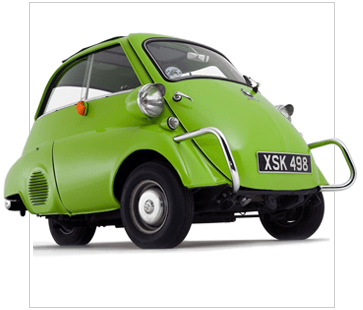
Bubble car is a subjective term used for some small, economical automobiles, usually produced in the 1950s and 1960s. The Messerschmitt KR175 and KR200, and the FMR Tg500, had aircraft-style bubble canopies, giving rise to the term bubble car to refer to all these post-war microcars. Bubble cars became popular in Europe at that time as a demand for cheap personal motorized transport emerged and fuel prices were high due in part to the 1956 Suez Crisis. Most of them were three-wheelers, which in many places qualified them for inexpensive taxes and licensing as motorcycles. Most bubble cars were manufactured in Germany, including by the former German military aircraft manufacturers, Messerschmitt and Heinkel.
BMW manufactured the Italian Iso Rivolta Isetta under licence, using an engine from one of their own motorcycles. France also produced large numbers of similar tiny vehicles called voiturettes, but unlike the German makes, these were rarely sold abroad. There were a small number of British three wheeled microcars, including the larger Regal and Robin from the Reliant Motor Company in Staffordshire and the smaller P50 and Trident from the Peel Engineering Company on the Isle of Man. Bubble cars were superseded by a new wave of ‘proper small cars’ like the 1959 Austin Mini, which gave far more functionality for their owners for only slightly higher costs.
Posted in Money, Technology |
Leave a Comment »





