October 22, 2015

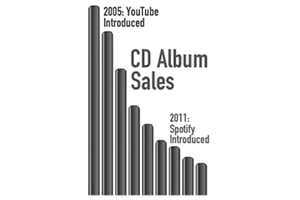
Vinyl revival refers to the renewed interest and increased sales of vinyl records since 2006. The analoge format made of polyvinyl chloride had been the main vehicle for the commercial distribution of pop music from the 1950s until the 1980s and 1990s when they were replaced by the Compact Disc. Since the early 2000s CDs have been partially replaced by digital downloads; conversely, vinyl sales have started growing. In some territories, vinyl is now more popular than it has been since the late 1980s, though vinyl records still make up only a marginal percentage (<3%) of overall music sales.
Founded in 2007, ‘Record Store Day’ is an internationally celebrated day observed the third Saturday of April each year. Its purpose, as conceived by independent record store employee Chris Brown, is to celebrate the art of music. The day brings together fans, artists, and thousands of independent record stores across the world.
Posted in Art, Money |
Leave a Comment »
October 21, 2015

Tower Records was an American retail music chain that liquidated in 2006. The brand currently exists as an international franchise and an online music store. Tower.com was purchased by a separate entity and was not affected by the retail store closings.
Tower was founded in 1960 by Russell Solomon in Sacramento, California. The store was named after his father’s drugstore, which shared a building and name with the Tower Theater, where Solomon first started selling records. The first Tower Records store was opened in 1960 on Watt Avenue in Sacramento. By 1976, Solomon had opened Tower Books, Posters, and Plants at 1600 Broadway, next door to Tower Records. It was also one of the first retailers to move online in 1995 as Tower.com.
read more »
Posted in Art, Money, World |
Leave a Comment »
October 16, 2015


Scam baiting is a form of Internet vigilantism, where the vigilante poses as a potential victim to the scammer in order to waste their time and resources, gather information that will be of use to authorities, and publicly expose the scammer. It is primarily used to thwart advance-fee fraud scams (e.g. ‘Nigerian Prince’ scams) and can be done out of a sense of civic duty (activism) by documenting scammers tools and methods, warning potential victims, or taking down fake websites.
A bait is very simply initiated, by answering a scam email, from a throwaway email account, i.e. one that is only used for baiting and untraceable back to the actual owner. The baiter then pretends to be receptive to the financial hook that the scammer is using, but requires increasingly ridiculous forms of security from the scammer before turning over funds. Scam baiters typically use jest in their attacks. However, some scam baiters have been accused of abject mockery, racism, and homophobia, and even scamming themselves.
Posted in Money, Politics, Technology |
Leave a Comment »
October 15, 2015
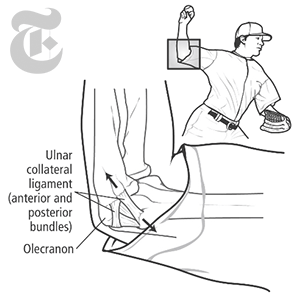
Tommy John surgery (TJS), known in medical practice as ulnar collateral ligament (UCL) reconstruction, is a surgical graft procedure in which a ligament in the elbow is replaced with a tendon from elsewhere in the body (ligaments and tendons are connective tissue; the former connects bones to each other and latter connects muscles to bone). The procedure is common among collegiate and professional athletes in several sports, particularly baseball pitchers.
The procedure was first performed in 1974 by orthopedic surgeon Dr. Frank Jobe, then a Los Angeles Dodgers team physician who served as a special advisor to the team until his death in 2014. It is named after the first baseball player to undergo the surgery, major league pitcher Tommy John, whose record of 288 career victories ranks seventh all time among left-handed pitchers.
read more »
Posted in Games, Health, Money |
Leave a Comment »
October 14, 2015
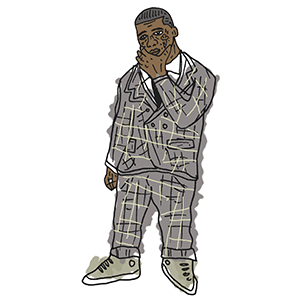
Ghetto fabulous refers to a fashion stereotype alluding to individuals living in an affluent materialistic style while not actually wealthy. It is part of a larger cultural trend of the 1990s where black, urban fashion was becoming a hot commodity through the rise of ‘hardcore’ rap. Because of the circumstances of many inner city families, poverty and consumerism became the focal point of artistic expression. With the rise of malls in the 1980s, this could be seen in the larger cultural context as well.
‘Excessive consumerism and an obsession with bling are certainly not confined to any particular demographic. We are a nation of excess and instant gratification. It has become the American way.’ For inner city youth, the ghetto fabulous life was about trying to outrun their socio-economic situations. For centuries, fashion has represented socio-economic status, so lower classes will buy outside their means in order to try and fit into an image of the upper classes.
read more »
Posted in Language, Money, Politics |
1 Comment »
October 8, 2015

Massimo [ma-see-moh] Vignelli [veen-yell-ee] (1931 – 2014) was an Italian graphic and industrial designer who worked in a number of areas including product packaging, housewares, furniture, public signage, and showrooms. He was the co-founder of Vignelli Associates, with his wife, Lella. His ethos was, ‘If you can design one thing, you can design everything,’ and this was reflected in the broad range of his work. Vignelli worked firmly within the Modernist tradition, and focused on simplicity through the use of basic geometric forms in all his work.
His educational background was in architecture, which he studied at the Politecnico di Milano and later at the Università di Architettura, Venice. From 1957 to 1960, he visited America on a fellowship, and returned to New York in 1966 to start the New York branch of a new company, Unimark International, which quickly became, in scope and personnel, one of the largest design firms in the world.
read more »
Posted in Art, Money, World |
1 Comment »
September 28, 2015


Tinker Hatfield (b. 1952) is the designer of many of Nike’s most popular and innovative athletic shoe designs, including the Air Jordan 3 through Air Jordan 15, the twentieth anniversary Air Jordan, the Air Jordan XXIII, XXV, XXIX, and other athletic sneakers including the world’s first ‘cross training’ shoes, the Nike Air Trainer. Hatfield oversees Nike’s ‘Innovation Kitchen.’ He is Nike’s Vice President for Design and Special Projects.
He attended the University of Oregon, where he ran track for coach and Nike co-founder Bill Bowerman, and at one time had the pole-vault record at the school. Academically, he studied architecture and graduated with a degree from the University of Oregon School of Architecture. Hatfield joined Nike in 1981, and in 1985 started working on shoe design, believing that his architectural skills could be applied to footwear.
read more »
Posted in Art, Games, Money |
Leave a Comment »
September 27, 2015
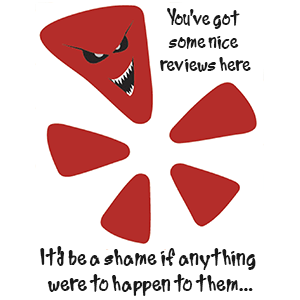
A protection racket is a scheme whereby a group provides protection to businesses or other groups through violence outside the sanction of the law. Through the credible threat of violence, the racketeers deter people from swindling, robbing, injuring, sabotaging or otherwise harming their clients. Protection rackets tend to appear in markets where the police and judiciary cannot be counted on to provide legal protection, either because of incompetence (as in weak or failed states) or illegality (black markets).
Protection rackets are often indistinguishable in practice from extortion rackets since, for the latter, there will be an implied threat that the racketeers themselves may attack the business if it fails to pay for their protection. In an extortion racket, the racketeers agree simply to not attack a business. In a protection racket the criminals agree to defend a business from any attack. Conversely, extortion racketeers will have to defend their clients if threatened by a rival gang to avoid the client transferring their allegiance.
read more »
Posted in Money, Politics |
Leave a Comment »
September 24, 2015


Rent-seeking is attempting to take advantage of a pre-existing resource without improving it. According to Nobel Laureate economist Robert Shiller the classic example is that of a feudal lord who installs a chain across a river that flows through his land and then hires a collector to charge passing boats a fee (or rent of the section of the river for a few minutes) to lower the chain. There is nothing productive about the chain or the collector. The lord has made no improvements to the river and is helping nobody in any way, directly or indirectly, except himself. All he is doing is finding a way to make money from something that used to be free.
An example of rent-seeking in a modern economy is spending money on political lobbying for government benefits or subsidies in order to be given a share of wealth that has already been created, or to impose regulations on competitors, in order to increase market share.
read more »
Posted in Money, Politics, World |
1 Comment »
September 18, 2015

Colonel Tom Parker (1909 – 1997), born Andreas Cornelis van Kuijk, was a Dutch-born American entertainment impresario known best as the manager of Elvis Presley. Parker’s management of Presley defined the role of masterminding talent management, which involved every facet of his life and was seen as central to the success of Presley’s career.
‘The Colonel’ displayed a ruthless devotion to his own financial gain rather than his client’s interests and took more than the traditional 10 to 15 percent of his earnings (reaching up to 50 percent by the end of Presley’s life). Presley said of Parker: ‘I don’t think I’d have ever been very big if it wasn’t for him. He’s a very smart man.’ For many years Parker falsely claimed to have been US-born, but it eventually emerged that he was born in Breda in the Netherlands.
read more »
Posted in Art, Money, Politics |
Leave a Comment »
September 16, 2015


The smart cow problem refers to the fact that when a group of individuals is faced with a technically difficult task, only one of their members has to solve it. When the problem has been solved once, an easily repeatable method may be developed, allowing the less technically proficient members of the group to accomplish the task.
The concept is relevant to copyright protection schemes such as DRM (Digital Rights Management), where, due to the rapid spread of information on the Internet, it only takes one individual’s defeat of a DRM technology to render the method obsolete. The term ‘smart cow’ is thought to be derive from the expression: ‘It only takes one smart cow to open the latch of the gate, and then all the other cows follow.’
Posted in Money, Politics, Technology |
Leave a Comment »
September 9, 2015


The Overton window is the range of ideas the public will accept. It is used by media pundits and particularly favored in conservative and libertarian discourse.
The term derives from its originator, Joseph P. Overton (1960–2003), of the Mackinac Center for Public Policy, a free market think tank. Overton described six degrees acceptance of an idea: Unthinkable, Radical, Acceptable, Sensible, Popular, and Policy.
read more »
Posted in Language, Money, Politics |
Leave a Comment »


 The Daily Omnivore