February 8, 2016

Helmut Krone (1925 – 1996) was a pioneer of modern advertising. He spent over 30 years at the advertising agency Doyle Dane Bernbach where he was the art director for the popular 1960s campaign for the Volkswagen Beetle, which featured a large unadorned photo of the car with the tiny word ‘Lemon’ underneath it. He was also responsible for the series of ‘When you’re only No. 2, you try harder’ advertisements for Avis, and the creation of Juan Valdez, who personified Colombian coffee. His work has been collected by the Museum of Modern Art and the Smithsonian. Krone’s ‘Think Small’ advertisement for Volkswagen was voted the best campaign of all time in Advertising Age’s 1999 ‘The Century of Advertising issue.’
Krone was born in Yorkville, on the upper east side of Manhattan, which was at that time a German neighborhood. He attended Public School 77 in Queens before enrolling at the School of Industrial Art, where he hoped to become a product designer. When he was 21, he took his first step towards advertising, working with designer Robert Greenwell doing freelance advertisements for magazines. He followed naval service in World War II with postwar classes with Alexey Brodovitch and stints at ‘Esquire’ and ‘Sudler & Hennessey.’ Then, at the age of 29, he began to work for Doyle Dane Bernbach.
Posted in Art, Money |
Leave a Comment »
February 6, 2016


Super Bowl ads are commercials run during the National Football League (NFL) championship game, among the United States’ most watched television broadcasts, with Nielsen having estimated that Super Bowl XLIX in 2015 was seen by at least 114.4 million domestic viewers, surpassing the previous year’s game as the highest-rated television broadcast in US history. As such, advertisers have typically used commercials during the Super Bowl as a means of building awareness for their products and services among this wide audience, while also trying to generate buzz around the ads themselves so they may receive additional exposure, such as becoming a viral video.
Super Bowl commercials have become a cultural phenomenon of their own alongside the game itself with some viewers reporting that they are more interested in the commercials than the game. In 2015, Dish Network went as far as allowing the ‘commercial skipping’ features on its Hopper digital video recorder to function in reverse and allow users to view a recording of the Super Bowl that skips over the game itself and only shows the commercials.
read more »
Posted in Games, Money |
1 Comment »
February 4, 2016


Rebranding is a marketing strategy in which a new name, term, symbol, design, or combination thereof is created for an established brand with the intention of developing a new, differentiated identity in the minds of consumers, investors, competitors, and other stakeholders. Often, this involves radical changes to a brand’s logo, name, legal names, image, marketing strategy, and advertising themes. Such changes typically aim to reposition the brand/company, occasionally to distance itself from negative connotations of the previous branding, or to move the brand upmarket; they may also communicate a new message a new board of directors wishes to communicate.
Rebranding can be applied to new products, mature products, or even products still in development. The process can occur intentionally through a deliberate change in strategy or occur unintentionally from unplanned, emergent situations, such as a ‘Chapter 11 corporate restructuring,’ ‘union busting,’ or ‘bankruptcy.’ Rebranding can also refer to a change in a company/ corporate brand that may own several sub-brands for products or companies.
read more »
Posted in Language, Money |
Leave a Comment »
February 3, 2016
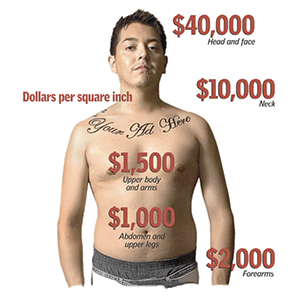
Forehead Advertising is a type of nontraditional advertising that involves using a person’s forehead as advertising space. John Carver and his London Creative Agency, CUNNING, is credited with inventing the concept in 2003 with ForeheADS. In a 2004 CUNNING campaign, forty young adults were paid $11 per hour to wear temporary tattoos on their foreheads for a 2004 campaign promoting the launch of the Scion tC for Toyota. A short lived startup in Rhode Island, Headvertise, offered up to $150 per week for wearing a temporary logo tattoo on one’s forehead. It was last reported that 64 students had featured ads on their foreheads for companies such as Roommates.com.
Forehead advertising made headlines in early 2005 when a 20-year-old man, Andrew Fischer, auctioned his forehead for advertising space on eBay. The winning company, SnoreStop, bid $37,375 to display their logo via temporary tattoo on his forehead for 30 days. Later that year forehead advertising moved beyond temporary tattoos. Kari Smith auctioned her forehead for advertising space on eBay for an asking price of $10,000. GoldenPalace.com, a Canadian Internet gambling company, paid $10,000 for Smith to permanently tattoo ‘GoldenPalace.com’ on her forehead. GoldenPalace.com has also advertised its logo via temporary and permanent tattoos on the backs of boxers, bellies of pregnant women, women’s legs, and the chest of a swimsuit model.
read more »
Posted in Humor, Money |
1 Comment »
February 2, 2016

Catvertising is the use of cats in advertising. The tongue-in-cheek portmanteau was coined in the late 1990s, and enjoyed a spike in popularity beginning 2011 as a result of a parody of commercialization of cat viral videos by the advertising agency st. john in Toronto.
The video was part of a series of spoofs beginning with ‘Pink Ponies: A Case Study,’ then ‘Catvertising,’ and finally ‘Buyral’ (a blend of ‘buy’ and ‘viral’). A University of Arizona marketing team competes under the name ‘Catvertising.’
Posted in Humor, Money |
Leave a Comment »
January 24, 2016

Miquela Sousa, better known as Lil Miquela, is a fictional character and digital art project. Miquela is an Instagram model and music artist claiming to be from Downey, California. In 2017, Miquela released her first single, ‘Not Mine.’ Her pivot into music has been compared to virtual musicians Gorillaz and Hatsune Miku.
The project began in 2016 as an Instagram profile. By 2018, the account had amassed more than a million followers. Miquela portrays the lifestyle of an Instagram it-girl over social media. The account also details a fictional narrative which presents her as a sentient robot in conflict with other digital projects.
read more »
Posted in Art, Money, Technology |
Leave a Comment »
January 14, 2016

The ADE 651 is a fake bomb detector produced by ATSC (UK), which claimed that the device could effectively and accurately, from long range, detect the presence and location of various types of explosives, drugs, ivory, and other substances. The device has been sold to 20 countries in the Middle East and Asia, including Iraq and Afghanistan, for as much as US$60,000 each. The Iraqi government is said to have spent £52 million on the devices.
Investigations by the BBC and other organizations found that the device is little more than a ‘glorified dowsing rod’ with no ability to perform its claimed functions. In 2010, export of the device was banned by the British government and the managing director of ATSC was arrested on suspicion of fraud. The company was dissolved in 2013, and the founder, Jim McCormick, was sentenced to ten years’ imprisonment. Similar ‘bomb sniffing’ devices, which are still widely used, have also come under scrutiny in the wake of the revelations about the ADE 651.
read more »
Posted in Money, Technology, War |
Leave a Comment »
January 11, 2016

The Knee Defender is a device that an airplane passenger can place on the struts that support his/her drop-down airplane seat tray table to limit the extent to which the seat directly in front of him/her can be reclined. The device was invented by Ira Goldman, and it was first sold to the public in 2003.
In August 2014, on a United Airlines flight from Newark to Denver, an argument developed between a passenger using a Knee Defender and the passenger seated in front of him who wanted to recline. Ultimately the pilot diverted the flight to Chicago and both of those passengers were deplaned.
Posted in Money, Politics, Technology |
Leave a Comment »
January 1, 2016

Visual brand language is the unique ‘alphabet’ of design elements – such as shape, color, materials, finish, typography and composition – which directly and subliminally communicate a company’s values and personality through compelling imagery and design style. This ‘alphabet,’ properly designed, results in an emotional connection between the brand and the consumer. Visual brand language is a key ingredient necessary to make an authentic and convincing brand strategy that can be applied uniquely and creatively in all forms of brand communications to both employees and customers.
For example, the BMW ‘split grill’ has come to represent the brand. While the grill size and design details evolve over time, the underlying idea is constant and memorable. The use of color is also a powerful associative element for consistent imagery, as exemplified by the comprehensive application of orange by The Home Depot across all its brand materials.
read more »
Posted in Art, Language, Money |
Leave a Comment »
December 15, 2015


Phreaking is a slang term coined to describe the activity of hobbyists who study, experiment with, or explore, telecommunication systems, such as equipment and systems connected to public telephone networks. ‘Phreak,’ ‘phreaker,’ or ‘phone phreak’ are names used for and by individuals who participate in phreaking. The term first referred to groups who had reverse engineered the system of tones used to route long-distance calls. By re-creating these tones, phreaks could switch calls from the phone handset, allowing free calls to be made around the world.
Electronic tone generators known as ‘blue boxes’ became a staple of the phreaker community, including future Apple Inc. cofounders Steve Jobs and Steve Wozniak. The blue box era came to an end with the ever increasing use of computerized phone systems, which sent dialling information on a separate, inaccessible channel. By the 1980s, much of the system in the US and Western Europe had been converted. Phreaking has since become closely linked with computer hacking.
read more »
Posted in Money, Politics, Technology |
Leave a Comment »
December 14, 2015


Almighty dollar is an idiom often used to satirize an individual or cultural obsession with material wealth, or with capitalism in general. The phrase implies that money is a kind of deity. Although the phrase was not popularized until the 19th century, similar expression were used much earlier. For example, British writer Ben Jonson wrote in 1616: ‘Whilst that for which all virtue now is sold, And almost every vice, almightie gold.’
The ‘dollar’ version of the phrase is commonly attributed to American writer Washington Irving, who used it in the story ‘The Creole Village,’ which was first published in the 1837 edition of ‘The Magnolia,’ a literary annual: ‘The almighty dollar, that great object of universal devotion throughout our land, seems to have no genuine devotees in these peculiar villages; and unless some of its missionaries penetrate there, and erect banking houses and other pious shrines, there is no knowing how long the inhabitants may remain in their present state of contented poverty.’
Posted in Money, Philosophy |
1 Comment »
December 10, 2015


Prolefeed is a Newspeak term in the novel ‘Nineteen Eighty-Four’ by George Orwell. It was used to describe the deliberately superficial literature, movies and music that were produced by Prolesec, a section of the Ministry of Truth, to keep the ‘proles’ (i.e., proletariat) content and to prevent them from becoming too knowledgeable. The ruling Party believes that too much knowledge could motivate the proles to rebel against them.
The term is used occasionally to describe shallow entertainment in the real world. For example, Theodore Dalrymple wrote in the ‘The Spectator’ that ‘France …. is less dominated by mass distraction (known here as popular culture, but in ‘Nineteen Eighty-Four’ as prolefeed) than Britain is.’ The term has also been applied to fast food, such as that of McDonald’s: ‘Once seen as the all-American corporation, ‘McDonald’s’ is now shorthand for a globalist mass culture that provides cheap, unhealthy food to lower-class people. McDonald’s is, quite literally, prolefeed. Part of this image was a deliberate choice by the corporation.’
read more »
Posted in Language, Money, Politics |
Leave a Comment »



