April 19, 2015
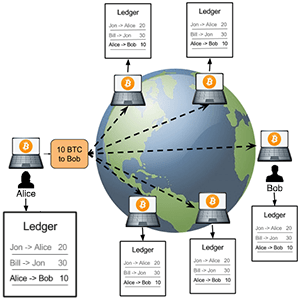
Bitcoin is a cryptocurrency, an online payment system secured by cryptography, released by the pseudonymous Satoshi Nakamoto in 2009. The system is peer-to-peer; users can transact directly without needing an intermediary. Transactions are verified by network nodes containing a public ledger called the block chain. Bitcoin nodes use the block chain to distinguish legitimate Bitcoin transactions from attempts to re-spend coins that have already been spent elsewhere. Bitcoin ‘mining’ is a record-keeping service. Miners keep the block chain consistent, complete, and unalterable by repeatedly verifying and collecting newly broadcast transactions into a new group of transactions called a ‘block.’
A new block contains information that ‘chains’ it to the previous block thus giving the block chain its name. It is a cryptographic hash (scrambled code that represents the block). Miners compute the hash functions to verify them for the network, a task that is intentionally designed to be resource-intensive and computationally difficult so that the number of blocks found each day remains steady. Mining is also the mechanism used to introduce new coins into the system: Miners are paid transaction fees as well as a ‘subsidy’ of newly created coins. This both serves the purpose of disseminating new coins in a decentralized manner as well as motivating people to provide security for the system.
Posted in Money, Technology |
1 Comment »
April 8, 2015

The religious texts of the world’s faiths are replete with examples of individuals who are well known by the general public. Some of the pharaohs of ancient Egypt set in motion devices to ensure their own fame for centuries to come. Herostratus, a young Greek man arsoned the Temple of Artemis (one of the Seven Wonders of the Ancient World) in 356 BCE in order to immortalize his name. Although authorities at the time tried to expunge him from history and punished people with the death penalty for even merely mentioning his name, he succeeded in achieving lasting fame, as his name is well known to this day.
Celebrity culture, once restricted to royalty and biblical/mythical figures, has pervaded many sectors of society including business, publishing, and even academia (scilebrities). With every scientific advance names have become attached to discoveries. Each nation or cultural community (linguistic, ethnic, religious) has its own independent celebrity system (e.g. J-Pop), but this is becoming less the case due to globalization. Mass media has increased the exposure and power of celebrity.
read more »
Posted in Money, Politics, World |
1 Comment »
March 30, 2015

David Miscavige (b. 1960) is the leader of the Church of Scientology. He was an assistant to church founder L. Ron Hubbard (a ‘Commodore’s messenger’) while a teenager, and rose to a leadership position by the early 1980s, becoming Chairman in 1987. He is lauded within Scientology for obtaining recognition as a tax-favored charity by the IRS, issuing restored and corrected editions of Hubbard’s works, and undertaking a program of new or remodeled churches and related facilities.
His official title is Chairman of the Board of Religious Technology Center (RTC), a corporation that controls the trademarks and copyrights of ‘Dianetics’ and Scientology. During his tenure, a number of allegations have been made against Miscavige, including claims of forced separation of family members, coercive fundraising practices, harassment of journalists and church critics, and humiliation of church staff members. He has also been accused of physically assaulting his staff. He has denied the majority of these claims, often criticizing the credibility of those who bring them.
read more »
Posted in Money, Philosophy, Politics |
Leave a Comment »
March 20, 2015
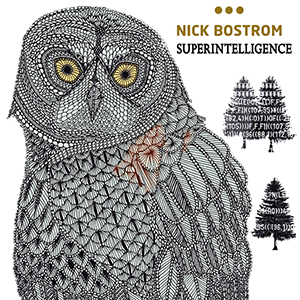
In philosophy, Pascal’s mugging is a thought experiment demonstrating a problem in expected utility maximization. A rational agent should choose actions whose outcomes, when weighed by their probability, have higher utility. But some very unlikely outcomes may have very great utilities, and these utilities can grow faster than the probability diminishes. Hence the agent should focus more on vastly improbable cases with implausibly high rewards. The name refers to Pascal’s Wager (an argument by French mathematician Blaise Pascal that the potential cost of not believing in God is higher than the cost of believing), but unlike the wager does not require infinite rewards. This removes any objections to the dilemma that are based on the nature of infinity.
British philosopher Jeremy Bentham’s: ‘The greatest good for the greatest number’ formed the foundation of utilitarianism, which says that the morally best action is the one that makes the most overall happiness or ‘utility’ (usefulness). Pascal’s mugging points out that in extreme case this philosophy can fail. The term for this problem was coined by artificial intelligence researcher Eliezer Yudkowsky in the ‘Less Wrong’ internet forum and his original example was: ‘Now suppose someone comes to me and says, ‘Give me five dollars, or I’ll use my magic powers from outside the Matrix to run a Turing machine that simulates and kills [trillions of] people.’ Even though the chance of this actually happening is negligible, the threatened outcome is so large a rational agent must accede to the demand.
read more »
Posted in Money, Philosophy, Technology |
Leave a Comment »
March 16, 2015
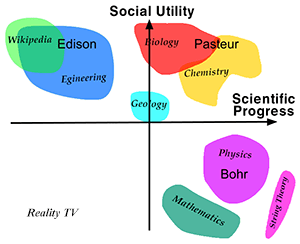

Blue skies research is scientific research in domains where ‘real-world’ applications are not immediately apparent. It has been defined as ‘research without a clear goal’ and ‘curiosity-driven science.’ It is sometimes used interchangeably with the term ‘basic research.’ Proponents of this mode of science argue that unanticipated scientific breakthroughs are sometimes more valuable than the outcomes of agenda-driven research, heralding advances in genetics and stem cell biology as examples of unforeseen benefits of research that was originally seen as purely theoretical in scope. Because of the inherently uncertain return on investment, blue-sky projects are politically and commercially unpopular and tend to lose funding to more reliably profitable or practical research.
Raytheon founder Vannevar Bush’s 1945 report, ‘Science: The Endless Frontier,’ made the argument for the value of basic research in the postwar era, and was the basis for many appeals to the federal funding of basic research. The 1957 launch of Sputnik prompted the United States Air Force Office of Scientific Research to sponsor basic science research into the 1960s. By the 1970s, financial strains brought pressure on public expenditure on the sciences, first in the UK and the Netherlands, and by the 1990s in Germany and the US.
read more »
Posted in Money, Science, Technology |
1 Comment »
March 14, 2015

Wrap rage, also called package rage, is the common name for heightened levels of anger and frustration resulting from the inability to open hard-to-openpackaging, particularly some heat-sealed plastic blister packs and clamshells. People suffer thousands of injuries per year, such as cut fingers and sprained wrists, from tools used to open packages and from packaging itself, and in some cases damage the items they are trying to free from packaging. Easy-opening systems are available to improve package opening convenience.
Packaging sometimes must be made difficult to open. For example, regulations dictate that some over-the-counter drugs have tamper resistance to deter unauthorized opening prior to the intended customer and be in child-resistant packaging. Other packages are intentionally made difficult to open to reduce package pilferage and shoplifting. Hard plastic blister packs also protect the products while they are being shipped. In addition, using transparent plastic allows customers to view products directly before purchasing them.
Posted in Humor, Money |
Leave a Comment »
March 10, 2015

David Graeber (b. 1961) is an American anthropologist, anarchist and activist, who is Professor of Anthropology at the London School of Economics. Specializing in theories of value and social theory, he was an assistant professor and associate professor of anthropology at Yale University from 1998 to 2007, although Yale controversially declined to rehire him. From Yale, he went on to become a Reader in Social Anthropology at Goldsmiths, University of London from 2007-13.
Graeber has been involved in social and political activism, including the protests against the 3rd Summit of the Americas in Quebec City in 2001 and the World Economic Forum in New York City in 2002. He is also a leading figure in the Occupy Wall Street movement.
read more »
Posted in Money, Politics, Science |
Leave a Comment »
February 25, 2015

Homo reciprocans [ri-sip-ruh-kahns], or reciprocal human, is the concept in some economic theories of humans as cooperative actors who are motivated by improving their environment. This concept stands in contrast to the idea of ‘homo economicus,’ which states the opposite theory that human beings are exclusively motivated by self-interest.
Russian polymath Peter Kropotkin wrote about the concept of ‘mutual aid’ in the early part of the 20th century. The homo reciprocans concept states that human being players interact with a propensity to cooperate. They will compromise in order to achieve a balance between what is best for them and what is best for the environment they are a part of.
read more »
Posted in Money |
Leave a Comment »
February 24, 2015

The Comedy of the Commons is an economic concept, developed as an opposite model to the tragedy of the commons (where individuals acting in their own self interest cooperatively deplete a shared resource, to the detriment of the group). In the ‘comedy’ individuals contribute knowledge and content for the good of the community rather than extracting resources for their own personal gain. Examples of this are free and open source software and Wikipedia. This phenomenon is linked to ‘viral’ effects and increases in prominence as individuals contribute altruistically and for social gain. The term appears to have originated in any essay by Yale law professor Carol M. Rose in 1986.
This outcome is more likely when the cost of the contribution is much less than its value over time. Information has this property. For example, it costs very little for a Wikipedia contributor to enter knowledge from their experience into Wikipedia’s servers, and very little for Wikipedia to serve that information over and over again to readers, generating great value over time. Unlike the pasture of a physical commons, information isn’t degraded by use. Thus the value of Wikipedia increases over time, attracting more readers of whom some become contributors, forming a virtuous cycle.
Posted in Money, Technology |
Leave a Comment »
February 22, 2015
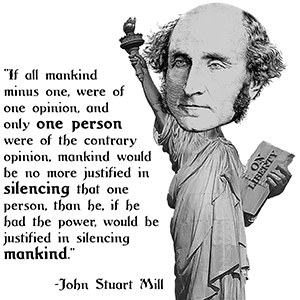
The ‘marketplace of ideas’ is a rationale for freedom of expression based on an analogy to the economic concept of a free market. The ‘marketplace of ideas’ belief holds that the truth will emerge from the competition of ideas in free, transparent public discourse. This concept is often applied to discussions of patent law as well as freedom of the press and the responsibilities of the media in a liberal democracy.
The general idea is that free speech should be tolerated because it will lead toward the truth. English poet John Milton suggested that restricting speech was not necessary because ‘in a free and open encounter,’ truth would prevail. President Thomas Jefferson argued that it is safe to tolerate ‘error of opinion … where reason is left free to combat it.’ Journalism professor Fredrick Siebert echoed the idea that free expression is self-correcting in ‘Four Theories of the Press’: ‘Let all with something to say be free to express themselves. The true and sound will survive. The false and unsound will be vanquished. Government should keep out of the battle and not weigh the odds in favor of one side or the other.’
read more »
Posted in Language, Money, Politics |
Leave a Comment »
February 15, 2015

I. Spiewak & Sons, Inc., commonly known simply as Spiewak, is a New York-based apparel manufacturer founded in 1904. Spiewak currently manufactures high-visibility safety apparel, EMS protective gear, and other uniforms for private businesses (including American Airlines and Avis) and government agencies (including the FBI, ATF, Secret Service, and Postal Service). During WWI, Spiewak produced wool coats and breeches for the US Army and Navy, including pea coats, which are still made by the company today. During WWII parkas, flight jackets, flight suits, and field jackets were produced for the US military. Spiewak also offers a line of consumer outerwear constructed with ‘workwear’ values.
Isaac Spiewak grew up in Warsaw, Poland and fled to Brooklyn, NY in 1903. He started a small family business, making sheepskin vests by hand and selling them on the docks of Williamsburg in 1904. By 1906, Isaac’s vests were in sufficient demand around New York for him to establish a small manufacturing space, calling it ‘House of the Golden Fleece.’ As his brothers entered into various facets of the outerwear business, the Spiewaks developed different, and sometimes competing, lines and companies to capitalize on prevailing trends and emerging market segments. Their family of brands including Bronco Manufacturing, Ram Manufacturing, United Sheeplined Clothing Company, Spiewak Brothers, Swiss Blouse, Excalibur, Frost King, Pan-Jac, Trappings, Prince Jason, and Flight Deck USA.
Posted in Money, War |
Leave a Comment »
February 14, 2015
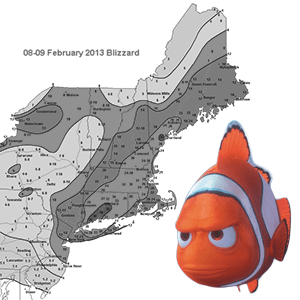
Winter storm naming in the United States has been used by The Weather Channel (TWC) since 2011, when the cable network informally used the previously-coined name ‘Snowtober’ for a 2011 Halloween nor’easter. In November 2012, TWC began systematically naming winter storms, starting with the November 2012 nor’easter it named ‘Winter Storm Athena.’ TWC compiled a list of winter storm names for the 2012–13 winter season. It would only name those storms that are ‘disruptive’ to people, said Bryan Norcross, a TWC senior director. TWC’s decision was met with criticism from other weather forecasters, who called the practice self-serving and potentially confusing to the public.
The U.S. government-operated National Oceanic and Atmospheric Administration (NOAA) (a division of which–the National Hurricane Center–has named hurricanes for many years) and its main division–the National Weather Service (NWS)–did not acknowledge TWC’s winter storm names and asked its forecast offices to refrain from using them. The NWS spokesperson Susan Buchanan stated, ‘The National Weather Service does not name winter storms because a winter storm’s impact can vary from one location to another, and storms can weaken and redevelop, making it difficult to define where one ends and another begins.’
Posted in Language, Money, Science |
Leave a Comment »


 The Daily Omnivore