March 10, 2015
David Graeber (b. 1961) is an American anthropologist, anarchist and activist, who is Professor of Anthropology at the London School of Economics. Specializing in theories of value and social theory, he was an assistant professor and associate professor of anthropology at Yale University from 1998 to 2007, although Yale controversially declined to rehire him. From Yale, he went on to become a Reader in Social Anthropology at Goldsmiths, University of London from 2007-13.
Graeber has been involved in social and political activism, including the protests against the 3rd Summit of the Americas in Quebec City in 2001 and the World Economic Forum in New York City in 2002. He is also a leading figure in the Occupy Wall Street movement.
read more »
Posted in Money, Politics, Science |
Leave a Comment »
February 25, 2015

Homo reciprocans [ri-sip-ruh-kahns], or reciprocal human, is the concept in some economic theories of humans as cooperative actors who are motivated by improving their environment. This concept stands in contrast to the idea of ‘homo economicus,’ which states the opposite theory that human beings are exclusively motivated by self-interest.
Russian polymath Peter Kropotkin wrote about the concept of ‘mutual aid’ in the early part of the 20th century. The homo reciprocans concept states that human being players interact with a propensity to cooperate. They will compromise in order to achieve a balance between what is best for them and what is best for the environment they are a part of.
read more »
Posted in Money |
Leave a Comment »
February 24, 2015
The Comedy of the Commons is an economic concept, developed as an opposite model to the tragedy of the commons (where individuals acting in their own self interest cooperatively deplete a shared resource, to the detriment of the group). In the ‘comedy’ individuals contribute knowledge and content for the good of the community rather than extracting resources for their own personal gain. Examples of this are free and open source software and Wikipedia. This phenomenon is linked to ‘viral’ effects and increases in prominence as individuals contribute altruistically and for social gain. The term appears to have originated in any essay by Yale law professor Carol M. Rose in 1986.
This outcome is more likely when the cost of the contribution is much less than its value over time. Information has this property. For example, it costs very little for a Wikipedia contributor to enter knowledge from their experience into Wikipedia’s servers, and very little for Wikipedia to serve that information over and over again to readers, generating great value over time. Unlike the pasture of a physical commons, information isn’t degraded by use. Thus the value of Wikipedia increases over time, attracting more readers of whom some become contributors, forming a virtuous cycle.
Posted in Money, Technology |
Leave a Comment »
February 22, 2015
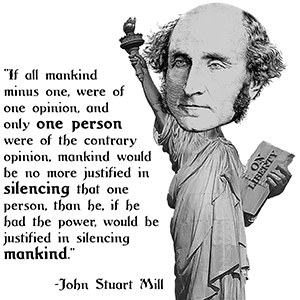
The ‘marketplace of ideas’ is a rationale for freedom of expression based on an analogy to the economic concept of a free market. The ‘marketplace of ideas’ belief holds that the truth will emerge from the competition of ideas in free, transparent public discourse. This concept is often applied to discussions of patent law as well as freedom of the press and the responsibilities of the media in a liberal democracy.
The general idea is that free speech should be tolerated because it will lead toward the truth. English poet John Milton suggested that restricting speech was not necessary because ‘in a free and open encounter,’ truth would prevail. President Thomas Jefferson argued that it is safe to tolerate ‘error of opinion … where reason is left free to combat it.’ Journalism professor Fredrick Siebert echoed the idea that free expression is self-correcting in ‘Four Theories of the Press’: ‘Let all with something to say be free to express themselves. The true and sound will survive. The false and unsound will be vanquished. Government should keep out of the battle and not weigh the odds in favor of one side or the other.’
read more »
Posted in Language, Money, Politics |
Leave a Comment »
February 15, 2015

I. Spiewak & Sons, Inc., commonly known simply as Spiewak, is a New York-based apparel manufacturer founded in 1904. Spiewak currently manufactures high-visibility safety apparel, EMS protective gear, and other uniforms for private businesses (including American Airlines and Avis) and government agencies (including the FBI, ATF, Secret Service, and Postal Service). During WWI, Spiewak produced wool coats and breeches for the US Army and Navy, including pea coats, which are still made by the company today. During WWII parkas, flight jackets, flight suits, and field jackets were produced for the US military. Spiewak also offers a line of consumer outerwear constructed with ‘workwear’ values.
Isaac Spiewak grew up in Warsaw, Poland and fled to Brooklyn, NY in 1903. He started a small family business, making sheepskin vests by hand and selling them on the docks of Williamsburg in 1904. By 1906, Isaac’s vests were in sufficient demand around New York for him to establish a small manufacturing space, calling it ‘House of the Golden Fleece.’ As his brothers entered into various facets of the outerwear business, the Spiewaks developed different, and sometimes competing, lines and companies to capitalize on prevailing trends and emerging market segments. Their family of brands including Bronco Manufacturing, Ram Manufacturing, United Sheeplined Clothing Company, Spiewak Brothers, Swiss Blouse, Excalibur, Frost King, Pan-Jac, Trappings, Prince Jason, and Flight Deck USA.
Posted in Money, War |
Leave a Comment »
February 14, 2015
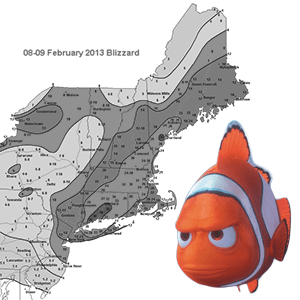
Winter storm naming in the United States has been used by The Weather Channel (TWC) since 2011, when the cable network informally used the previously-coined name ‘Snowtober’ for a 2011 Halloween nor’easter. In November 2012, TWC began systematically naming winter storms, starting with the November 2012 nor’easter it named ‘Winter Storm Athena.’ TWC compiled a list of winter storm names for the 2012–13 winter season. It would only name those storms that are ‘disruptive’ to people, said Bryan Norcross, a TWC senior director. TWC’s decision was met with criticism from other weather forecasters, who called the practice self-serving and potentially confusing to the public.
The U.S. government-operated National Oceanic and Atmospheric Administration (NOAA) (a division of which–the National Hurricane Center–has named hurricanes for many years) and its main division–the National Weather Service (NWS)–did not acknowledge TWC’s winter storm names and asked its forecast offices to refrain from using them. The NWS spokesperson Susan Buchanan stated, ‘The National Weather Service does not name winter storms because a winter storm’s impact can vary from one location to another, and storms can weaken and redevelop, making it difficult to define where one ends and another begins.’
Posted in Language, Money, Science |
Leave a Comment »
February 12, 2015
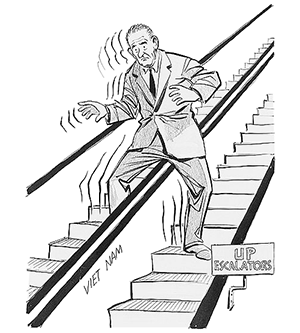
Escalation of commitment was first described by business professor Barry M. Staw in his 1976 paper, ‘Knee deep in the big muddy: A study of escalating commitment to a chosen course of action.’ More recently the term ‘sunk cost fallacy’ has been used to describe the phenomenon where people justify increased investment in a decision, based on the cumulative prior investment, despite new evidence suggesting that the cost, starting today, of continuing the decision outweighs the expected benefit. Such investment may include money, time, or even — in the case of military strategy— human lives (the term has been used to describe the US commitment to military conflicts including Vietnam and Iraq).
The phenomenon and the sentiment underlying it are reflected in such proverbial images as ‘Throwing good money after bad,’ ‘In for a dime, in for a dollar,’ or ‘In for a penny, in for a pound.’ A common example irrational escalation is a bidding war; the bidders can end up paying much more than the object is worth to justify the initial expenses associated with bidding (such as research), as well as part of a competitive instinct. The main drivers of the tendency to invest in losing propositions are: Social (peer pressure), Psychological (gambling), Project (past commitments), and Structural (cultural and environmental factors). After a heated bidding war, Canadian financier Robert Campeau ended up buying Bloomingdale’s for an estimated $600 million more than it was worth. The ‘Wall Street Journal’ noted that ‘we’re not dealing in price anymore but egos.’ Campeau was forced to declare bankruptcy soon afterwards.
Posted in Money, Science, War |
1 Comment »
February 6, 2015

Pet Rock was a collectible conceived by advertising executive Gary Dahl. In April 1975, he was in a bar listening to his friends complain about their pets. This gave him the idea for the perfect ‘pet,’ one that would not need to be fed, walked, bathed, or groomed; and would not die, become sick, or be disobedient. His friends thought he was joking, but Dahl bought a load of smooth stones from Mexico’s Rosarito Beach for about a penny a stone. He marketed them like live pets, in custom cardboard boxes, complete with straw and breathing holes for the ‘animal.’ The fad lasted about six months. Dahl sold 1.5 million Pet Rocks for $4 each and became a millionaire.
A 32-page official training manual titled ‘The Care and Training of Your Pet Rock’ was included, which was the real product: it was full of gags, puns and jokes. It contained several commands that could be taught to the new pet. While ‘sit’ and ‘stay’ were effortless to accomplish, ‘roll over’ usually required a little extra help from the trainer (as did ‘attack’). The owners also found that potty-training their pet rocks was easy, given that they were, in fact, rocks. Dahl continued to work in advertising but avoided interviews for years, because ‘a bunch of wackos’ harassed him with lawsuits and threats. He said in 1988, ‘Sometimes I look back and wonder if my life wouldn’t have been simpler if I hadn’t done it.’
Posted in Humor, Money |
Leave a Comment »
January 19, 2015

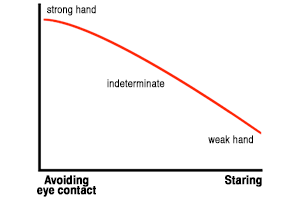
A tell in poker is a change in a player’s behavior or demeanor that can indicate the strength of their hand. A player gains an advantage if they observe and understand the meaning of another player’s tell, particularly if the tell is unconscious and reliable. Sometimes a player may fake a tell, hoping to induce their opponents to capitalize on bad information. More often, people try to avoid giving out a tell, by maintaining an expressionless ‘poker face’ regardless of how strong or weak their hand is.
A tell may be common to a class of players or unique to a single player. Some possible tells include leaning forward or back, placing chips with more or less force, fidgeting, doing chip tricks, showing nervous tics, or changing one’s breathing, tone of voice, facial expressions, direction of gaze. Other tells are associated with a player’s actions with the cards, cigarettes, or drinks, or merely by their style of play.
read more »
Posted in Games, Money |
Leave a Comment »
December 16, 2014

Jargon [jahr-guhn], or term of art, is ‘the technical terminology or characteristic idiom of a special activity or group.’ The word ‘jargon’ is French and is believed to have been derived from the Latin ‘gaggire,’ meaning ‘to chatter,’ which was used to describe something in which the speaker did not understand.
An ‘industry term’ is jargon that is associated with one particular industry. Jargon is similar to slang, both are non-standard definitions often created by and for subcultures. It is also common for each generation to create their own jargon. Whether this is because they want to identify with each other and thus create a language of their own, or conversely, if they deliberately do not want to be understood by anybody else (e.g. texting slang used by teens to communicate messages their parents won’t be able to translate).
read more »
Posted in Language, Money, Technology |
Leave a Comment »
December 9, 2014
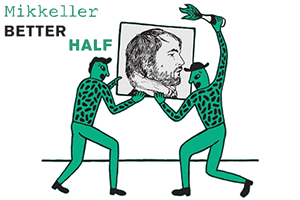
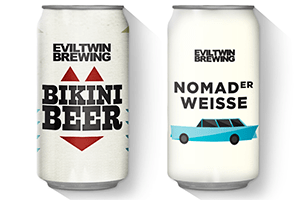
A gypsy brewery is a beer company that does not have its own equipment or premises; it operates on a temporary or itinerant basis out of the facilities of another brewery, generally making ‘one-off’ special occasion beers. The term may refer to the brewmaster, or to the brand of beer. The trend of gypsy brewing spread early in Scandinavia. Their beers, and collaborations later spread to America and Australia.
Gypsy brewers typically use facilities of larger makers with excess capacity. Often, their beers are made with herbs, spices, and fruits, use experimental styles, are high in alcohol, or are aged in old wine or liquor barrels. Prominent examples include Pretty Things, Stillwater Artisanal Ales, Mikkeller and Evil Twin.
Posted in Drugs, Food, Money |
Leave a Comment »
December 8, 2014
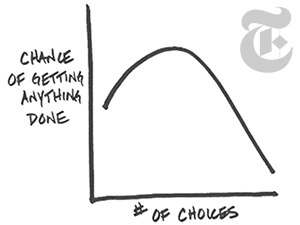
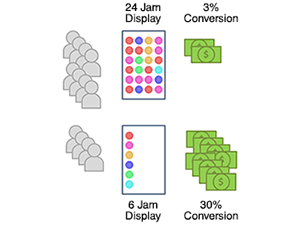
Overchoice, also referred to as ‘choice overload,’ is a term describing a problem facing consumers in the postindustrial society: too many choices. The term was first introduced by futurist Alvin Toffler in his 1970 book, ‘Future Shock.’ Overchoice is the result of technological progress. Since the beginning of the Industrial Revolution, each year, more and more products are being offered. Consumers have more disposable income to spend, and producers can more easily and cheaply introduce product variations.
Having more choices, on the surface, appears to be a positive development; however it hides an underlying problem: faced with too many choices, consumers have trouble making optimal choices, and thus as a result can be indecisive. When confronted with a plethora of choices without perfect information, many people prefer to make no choice at all, even if making a choice would lead to a better outcome. Toffler noted that as the choice turns to overchoice, ‘freedom of more choices’ ironically becomes the opposite—the ‘unfreedom.’
read more »
Posted in Education, Money |
Leave a Comment »



