February 12, 2015
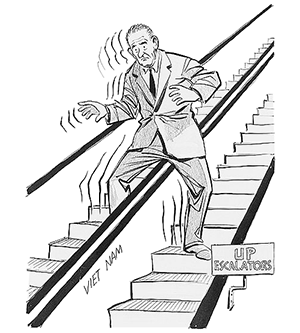
Escalation of commitment was first described by business professor Barry M. Staw in his 1976 paper, ‘Knee deep in the big muddy: A study of escalating commitment to a chosen course of action.’ More recently the term ‘sunk cost fallacy’ has been used to describe the phenomenon where people justify increased investment in a decision, based on the cumulative prior investment, despite new evidence suggesting that the cost, starting today, of continuing the decision outweighs the expected benefit. Such investment may include money, time, or even — in the case of military strategy— human lives (the term has been used to describe the US commitment to military conflicts including Vietnam and Iraq).
The phenomenon and the sentiment underlying it are reflected in such proverbial images as ‘Throwing good money after bad,’ ‘In for a dime, in for a dollar,’ or ‘In for a penny, in for a pound.’ A common example irrational escalation is a bidding war; the bidders can end up paying much more than the object is worth to justify the initial expenses associated with bidding (such as research), as well as part of a competitive instinct. The main drivers of the tendency to invest in losing propositions are: Social (peer pressure), Psychological (gambling), Project (past commitments), and Structural (cultural and environmental factors). After a heated bidding war, Canadian financier Robert Campeau ended up buying Bloomingdale’s for an estimated $600 million more than it was worth. The ‘Wall Street Journal’ noted that ‘we’re not dealing in price anymore but egos.’ Campeau was forced to declare bankruptcy soon afterwards.
Posted in Money, Science, War |
1 Comment »
February 6, 2015

Pet Rock was a collectible conceived by advertising executive Gary Dahl. In April 1975, he was in a bar listening to his friends complain about their pets. This gave him the idea for the perfect ‘pet,’ one that would not need to be fed, walked, bathed, or groomed; and would not die, become sick, or be disobedient. His friends thought he was joking, but Dahl bought a load of smooth stones from Mexico’s Rosarito Beach for about a penny a stone. He marketed them like live pets, in custom cardboard boxes, complete with straw and breathing holes for the ‘animal.’ The fad lasted about six months. Dahl sold 1.5 million Pet Rocks for $4 each and became a millionaire.
A 32-page official training manual titled ‘The Care and Training of Your Pet Rock’ was included, which was the real product: it was full of gags, puns and jokes. It contained several commands that could be taught to the new pet. While ‘sit’ and ‘stay’ were effortless to accomplish, ‘roll over’ usually required a little extra help from the trainer (as did ‘attack’). The owners also found that potty-training their pet rocks was easy, given that they were, in fact, rocks. Dahl continued to work in advertising but avoided interviews for years, because ‘a bunch of wackos’ harassed him with lawsuits and threats. He said in 1988, ‘Sometimes I look back and wonder if my life wouldn’t have been simpler if I hadn’t done it.’
Posted in Humor, Money |
Leave a Comment »
January 19, 2015

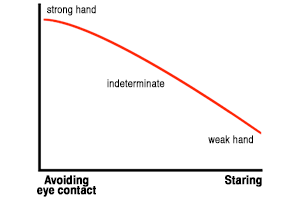
A tell in poker is a change in a player’s behavior or demeanor that can indicate the strength of their hand. A player gains an advantage if they observe and understand the meaning of another player’s tell, particularly if the tell is unconscious and reliable. Sometimes a player may fake a tell, hoping to induce their opponents to capitalize on bad information. More often, people try to avoid giving out a tell, by maintaining an expressionless ‘poker face’ regardless of how strong or weak their hand is.
A tell may be common to a class of players or unique to a single player. Some possible tells include leaning forward or back, placing chips with more or less force, fidgeting, doing chip tricks, showing nervous tics, or changing one’s breathing, tone of voice, facial expressions, direction of gaze. Other tells are associated with a player’s actions with the cards, cigarettes, or drinks, or merely by their style of play.
read more »
Posted in Games, Money |
Leave a Comment »
December 16, 2014

Jargon [jahr-guhn], or term of art, is ‘the technical terminology or characteristic idiom of a special activity or group.’ The word ‘jargon’ is French and is believed to have been derived from the Latin ‘gaggire,’ meaning ‘to chatter,’ which was used to describe something in which the speaker did not understand.
An ‘industry term’ is jargon that is associated with one particular industry. Jargon is similar to slang, both are non-standard definitions often created by and for subcultures. It is also common for each generation to create their own jargon. Whether this is because they want to identify with each other and thus create a language of their own, or conversely, if they deliberately do not want to be understood by anybody else (e.g. texting slang used by teens to communicate messages their parents won’t be able to translate).
read more »
Posted in Language, Money, Technology |
Leave a Comment »
December 9, 2014
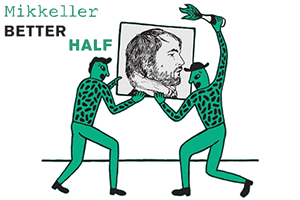

A gypsy brewery is a beer company that does not have its own equipment or premises; it operates on a temporary or itinerant basis out of the facilities of another brewery, generally making ‘one-off’ special occasion beers. The term may refer to the brewmaster, or to the brand of beer. The trend of gypsy brewing spread early in Scandinavia. Their beers, and collaborations later spread to America and Australia.
Gypsy brewers typically use facilities of larger makers with excess capacity. Often, their beers are made with herbs, spices, and fruits, use experimental styles, are high in alcohol, or are aged in old wine or liquor barrels. Prominent examples include Pretty Things, Stillwater Artisanal Ales, Mikkeller and Evil Twin.
Posted in Drugs, Food, Money |
Leave a Comment »
December 8, 2014
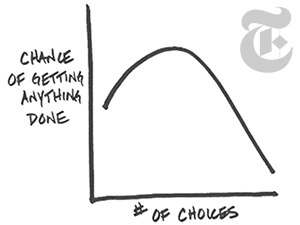
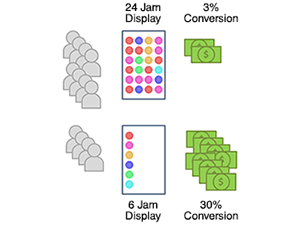
Overchoice, also referred to as ‘choice overload,’ is a term describing a problem facing consumers in the postindustrial society: too many choices. The term was first introduced by futurist Alvin Toffler in his 1970 book, ‘Future Shock.’ Overchoice is the result of technological progress. Since the beginning of the Industrial Revolution, each year, more and more products are being offered. Consumers have more disposable income to spend, and producers can more easily and cheaply introduce product variations.
Having more choices, on the surface, appears to be a positive development; however it hides an underlying problem: faced with too many choices, consumers have trouble making optimal choices, and thus as a result can be indecisive. When confronted with a plethora of choices without perfect information, many people prefer to make no choice at all, even if making a choice would lead to a better outcome. Toffler noted that as the choice turns to overchoice, ‘freedom of more choices’ ironically becomes the opposite—the ‘unfreedom.’
read more »
Posted in Education, Money |
Leave a Comment »
December 7, 2014

Behavioral economics is a smaller part of economics that combines what we know about psychology with what we know about economics. Normally, economics does not consider the way humans actually think, but instead, abstracts complex decision-making into comparatively simple mathematical models.
Normally, economists assume people are rational, meaning they make good decisions at the right times using all information. In reality, people are subject to problems with self-control, limitations of time and physical resources, and make different choices depending on how decisions are presented to them.
read more »
Posted in Money, Science |
Leave a Comment »
December 7, 2014


Naïve diversification is a ‘choice heuristic,’ a mental shortcut used to simplify decisions, first demonstrated by professor of marketing Itamar Simonson in the context of consumption decisions by individuals. It was subsequently shown in the context of economic and financial decisions.
Simonson showed that when people have to make a simultaneous choice (e.g. choose now which of six snacks to consume in the next three weeks), they tend to seek more variety (e.g., pick more kinds of snacks) than when they make sequential choices (e.g., choose once a week which of six snacks to consume that week for three weeks).
read more »
Posted in Money, Science |
Leave a Comment »
December 6, 2014

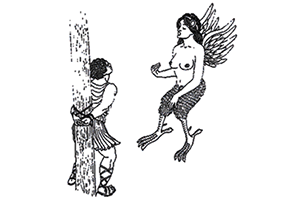
In economics, dynamic inconsistency, or time inconsistency, describes the situation: A decision-maker’s preferences change over time, in such a way that a preference, at one point in time, is inconsistent with a preference at another point in time. It is often easiest to think about preferences over time in this context by thinking of decision-makers as being made up of many different ‘selves,’ with each self representing the decision-maker at a different point in time. So, for example, there is my today self, my tomorrow self, my next Tuesday self, my year from now self, etc. The inconsistency will occur when somehow the preferences of some of the selves are not aligned with each other.
In the context of behavioral economics, time inconsistency is related to how each different self of a decision-maker may have different preferences over current and future choices. One common way in which selves may differ in their preferences is they may be modeled as all holding the view that now has especially high value compared to any future time. This is sometimes called the ‘immediacy effect’ or ‘temporal discounting.’ As a result the present self will care too much about herself and not enough about her future selves. Self control literature relies heavily on this type of time inconsistency, and it relates to a variety of topics including procrastination, addiction, efforts at weight loss, and saving for retirement.
read more »
Posted in Games, Money, Politics |
Leave a Comment »
December 5, 2014
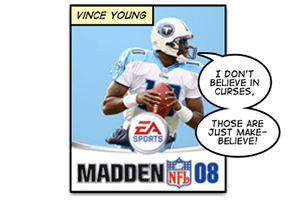

Regression toward the mean simply says that, following an extreme random event, the next random event is likely to be less extreme. In no sense does the future event ‘compensate for’ or ‘even out’ the previous event, though this is assumed in the gambler’s fallacy. Regression toward the mean was first described by Victorian polymath Francis Galton. He found that offspring of tall parents tended to be shorter. Also, offspring of shorter parents tended to be taller. Galton stated that processes that did not follow regression towards the mean would quickly go out of control. In finance, the term ‘mean reversion’ has a different meaning. Jeremy Siegel at Wharton uses it to describe a financial time series in which ‘returns can be very unstable in the short run but very stable in the long run,’ in seasonal businesses for example.
The effect can be exploited for general inference and estimation: the hottest place in the country today is more likely to be cooler tomorrow than hotter, as compared to today; the best performing mutual fund over the last three years is more likely to see relative performance decline than improve over the next three years; the most successful Hollywood actor of this year is likely to have less gross than more gross for his or her next movie; the baseball player with the greatest batting average by the All-Star break is more likely to have a lower average than a higher average over the second half of the season, etc.
read more »
Posted in Games, Money, Science |
Leave a Comment »
November 23, 2014
To have ‘skin in the game’ is to have incurred monetary risk by being invested in achieving a goal. In the phrase, ‘skin’ is a synecdoche (a part that represents the whole) for the person involved, and ‘game’ is the metaphor for the actions on whatever field of play is at reference. The aphorism is common in finance, gambling, and politics. The origin of the phrase is unknown. It has been attributed to Warren Buffett since in Buffett’s first fund he raised $105,000 from 11 doctors, himself placing a token sum of $100.00 as his ‘skin in the game’ (though New York Times columnist William Safire dispelled the Buffett origin). Another possible explanation is that the phrase is derived from William Shakespeare’s ‘The Merchant of Venice’; in which a money lender demands a pound of actual flesh from a borrower should they default.
The term is used to ask or convey a principals undefined but significant equity stake in an investment vehicle where outside investors are solicited to invest. The theory is that principal’s equity contribution is directly related to the stability of the investment and confidence that management has in the venture and is also (falsely) strongly correlated to the expected yield of the investment. Research has shown that there tends to be a negative correlation between excess ‘skin’ and negative returns. The main issues is the principal–agent problem whereby transparency and fiduciary obligations are disregarded by principals who have capital or excess capital (skin) tied into an entity. Many banks and other financial institutions bar employees from having any ‘skin’ where client capital is managed, principally to address the issue of commingled funds. Hedge funds, private equity, Trusts, and Mutual funds are legally limited to a minority investment positions.
Posted in Language, Money |
Leave a Comment »
November 14, 2014


The curse of knowledge is a cognitive bias that leads better-informed parties to find it extremely difficult to think about problems from the perspective of lesser-informed parties. It is related to public policy engineer Baruch Fischhoff’s work on the hindsight bias (the knew-it-all-along effect). In economics the bias is studied to understand why the assumption that better informed agents can accurately anticipate the judgments of lesser informed agents is not inherently true, as well as to support the finding that sales agents who are better informed about their products may, in fact, be at a disadvantage against other, less-informed agents. It is believed that better informed agents fail to ignore the privileged knowledge that they possess, thus ‘cursed’ and unable to sell their products at a value that more naïve agents would deem acceptable.
In one experiment, one group of subjects ‘tapped’ a well-known song on a table while another listened and tried to identify the song. Some ‘tappers’ described a rich sensory experience in their minds as they tapped out the melody. Tappers on average estimated that 50% of listeners would identify the specific tune; in reality only 2.5% of listeners could. Related to this finding is the phenomenon experienced by players of charades: The actor may find it frustratingly hard to believe that his or her teammates keep failing to guess the secret phrase, known only to the actor, conveyed by pantomime.
Posted in Education, Language, Money |
Leave a Comment »


 The Daily Omnivore