May 26, 2015

A burl is a tree growth in which the grain has grown in a deformed manner. It is commonly found in the form of a rounded outgrowth on a tree trunk or branch that is filled with small knots from dormant buds. Insect infestation and certain types of molds are the most common causes of this condition, although other stresses can also promote burl formation, such as physical injury, or viral or fungal infection.
Most burls grow beneath the ground, attached to the roots as a type of malignancy that is generally not discovered until the tree dies or falls over. Such burls sometimes appear as groups of bulbous protrusions connected by a system of rope-like roots. Almost all burl wood is covered by bark, even if it is underground. In some tree species, burls can grow to great size. The largest, at 26 feet, occur in redwoods and can encircle the entire trunk. Burls yield a very peculiar and highly figured wood, prized for its beauty, strength, and rarity. It is sought after by furniture makers, artists, and wood sculptors.
read more »
Posted in Art, Money |
1 Comment »
May 21, 2015

The tiny house movement is a popular description for the architectural and social movement that advocates living simply in small homes. In the US the average size of new single family homes grew from 1,780 square feet in 1978 to 2,479 in 2007, despite a decrease in the size of the average family. Reasons for this include increased material wealth and prestige. The small house movement is a return to houses less than 1,000 square feet, some as small as 80 square feet.
Sarah Susanka has been credited with starting the recent countermovement toward smaller houses when she published ‘The Not So Big House’ in 1997. Earlier pioneers include Lloyd Kahn, author of ‘Shelter’ in 1973.’ Tiny houses on wheels were popularized by Jay Shafer who designed and lived in a 96 sq ft house and later went on to offer the first plans for tiny houses on wheels, initially founding ‘Tumbleweed Tiny House Company,’ and then ‘Four Lights Tiny House Company’ in 2012.
read more »
Posted in Money, Technology, World |
1 Comment »
May 13, 2015

Pappy Van Winkle’s Family Reserve is the flagship brand of bourbon whiskey owned by the ‘Old Rip Van Winkle Distillery’ company (which does not actually own or operate a distillery, but rather has it produced under a contract with another company). It is distilled and bottled by the Sazerac Company at its Buffalo Trace Distillery in Frankfort, Kentucky. It is often regarded as one of the finest bourbons in the world, and is rare to find on the market due to its very low production and high demand. The product has a cult-like following. Famous chefs such as Anthony Bourdain and David Chang have favored the product.
‘Food Republic’ reported that Chef John Currence said: ‘There’s Pappy Van Winkle, then there’s everything else.’ Bourbon aficionados have shown up in droves to get a small chance in a lottery to purchase some. It has been called ‘the bourbon everyone wants but no one can get.’ A writer for ‘The Wall Street Journal’ said ‘You could call it bourbon, or you could call it a $5,000 bottle of liquified, barrel-aged unobtanium.’ Jen Doll wrote in ‘The Wire,’ ‘It’s an age-old dilemma (supply and demand) leading to an age-old marketing dream (a product that can’t be kept on the shelves … money in the pockets … bourbon in the bourbon snifters).’
read more »
Posted in Drugs, Food, Money |
Leave a Comment »
May 8, 2015

Card counting is a casino card game strategy used primarily in blackjack to determine whether the next hand is likely to give a probable advantage to the player or to the dealer. Card counters are a class of advantage players, who attempt to decrease the house edge by keeping a running tally of all high and low valued cards seen by the player.
Card counting allows players to bet more with less risk when the count gives an advantage as well as minimize losses during an unfavorable count. Card counting also provides the ability to alter playing decisions based on the composition of remaining cards. Card counting (sometimes called ‘card reading’) is also used in trick-taking games such as contract bridge or spades to optimize the winning of tricks (rounds of play).
read more »
Posted in Games, Money, Politics |
Leave a Comment »
April 30, 2015

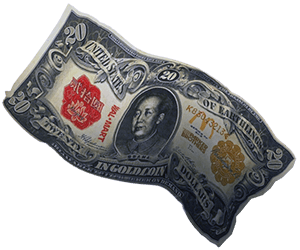
World currency normally refers to a currency that is transacted internationally, with no set borders, but an alternative definition refers to a hypothetical single global currency or supercurrency, such as the proposed ‘terra’ or the ‘DEY’ (Dollar Euro Yen), produced and supported by a central bank which is used for all transactions around the world, regardless of the nationality of the entities (individuals, corporations, governments, or other organizations) involved in the transaction.
Advocates of a global currency, notably famed economist John Maynard Keynes, have argued that such a currency would not suffer from inflation, which, in extreme cases, has had disastrous effects for economies. In addition, many argue that a single global currency would make conducting international business more efficient and would encourage foreign direct investment.
read more »
Posted in Money, Politics, World |
1 Comment »
April 29, 2015
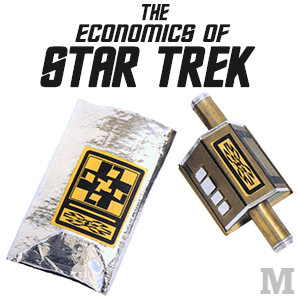
The United Federation of Planets, usually referred to as ‘the Federation,’ is an interstellar federal republic composed of planetary sovereignties depicted in the ‘Star Trek’ science fiction franchise. Formed in 2161, the planetary governments voluntarily exist semi-autonomously under a single central government based on the Utopian principles of universal liberty, rights, and equality, and to share their knowledge and resources in peaceful cooperation and space exploration.
The Federation is described a post-capitalist, libertarian, constitutional republic, which was composed of more than 150 member planets and thousands of colonies spread across some 6,000,000 cubic light years of the Milky Way Galaxy by 2373. The social structure within the Federation is classless and operates within a moneyless ‘New World Economy.’ It is described as stressing, at least nominally, the values of universal liberty, equality, justice, peace, and cooperation. The Federation also maintains its own quasi-militaristic and scientific exploratory agency, known as ‘Starfleet’ which handles many other governmental processes, sometimes with no other agency’s influence, such as border defense and diplomatic relations.
read more »
Posted in Art, Money, Politics |
Leave a Comment »
April 19, 2015
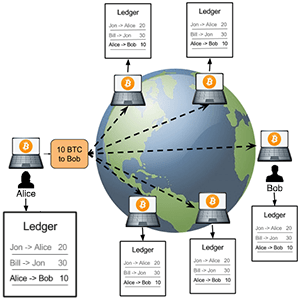
Bitcoin is a cryptocurrency, an online payment system secured by cryptography, released by the pseudonymous Satoshi Nakamoto in 2009. The system is peer-to-peer; users can transact directly without needing an intermediary. Transactions are verified by network nodes containing a public ledger called the block chain. Bitcoin nodes use the block chain to distinguish legitimate Bitcoin transactions from attempts to re-spend coins that have already been spent elsewhere. Bitcoin ‘mining’ is a record-keeping service. Miners keep the block chain consistent, complete, and unalterable by repeatedly verifying and collecting newly broadcast transactions into a new group of transactions called a ‘block.’
A new block contains information that ‘chains’ it to the previous block thus giving the block chain its name. It is a cryptographic hash (scrambled code that represents the block). Miners compute the hash functions to verify them for the network, a task that is intentionally designed to be resource-intensive and computationally difficult so that the number of blocks found each day remains steady. Mining is also the mechanism used to introduce new coins into the system: Miners are paid transaction fees as well as a ‘subsidy’ of newly created coins. This both serves the purpose of disseminating new coins in a decentralized manner as well as motivating people to provide security for the system.
Posted in Money, Technology |
1 Comment »
April 8, 2015

The religious texts of the world’s faiths are replete with examples of individuals who are well known by the general public. Some of the pharaohs of ancient Egypt set in motion devices to ensure their own fame for centuries to come. Herostratus, a young Greek man arsoned the Temple of Artemis (one of the Seven Wonders of the Ancient World) in 356 BCE in order to immortalize his name. Although authorities at the time tried to expunge him from history and punished people with the death penalty for even merely mentioning his name, he succeeded in achieving lasting fame, as his name is well known to this day.
Celebrity culture, once restricted to royalty and biblical/mythical figures, has pervaded many sectors of society including business, publishing, and even academia (scilebrities). With every scientific advance names have become attached to discoveries. Each nation or cultural community (linguistic, ethnic, religious) has its own independent celebrity system (e.g. J-Pop), but this is becoming less the case due to globalization. Mass media has increased the exposure and power of celebrity.
read more »
Posted in Money, Politics, World |
1 Comment »
March 30, 2015

David Miscavige (b. 1960) is the leader of the Church of Scientology. He was an assistant to church founder L. Ron Hubbard (a ‘Commodore’s messenger’) while a teenager, and rose to a leadership position by the early 1980s, becoming Chairman in 1987. He is lauded within Scientology for obtaining recognition as a tax-favored charity by the IRS, issuing restored and corrected editions of Hubbard’s works, and undertaking a program of new or remodeled churches and related facilities.
His official title is Chairman of the Board of Religious Technology Center (RTC), a corporation that controls the trademarks and copyrights of ‘Dianetics’ and Scientology. During his tenure, a number of allegations have been made against Miscavige, including claims of forced separation of family members, coercive fundraising practices, harassment of journalists and church critics, and humiliation of church staff members. He has also been accused of physically assaulting his staff. He has denied the majority of these claims, often criticizing the credibility of those who bring them.
read more »
Posted in Money, Philosophy, Politics |
Leave a Comment »
March 20, 2015
In philosophy, Pascal’s mugging is a thought experiment demonstrating a problem in expected utility maximization. A rational agent should choose actions whose outcomes, when weighed by their probability, have higher utility. But some very unlikely outcomes may have very great utilities, and these utilities can grow faster than the probability diminishes. Hence the agent should focus more on vastly improbable cases with implausibly high rewards. The name refers to Pascal’s Wager (an argument by French mathematician Blaise Pascal that the potential cost of not believing in God is higher than the cost of believing), but unlike the wager does not require infinite rewards. This removes any objections to the dilemma that are based on the nature of infinity.
British philosopher Jeremy Bentham’s: ‘The greatest good for the greatest number’ formed the foundation of utilitarianism, which says that the morally best action is the one that makes the most overall happiness or ‘utility’ (usefulness). Pascal’s mugging points out that in extreme case this philosophy can fail. The term for this problem was coined by artificial intelligence researcher Eliezer Yudkowsky in the ‘Less Wrong’ internet forum and his original example was: ‘Now suppose someone comes to me and says, ‘Give me five dollars, or I’ll use my magic powers from outside the Matrix to run a Turing machine that simulates and kills [trillions of] people.’ Even though the chance of this actually happening is negligible, the threatened outcome is so large a rational agent must accede to the demand.
read more »
Posted in Money, Philosophy, Technology |
Leave a Comment »
March 16, 2015
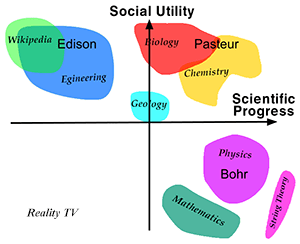

Blue skies research is scientific research in domains where ‘real-world’ applications are not immediately apparent. It has been defined as ‘research without a clear goal’ and ‘curiosity-driven science.’ It is sometimes used interchangeably with the term ‘basic research.’ Proponents of this mode of science argue that unanticipated scientific breakthroughs are sometimes more valuable than the outcomes of agenda-driven research, heralding advances in genetics and stem cell biology as examples of unforeseen benefits of research that was originally seen as purely theoretical in scope. Because of the inherently uncertain return on investment, blue-sky projects are politically and commercially unpopular and tend to lose funding to more reliably profitable or practical research.
Raytheon founder Vannevar Bush’s 1945 report, ‘Science: The Endless Frontier,’ made the argument for the value of basic research in the postwar era, and was the basis for many appeals to the federal funding of basic research. The 1957 launch of Sputnik prompted the United States Air Force Office of Scientific Research to sponsor basic science research into the 1960s. By the 1970s, financial strains brought pressure on public expenditure on the sciences, first in the UK and the Netherlands, and by the 1990s in Germany and the US.
read more »
Posted in Money, Science, Technology |
1 Comment »
March 14, 2015

Wrap rage, also called package rage, is the common name for heightened levels of anger and frustration resulting from the inability to open hard-to-openpackaging, particularly some heat-sealed plastic blister packs and clamshells. People suffer thousands of injuries per year, such as cut fingers and sprained wrists, from tools used to open packages and from packaging itself, and in some cases damage the items they are trying to free from packaging. Easy-opening systems are available to improve package opening convenience.
Packaging sometimes must be made difficult to open. For example, regulations dictate that some over-the-counter drugs have tamper resistance to deter unauthorized opening prior to the intended customer and be in child-resistant packaging. Other packages are intentionally made difficult to open to reduce package pilferage and shoplifting. Hard plastic blister packs also protect the products while they are being shipped. In addition, using transparent plastic allows customers to view products directly before purchasing them.
Posted in Humor, Money |
Leave a Comment »