November 7, 2014
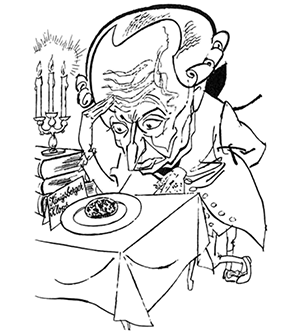
In sociology, taste is an individual’s personal and cultural patterns of choice and preference. It is drawing qualitative distinctions between things such as styles, manners, consumer goods, and works of art. Aesthetic preferences and attendance to various cultural events are associated with education and social origin. Different socioeconomic groups are likely to have different tastes, and social class is one of the most prominent factors structuring taste. The concept of aesthetics has been the interest of philosophers such as Plato, Hume and Kant, who understood it as something pure and searched for the ‘essence of beauty,’ the ontology of taste. But it was not until the beginning the early 19th century that the question was problematized in its social context.
In his aesthetic philosophy, Kant denies any standard of a good taste, which would be the taste of the majority or any social group. For Kant, beauty is not a property of an object, but a judgement based on a subjective feeling. He claims that even if a universal, non-relativistic ‘good taste’ does exist, it can not be empirically identified, or found in any standards or generalizations, and the validity of a judgement is not the general view of the majority or some specific social group. Taste is both personal and beyond reasoning, and therefore disputes over matters of taste never reach a finite conclusion. Kant stresses that our preferences, even on generally liked things, do not justify our judgements.
read more »
Posted in Art, Money, Politics |
Leave a Comment »
November 6, 2014

In American suburban communities, McMansion is a pejorative for a type of large, new luxury house which is judged to be oversized for the parcel or incongruous and out-of-place for its neighborhood. Alternatively, a McMansion can be a large, new house in a subdivision of similarly large houses, which all seem mass-produced and lacking in distinguishing characteristics, as well as appearing at odds with the traditional local architecture.
The neologism seems to have been coined sometime in the early 1980s. It first appeared in print the ‘Los Angeles Times’ in 1990. Related terms include ‘Persian palace,’ ‘garage Mahal,’ ‘starter castle,’ and ‘Hummer house.’ Marketing parlance often uses the term ‘tract mansion’ or ‘executive home.’ An example of a McWord, ‘McMansion’ associates the generic quality of these luxury homes with that of mass-produced fast food by evoking the McDonald’s restaurant chain.
read more »
Posted in Language, Money |
Leave a Comment »
October 30, 2014
In the US, a maraschino [mar-uh-skee-noh] cherry is a preserved, sweetened cherry, typically made from light-colored sweet cherries such as the Royal Ann, Rainier, or Gold varieties. In their modern form, the cherries are first preserved in a brine solution usually containing sulfur dioxide and calcium chloride to bleach the fruit, then soaked in a suspension of food coloring (usually Red 40), sugar syrup, and other components.
Maraschino cherries are an ingredient in many cocktails, giving them the nickname: ‘Cocktail cherries.’ As a garnish, they often are used to decorate frozen yogurt, baked ham, cakes, pastry, parfaits, milkshakes, ice cream sundaes, and ice cream sodas. They are frequently included in canned fruit cocktail. They are also used as an accompaniment to sweet paan (an Indian preparation of herbs for chewing), and sometimes, along with some of the maraschino “‘juice,’ put into a glass of Coca-Cola to make an old-fashioned or homemade ‘Cherry Coke.’
read more »
Posted in Food, Money, Science |
Leave a Comment »
October 24, 2014
Freebie marketing, also known as the ‘razor and blades’ business model, is a business model wherein one item is sold at a low price (or given away for free) in order to increase sales of a complementary good, such as supplies. For example, inkjet printers require ink cartridges, ‘Swiffers’ require cloths and cleaning fluid, mobile phones require service contracts, and game consoles require accessories and software. It is distinct from a loss leader (an inexpensive product sold at a loss to stimulate sales of more profitable ones) and free sample marketing, which do not depend on complementarity of products or services.
Although the concept and its proverbial example ‘Give ’em the razor; sell ’em the blades’ are widely credited to King Camp Gillette, the inventor of the disposable safety razor, he did not originate this model. The usual story about Gillette is that he realized that a disposable blade would not only be convenient, but also generate a continuous revenue stream. To foster that stream, he sold razors at an artificially low price to create the market for the blades. However, Gillette razors were expensive when they were first introduced, and the price only went down after his 1901 patent expired: it was his competitors who invented the razors-and-blades model.
read more »
Posted in Money |
1 Comment »
October 23, 2014
‘There ain’t no such thing as a free lunch’ (TANSTAAFL) is a popular adage communicating the idea that it is impossible to get something for nothing. The phrase dates to the 1930s and 1940s, but its first appearance is unknown. The ‘free lunch’ in the saying refers to the nineteenth-century practice in American bars of offering a ‘free lunch’ in order to entice drinking customers.
The phrase and the acronym are central to Robert Heinlein’s 1966 science-fiction novel ‘The Moon Is a Harsh Mistress,’ about the revolt of a lunar colony and the installation of a libertarian regime. Free-market economist Milton Friedman used it as the title of a 1975 book, and it is often mentioned in economics literature to describe opportunity cost (the value of the next best thing you give up whenever you make a decision). Macroeconomist Campbell McConnell writes that the idea is ‘at the core of economics.’
read more »
Posted in Language, Money, Science |
Leave a Comment »
October 22, 2014


Slacktivism (‘slacker activism’) is a sometimes pejorative term that describes ‘feel-good’ measures, in support of an issue or social cause, that have little or no practical effect other than to make the person doing it take satisfaction from having contributed. The underlying assumption being promoted by the term is that these low cost efforts substitute for more substantive actions rather than supplementing them, although this assumption has not been borne out by research.
Proponents argue that slacktivism plays a significant role in repressive and authoritarian regimes. Journalist Courtney C. Radsch argues that low level engagement was an important form of activism for Arab youth during the Arab Spring because it was an outlet for free speech and sparked mainstream media coverage. She contends that when a hashtag becomes ‘a trending topic [it] helps generate media attention, even as it helps organize information. The power of social media to help shape the international news agenda is one of the ways in which they subvert state authority and power.’
read more »
Posted in Money, Politics |
1 Comment »
October 1, 2014

A fan edit is a version of a film modified by a viewer, that removes, reorders, or adds material in order to create a new interpretation of the source material. This includes the removal of scenes or dialogue, replacement of audio and/or visual elements, and adding material from sources such as deleted scenes or even other films. The field was popularized by an individual calling himself the ‘Phantom Editor’ (later revealed as professional editor Mike J. Nichols). He removed elements from George Lucas’ ‘The Phantom Menace’ that he felt detracted from the film, and made minor changes in dialogue, languages, and subtitles to give the film’s villains a more menacing tone.
There were a total of 18 minutes cut from the original film, reducing the run time from 136 minutes to 118 minutes. The end result became known as ‘The Phantom Edit,’ which circulated Hollywood studios on VHS in 2000. It was the first unauthorized re-edit of a major film to receive publicity and acclaim and inspired dozens of other edits to surface on the internet. Lucasfilm, the production company of series creator George Lucas, condoned the edit, and did not pursue legal action against its distributors.
read more »
Posted in Art, Money |
1 Comment »
September 12, 2014
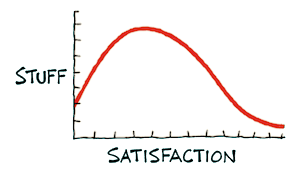

In economics, ‘utility’ is the amount of satisfaction received from consuming (using) goods and services, and ‘marginal’ refers to a small change, starting from some baseline level. Marginal utility describes the change in utility from consuming more or less of a product. Economists sometimes speak of a law of ‘diminishing marginal utility,’ meaning that consuming the first unit usually has a higher utility than every other unit. When the number of units that are consumed increases, their marginal utility decreases (and vice versa).
As 20th century English economist Philip Wicksteed explained the term, ‘Marginal considerations are considerations which concern a slight increase or diminution of the stock of anything which we possess or are considering.’ ‘Marginal cost’ is the cost of producing one more unit of a good. The ‘marginal decision rule’ states that a good or service should be consumed at a quantity at which the marginal utility is equal to the marginal cost (i.e. at a cost that justifies the satisfaction derived from the product).
read more »
Posted in Money, Politics |
Leave a Comment »
September 10, 2014

Liebeck v. McDonald’s Restaurants, also known as the McDonald’s coffee case, was a 1994 product liability lawsuit that became a flash point in the tort reform debate in the US. A New Mexico civil jury awarded $2.86 million to plaintiff Stella Liebeck, a 79-year-old woman who suffered third-degree burns in her pelvic region when she accidentally spilled hot coffee in her lap after purchasing it from a McDonald’s restaurant. Liebeck was hospitalized for eight days while she underwent skin grafting, followed by two years of medical treatment.
Liebeck’s attorneys argued that at 180–190 °F coffee was defective, claiming it was too hot and more likely to cause serious injury than coffee served at any other establishment. The jury damages included $160,000 to cover medical expenses and $2.7 million in punitive damages. The trial judge reduced the final verdict to $640,000, and the parties settled for a confidential amount before an appeal was decided. The case was said by some to be an example of frivolous litigation; ABC News called it, ‘the poster child of excessive lawsuits,’ while legal scholar Jonathan Turley said it was ‘a meaningful and worthy lawsuit.’
read more »
Posted in Food, Money, Politics |
Leave a Comment »
August 18, 2014


A visiting card, also known as a calling card, is a small paper card with one’s name printed on it, and often bearing an artistic design. In 18th century Europe the footmen of aristocrats and royalty would deliver these first European visiting cards to the servants of their prospective hosts solemnly introducing the arrival of their owners.
Visiting cards became an indispensable tool of etiquette, with sophisticated rules governing their use. The essential convention was that one person would not expect to see another person in her own home (unless invited or introduced) without first leaving his visiting card for the person at her home. Upon leaving the card, he would not expect to be admitted at first, but might receive a card at his own home in response. This would serve as a signal that a personal visit and meeting at home would be welcome. On the other hand, if no card were forthcoming, or if a card were sent in an envelope, a personal visit was thereby discouraged.
read more »
Posted in Language, Money, World |
Leave a Comment »
August 11, 2014
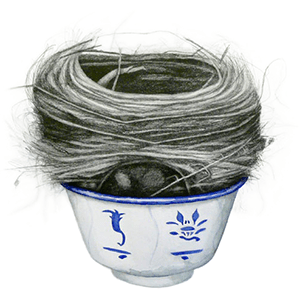
Edible bird’s nests are among the most expensive animal products consumed by humans, with an average nest selling for $2,500 per kilo for end-consumers in Asia. The nests have been used in Chinese cooking for over 400 years, most often as bird’s nest soup. Legend has it that shipwrecked sailors scavenging for food cleaned and cooked the nests and found the resulting stew so invigorating they were able to sail home to inform the emperor of their new discovery.
The Chinese name for edible bird’s nest, ‘yàn wō,’ translates literally as ‘swiftlet nest’ (swiftlets, common to asia, are superficially similar to swallows and known for building nests of solidified saliva). The most famous use for the nests is bird’s nest soup, a delicacy in Chinese cuisine. When dissolved in water, the swiftlet nests have a gelatinous texture used for soup or sweet tong sui (a Cantonese custard).
read more »
Posted in Food, Money, World |
1 Comment »
August 6, 2014

Imelda Marcos (b. 1929) is the widow of former Philippine President Ferdinand Marcos. In popular culture, she is remembered for her collection of more than a thousand pairs of shoes. She began her career as a local singer and model in Manila before meeting her husband. After the declaration of martial law in 1972, Imelda began holding positions in the national government that allowed her to travel the world and accumulate artwork and real estate. The couple consolidated their power allowing them to transport funds from the Philippine treasury into offshore accounts, such as banks in Switzerland.
President Marcos was accused of the assassination of Benigno Aquino, Jr., leading to the People Power Revolution which forced the Marcoses out of office and into exile in Hawaii. After the death of Ferdinand, Imelda and her family were given amnesty by then President Corazon Aquino, Benigno Jr’s widow. Her return to the Philippines has since allowed her to restore her political dynasty. Despite numerous cases involving alleged corruption, she has not been imprisoned and continues to wield influence. Her ability to survive upheavals in her life has led her to be called the ‘Steel Butterfly.’
read more »
Posted in Money, Politics, World |
Leave a Comment »



 The Daily Omnivore