August 4, 2014

Anchoring or focalism is a cognitive bias that describes the common human tendency to rely too heavily on the first piece of information offered (the ‘anchor’) when making decisions. Once an anchor is set, other judgments are made by adjusting away from that anchor, and there is a bias toward interpreting other information around the anchor. For example, the initial price offered for a used car sets the standard for the rest of the negotiations, so that prices lower than the initial price seem more reasonable even if they are still higher than what the car is really worth.
Anchoring is also called the focusing effect (or focusing illusion) because it occurs when people place too much importance on one aspect of an event, causing an error in accurately predicting the utility of a future outcome. Individuals tend to focus on notable differences, excluding those that are less conspicuous, when making predictions about happiness or convenience.
read more »
Posted in Health, Money, Science |
Leave a Comment »
July 30, 2014

The Monobloc [mon-uh-blok] chair is a lightweight stackable polypropylene chair, often described as the world’s most common plastic chair. Based on original designs by the Italian designer Vico Magistretti in 1967, variants of the one-piece plastic chair went into production with Allibert Group and Grossfillex Group in the 1970s. Since then, millions have been manufactured globally. Many design variants of the basic idea exist.
The Monobloc chair is so named because it is injection molded from thermoplastic polypropylene, the granules being heated to about 220 degrees Celsius, and the melt injected into a mold. The gate of the mold is usually located in the seat to ensure smooth flow to all parts of the tool. The chairs cost approximately $3 to produce, making them affordable across the world. Social theorist Ethan Zuckerman describes them as having achieved a global ubiquity: ‘The Monobloc is one of the few objects I can think of that is free of any specific context. Seeing a white plastic chair in a photograph offers you no clues about where or when you are.’
Posted in Money, Technology, World |
Leave a Comment »
July 17, 2014

The Album Era was a period in English-language popular music from the mid 1960s to the mid 2000s in which the album was the dominant form of recorded music expression and consumption. It was primarily driven by three successive music recording formats, the 331⁄3 rpm phonograph record (1931), the audiocassette (1964), and the compact disc (1982).
In 1999, peer-to-peer file sharing application Napster was released, popularizing digital copies of music. The ease of downloading individual songs facilitated by it and later networks is often credited with ushering in the end of the Album Era in popular music.
read more »
Posted in Art, Money, Technology |
2 Comments »
July 16, 2014

Napster was a peer-to-peer (P2P) music sharing application first developed in 1999 by Shawn Fanning at Northeastern University. The original program was available for three years before being shut down by a court order for copyright violations. The company’s brand and other assets was subsequently acquired at a bankruptcy proceeding by Roxio, maker of CD burning software. In its second incarnation Napster became an online music store until it was bought by music streaming site Rhapsody in late 2011.
Fanning lead the original company along with his uncle John Fanning and entrepreneur Sean Parker (who would go on to make billions as an early employee of Facebook). Later companies and projects successfully followed its P2P file sharing example such as Gnutella, Freenet, and many others. Some services, like LimeWire, Grokster, Madster and the original eDonkey network, were brought down or changed due to similar circumstances.
read more »
Posted in Money, Politics, Technology |
Leave a Comment »
July 11, 2014


Open-source economics is an economic platform (a two-sided market with two distinct user groups that provide each other with network benefits) based on open collaboration for the production of software, services, or other products. First applied to the open-source software industry, this economic model may be applied to a wide range of enterprises. The system requires work or investment to be carried out without an expressed expectation of return; products or services are produced through collaboration between users and developers; there is no direct individual ownership of the enterprise itself.
The structure of open source is based on user participation. According to technology law professor Yochai Benkler, ‘networked environment makes possible a new modality of organizing production: radically decentralized, collaborative, and non-proprietary; based on sharing resources and outputs among widely distributed, loosely connected individuals who cooperate with each other without relying on either market signals or managerial commands.’
read more »
Posted in Money, Politics, Technology |
1 Comment »
July 1, 2014

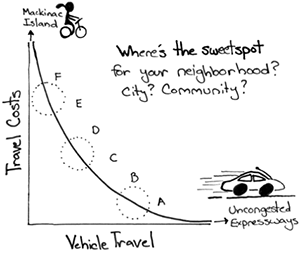
Induced demand, or latent demand, refers to the phenomenon that after supply increases, more of a good is consumed. This is entirely consistent with the economic theory of supply and demand; however, the idea has become important in the debate over the expansion of transportation systems, and is often used as an argument against widening roads, such as major commuter roads. It is considered by some to be a contributing factor to urban sprawl.
Latent demand has been recognized by road traffic professionals for many decades. J. J. Leeming, a British road-traffic engineer and county surveyor between 1924 and 1964, described the phenomenon is his 1969 book: ‘Motorways and bypasses generate traffic, that is, produce extra traffic, partly by inducing people to travel who would not otherwise have done so by making the new route more convenient than the old, partly by people who go out of their direct route to enjoy the greater convenience of the new road, and partly by people who use the towns bypassed because they are more convenient for shopping and visits when through traffic has been removed.’
read more »
Posted in Money, Politics, Technology |
Leave a Comment »
June 24, 2014


Antipatterns are common practices that initially appear to be beneficial, but ultimately result in bad consequences that outweigh hoped-for advantages. The term, coined in 1995 by programmer Andrew Koenig, was inspired by a book, ‘Design Patterns,’ in which the authors highlighted a number of practices in software development that they considered to be highly reliable and effective.
The term was popularized three years later by the book ‘AntiPatterns,’ which extended its use beyond the field of software design and into general social interaction and may be used informally to refer to any commonly reinvented but bad solution to a problem. Examples include analysis paralysis (over-analyzing a situation while indefinitely delaying making a decision), cargo cult programming (the ritual inclusion of code that serves no real purpose), death march (pressing ahead on a project members feel is destined to fail), groupthink (a desire for harmony in the group results in an irrational decision-making outcome), and vendor lock-in (preventing customers from seeking alternatives).
read more »
Posted in Money, Technology |
Leave a Comment »
June 23, 2014


The term wet bias refers to weather forecasters deliberately reporting a higher probability of rain than their predictive models show. The Weather Channel has been empirically shown, and has also admitted, to having a wet bias in the case of low probability of precipitation (for instance, a 5% probability may be reported as a 20% probability) but not at higher probabilities (a 60% probability will likely be reported accurately). Blogger Dan Allan noted that the channel is also biased at the upper end (a probability of 90% or higher will be rounded up to 100%). Local weather stations have been shown to have a significantly greater wet bias, with some reporting a probability as low as 70% as a certainty.
In 2002, computer scientist Eric Floehr started analyzing historical weather prediction data on a website called ForecastWatch. He found that the commercial forecasts were biased and the National Weather Service forecasts weren’t. His findings, though known within the meteorology community for some time, was first popularized in Nate Silver’s 2012 book ‘The Signal and the Noise.’ According to Silver, the phenomenon is due to skewed incentives: if the correct low probability of precipitation is given, viewers may interpret the forecast as if there were no probability of rain, and then be upset if it does rain. Forecasters are compensating for the fact that people have greater loss aversion than they think they do (and are especially prone to miscalculate their cost-loss ratio when it is low). Silver quotes Dr. Rose of The Weather Channel as saying, ‘If the forecast was objective, if it has zero bias in precipitation, we are in trouble.’
Posted in Money, Science |
1 Comment »
May 14, 2014
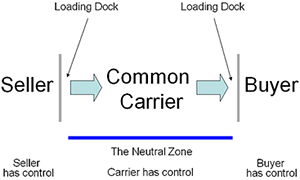
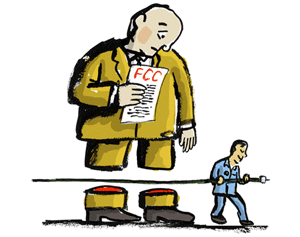
Common carrier is a legal term for a company that transports goods or people and is responsible for any loss in transit. Such services are offered to the general public under license or authority provided by a regulatory body, which may create, interpret, and enforce its regulations upon the common carrier (subject to judicial review) with independence and finality, as long as it acts within the bounds of the enabling legislation.
A common carrier is distinguished from a contract carrier, which transports goods for only a certain number of clients and that can refuse to transport goods for anyone else, and from a private carrier (a company that transports only their own goods). A common carrier holds itself out to provide service to the general public without discrimination (to meet the needs of the regulator’s quasi judicial role of impartiality toward the public’s interest) for the ‘public convenience and necessity.’
read more »
Posted in Money, Politics, Technology |
Leave a Comment »
May 4, 2014

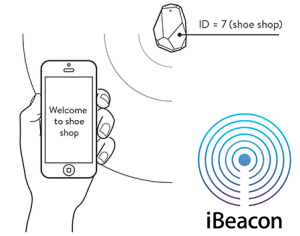
An indoor positioning system (IPS, or micromapping) is a network of devices that wirelessly locate objects or people inside a building. Instead of using satellites like GPS, it relies on nearby anchors (nodes with a known position), which either actively locate tags or provide ambient location or environmental context for devices. Systems use optical, radio, or even acoustic technologies. Integration of data from several navigation systems with different physical principles can increase the accuracy and robustness of the overall solution.
Wireless transmission indoors faces several obstacles including signal attenuation caused by construction materials, multiple reflections at surfaces causing transmission errors, and interference with devices that emit or receive electromagnetic waves (e.g. microwave ovens, cellular phones). Error correction systems that don’t rely on wireless signals are being used to compensate for these shortcomings, such as Inertial Measurement Units (reports velocity, orientation, and gravitational forces using accelerometers and gyroscopes), and Simultaneous Localization and Mapping (SLAM, a technique used by robots and autonomous vehicles to build up a map within an unknown environment).
Posted in Money, Technology |
Leave a Comment »
May 3, 2014
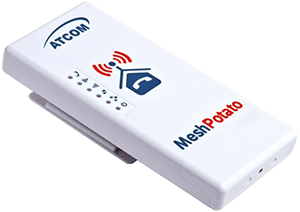

A wireless mesh network (WMN) is a communications network made up of radio nodes organized in a mesh topology; each node is connected to one or more other nodes, and information is passed from one node to the next, until it reaches its target destination. As in most cases, there is more than one path from one node to another, making such networks very reliable. When a node fails, the data will simply take another route. This type of infrastructure can be decentralized (with no central server) or centrally managed (with a central server).
The coverage area of the radio nodes working as a single network is sometimes called a mesh cloud. Mesh architecture sustains signal strength by breaking long distances into a series of shorter hops. Intermediate nodes not only boost the signal, but cooperatively make forwarding decisions based on their knowledge of the network, i.e. perform routing. Such an architecture may with careful design provide high bandwidth, spectral efficiency, and economic advantage over the coverage area.
read more »
Posted in Money, Technology |
Leave a Comment »
May 1, 2014

A barber’s pole is a type of sign used by barbers to signify the place or shop where they perform their craft. The trade sign is, by a tradition dating back to the Middle Ages, a staff or pole with a helix of colored stripes (often red and white in many countries, but usually red, white, and blue in the US). The pole may be stationary or may revolve, often with the aid of an electric motor.
The origin of the red and white barber pole is associated with the service of bloodletting and was historically a representation of bloody bandages wrapped around a pole. During medieval times, barbers performed surgery on customers, as well as tooth extractions. The original pole had a brass wash basin at the top (representing the vessel in which leeches were kept) and bottom (representing the basin that received the blood). The pole itself represents the staff that the patient gripped during the procedure to encourage blood flow.
read more »
Posted in Health, Money, Sex |
Leave a Comment »


 The Daily Omnivore