January 20, 2014
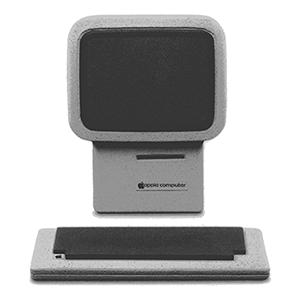
The Snow White design language was an industrial design language (an overarching scheme or style that guides the design of a complement of products) developed by German-American industrial designer Hartmut Esslinger’s Frog Design. Used by Apple Computer from 1984 to 1990, the scheme has vertical and horizontal stripes for decoration, ventilation, and the illusion that the computer enclosure is smaller than it actually is.
The design language boosted Apple’s global reputation, set design trends for the computer industry, and molded the perception of computers in the manufacturing and business world. Among other design features, Esslinger’s presentation of the Apple logo—a three-dimensional logo inlaid into the product case with the product name printed onto its surface—was included on nearly every product for several years.
read more »
Posted in Money, Technology |
Leave a Comment »
January 15, 2014
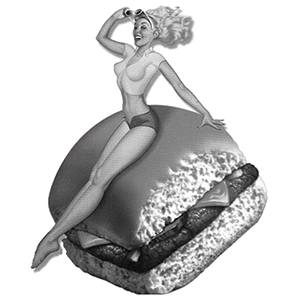
White Castle is a restaurant generally credited as the first fast food chain, known for its small, square hamburgers. Sometimes referred to as ‘sliders,’ the burgers were priced at five cents until the 1940s, and remained at ten cents for years thereafter. For several years, when the original burgers sold for five cents, White Castle periodically ran promotional ads in local newspapers which contained coupons offering five burgers for ten cents, takeout only.
White Castle was founded in 1921 in Wichita, Kansas by Cook Walt A. Anderson an insurance man Billy Ingram. At the time, Americans were hesitant to eat ground beef after Upton Sinclair’s 1906 novel ‘The Jungle’ publicized poor sanitation practices in the meatpacking industry. To invoke a feeling of cleanliness, their restaurants were small buildings with white porcelain enamel on steel exteriors, stainless steel interiors, and employees outfitted with spotless uniforms.
read more »
Posted in Food, Money |
1 Comment »
January 6, 2014
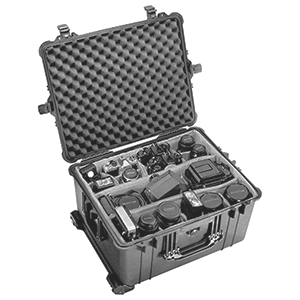
Pelican Products is an American multinational company based out Torrance, California that designs and manufactures flashlights and cases. Their products are used in many industries including military, law enforcement, fire safety and entertainment. Pelican has over 1,300 employees and operates offices across the globe. The company was founded in Torrance, California in 1975 as a mail-order home business offering unique and practical products for the dive market.
Today, Pelican is known for molded plastic containers that seal with an airtight and watertight gasket. They include a barometric relief valve made of Gore-Tex to prevent pressure damage to the case, during transportation or when the air pressure in the environment changes. Pelican cases meet military standards for waterproofing, stacking, impact, and durability, and feature a lifetime guarantee.
read more »
Posted in Money, Technology |
Leave a Comment »
January 6, 2014
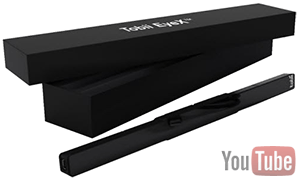
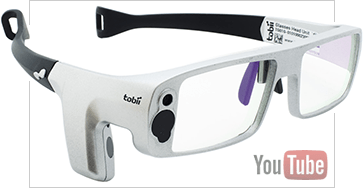
Tobii Technology is a Swedish high-technology company that develops and sells products for eye control and eye tracking. Founded in 2001, the company has products in several market segments such as people with communication disabilities who use Tobii’s technical devices and language tools (AAC devices) to communicate.
It also has products that are widely used for research in the academic community, and to conduct usability studies and market surveys of commercial products. Tobii also partners with others to integrate eye tracking and eye control in different industry applications and fields such as advanced driver assistance, consumer computing, and gaming.
Posted in Health, Money, Technology |
Leave a Comment »
January 5, 2014
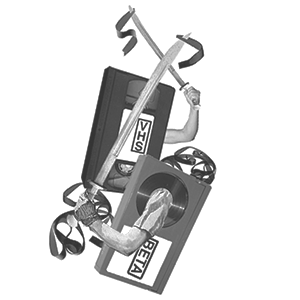
A format war describes competition between mutually incompatible proprietary formats that compete for the same market, typically for data storage devices and recording formats for electronic media.
It is often characterized by political and financial influence on content publishers by the developers of the technologies. Developing companies may be characterized as engaging in a format war if they actively oppose or avoid interoperable open industry technical standards in favor of their own.
read more »
Posted in Money, Politics, Technology |
Leave a Comment »
January 4, 2014
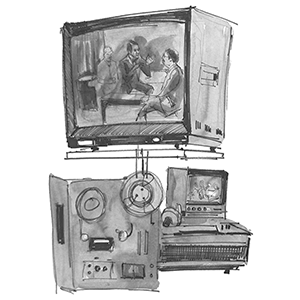
Abscam was an FBI sting operation run from the Bureau’s Long Island office in the late 1970s and early ’80s. The operation initially targeted trafficking in stolen property but was converted to a public corruption investigation. The investigation ultimately led to the conviction of a U.S. senator, six members of the House of Representatives, one member of the New Jersey State Senate, members of the Philadelphia City Council, the Mayor of Camden, New Jersey, and an inspector for the Immigration and Naturalization Service.
In 1978, the FBI hired Melvin Weinberg, a convicted con artist, to help plan and conduct the operation, forming Abdul Enterprises, Ltd., as its front company for the investigation. FBI employees posed as Karim Abdul Rahman, a fictional Middle Eastern sheikh, in videotaped meetings with targeted government officials. The agents posing as Rahman offered the officials money in return for political favors such as political asylum in the U.S., involvement in an investment scheme for a high-class hotel, and help in transferring money out of his country.
Posted in Money, Politics |
1 Comment »
December 20, 2013
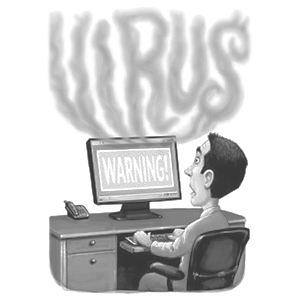
Scareware, nowadays included into the class of malware known as FraudTool, comprises several classes of ransomware or scam software with malicious payloads, usually of limited or no benefit, that are sold to consumers via certain unethical marketing practices. The selling approach uses social engineering to cause shock, anxiety, or the perception of a threat, generally directed at an unsuspecting user. Some forms of spyware and adware also use scareware tactics.
A tactic frequently used by criminals involves convincing users that a virus has infected their computer, then suggesting that they download (and pay for) fake antivirus software to remove it. Usually the virus is entirely fictional and the software is non-functional or malware itself. Another approach is to trick users into uninstalling legitimate antivirus software, or disabling their firewall.
read more »
Posted in Money, Politics, Technology |
1 Comment »
December 19, 2013

Ransomware comprises a class of malware which restricts access to the computer system that it infects, and demands a ransom paid to the creator of the malware in order for the restriction to be removed.
Some forms of ransomware encrypt files on the system’s hard drive (cryptoviral extortion), while some may simply lock the system and display messages intended to coax the user into paying. While initially popular in Russia, the use of ransomware scams has grown internationally.
read more »
Posted in Money, Politics, Technology |
Leave a Comment »
December 5, 2013

Personal genomics [jee‐noh-miks] (sequencing and analysis of the genome of an individual) employs several techniques, including single-nucleotide polymorphism (SNP) analysis chips (typically 0.02% of the genome), or partial or full genome sequencing. Once the genotypes are known, the individual’s genotype can be compared with the published literature to determine likelihood of trait expression and disease risk.
Automated sequencers have increased the speed and reduced the cost of sequencing, making it possible to offer genetic testing to consumers. 23andMe sells mail order kits for SNP genotyping. The information is stored in a user profile and used to estimate the genetic risk of the consumer for over 240 diseases and conditions, as well as ancestry analysis.
read more »
Posted in Health, Money, Technology |
Leave a Comment »
December 1, 2013

The Queen of Versailles is a 2012 American documentary film by Lauren Greenfield, depicting Jackie Siegel and her husband David, founder and CEO of Westgate Resorts (a timeshare company based out of Florida), and their family as they build the Versailles house, the largest and most expensive single-family house in the United States, and the crisis they face as the US economy declines.
‘Washington Post’ columnist Ezra Klein called it, ‘perhaps the single best film on the Great Recession,’ writing that one scene, in which Siegel recounts a series of transactions that allowed him to purchase at a fraction of its original value a loan on which he owes money, ‘might stand as the single most complete vignette on the mechanics of the financial crisis and the subsequent slow recovery.’
Posted in Humor, Money |
Leave a Comment »
November 27, 2013

So-called ‘reverse product placement‘ is the creation of products in real life to match those seen in a fictional setting. In 2007, 7-Eleven rebranded 11 of its American stores and one Canadian store as ‘Kwik-E-Marts,’ selling some real-life versions of products seen in episodes of the ‘The Simpsons,’ such as Buzz Cola and Krusty-O’s cereal. In 1997, Acme Communications was created as a chain of real television stations; the firm is named for the fictional Acme Corporation of Warner Brothers fame.
The fictional Willy Wonka from ‘Willy Wonka & the Chocolate Factory’ (1971) was licensed to name a real candy company soon after the film’s release; the brand is now controlled by Nestlé. In the 1984 cult film ‘Repo Man,’ a reverse form of product placement is used, with an exaggerated form of 1980s era generic packaging used on products prominently shown on-screen (these include ‘Beer,’ ‘Drink,’ ‘Dry Gin,’ and ‘Food – Meat Flavored’).
Posted in Art, Humor, Money |
1 Comment »
November 27, 2013

Fictional brands are used in artistic works to imitate or satirize corporate brands, and/or to avoid trademark or copyright infringement.
Such a device may be required where real corporations are unwilling to license their brand names for use in the fictional work, particularly where the work holds the product in a negative light.
read more »
Posted in Art, Money, Politics |
Leave a Comment »


 The Daily Omnivore